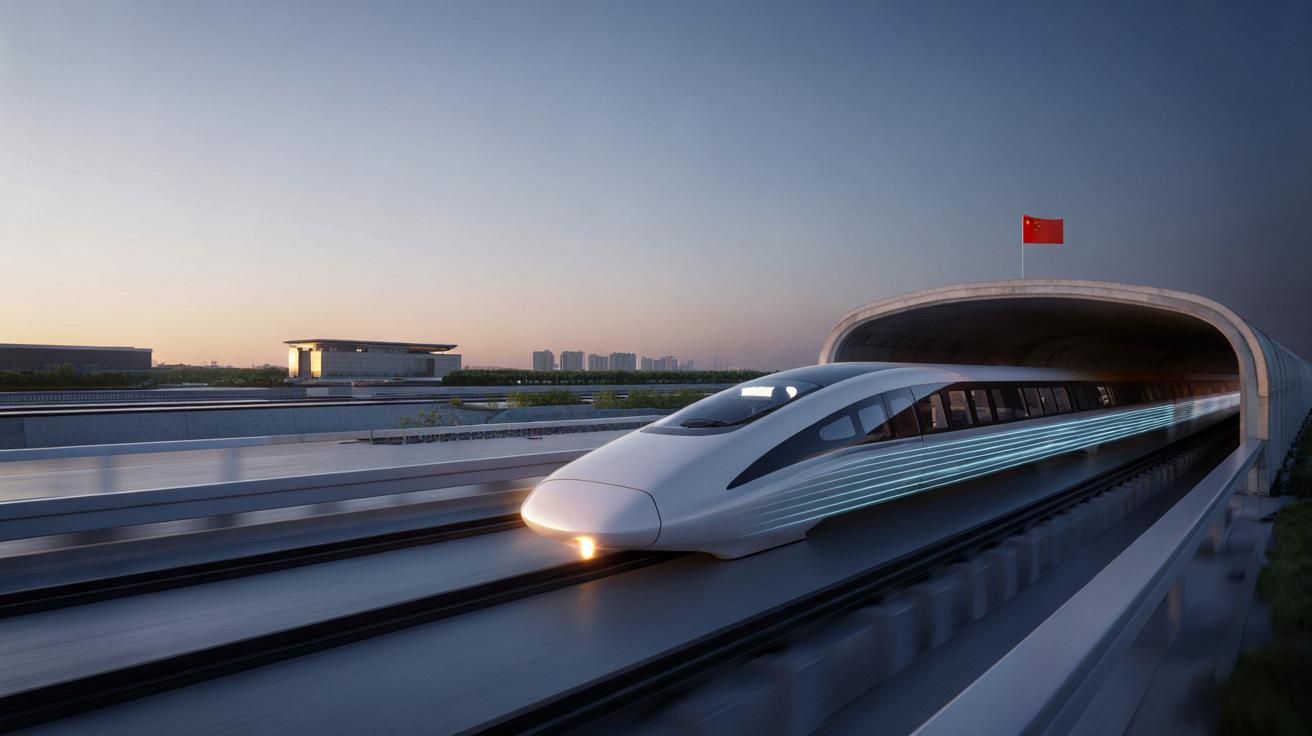
The experiment, carried out by a military-backed Chinese university, lasted only a couple of seconds. Yet it pushed a futuristic train concept from theory into something that looks uncomfortably real for its global rivals.
From 0 to 700 km/h in 2 seconds: a brutal new benchmark
Chinese researchers have confirmed a striking milestone in magnetic levitation research: a 1.1‑tonne superconducting maglev test vehicle shot from 0 to 700 km/h in just 2 seconds, then came to a swift halt on the same 400‑metre track.
A one‑tonne maglev frame going from standstill to 700 km/h in 2 seconds means an average acceleration close to that of a fighter jet catapulted off an aircraft carrier.
The run took place on an experimental maglev line developed by the National University of Defense Technology (NUDT), an institution closely linked to China’s military research ecosystem. While the vehicle had no cabin or passengers, the test focused on four core capabilities:
- Extremely rapid acceleration powered by electromagnetic propulsion
- Stable magnetic levitation at ultra‑high speed
- Precise guidance without physical contact with rails
- Non‑contact braking and energy recovery
Coordinating all these systems in such a tiny time window is technically daunting. Any timing error between propulsion, levitation and guidance would have risked destabilising the chassis or even sending it off the track.
Why this matters for the future hyperloop dream
Maglev technology itself is not new. Engineers in Germany and Japan were already testing magnetic levitation trains in the 1960s. The principle is simple on paper: if you remove physical contact between train and rail, you remove almost all rolling friction. Push the system with linear electric motors and you can reach far higher speeds than conventional high‑speed trains.
Germany’s Transrapid proved the point, passing 430 km/h on test tracks, but failed to find a convincing business case at home. Japan went further with the SCMaglev, using superconducting magnets and setting a world record of 603 km/h with passengers on board.
In the 2010s, the idea mutated into the hyperloop concept popularised by Elon Musk. Capsules would shoot through low‑pressure tubes, combining maglev with thin air to slash aerodynamic drag and theoretically hit 1,000 km/h or more. Start‑ups raised money, built demo tracks, and ran public tests. Most of those projects have since stalled due to eye‑watering costs, a lack of clear regulation, and safety concerns.
China is now betting that advanced maglev, refined and militarised, can serve as the technological backbone for any future hyperloop‑style system.
➡️ Theken Käse und Lidl Waffeln: Diese Produkte sollten Sie nicht verzehren laut aktueller Warnung
➡️ Diebstahlschutz für E-Bikes in der Garage: Warum ein einfaches Bügelschloss oft nicht ausreicht
➡️ Darum sollten Sie eine Banane in Ihrem Gemüsegarten vergraben
➡️ Neues Gesetz zum Seniorenführerschein: Fahrten ab 70 Jahren nur noch bei Tageslicht
This latest test does not take place in a vacuum tube, so air resistance still plays a big role. Yet it tackles one of the hardest parts of Musk’s original idea: how to accelerate and decelerate a capsule very quickly while keeping it stable and controllable.
An acceleration the human body would struggle to endure
The record is not just an engineering stunt; it is also a lesson in human limits. Going from 0 to 700 km/h in 2 seconds means subjecting passengers to extreme g‑forces.
| Parameter | Approximate value |
|---|---|
| Top speed reached | 700 km/h (about 435 mph) |
| Time taken | 2 seconds |
| Average acceleration | ≈ 97 m/s² (~10 g) |
| Typical sports car launch | 0.8–1.2 g |
| Roller coaster peak | 3–4 g (short bursts) |
A sustained 10 g load would knock most people unconscious, and could seriously injure many. So this kind of profile is not intended for commercial travel. Instead, engineers use it to test the raw capacity of the propulsion and control systems in a compressed space.
The key takeaway: if the infrastructure can handle such a violent acceleration without shaking itself apart, running a passenger capsule at 800 or 1,000 km/h with more moderate, comfortable forces over a longer distance becomes far easier.
A record built on decades of Chinese rail ambition
This test does not come from nowhere. Over the last half‑century, China has gone from a latecomer in rail technology to the undisputed heavyweight of high‑speed lines.
China now operates a high‑speed rail network that, by track length, is around fifteen times larger than France’s TGV network.
The country has spent trillions of yuan building dedicated corridors, refining signalling systems, and industrialising train production. The high‑speed CR series, including the CR450 currently under development, aims to cruise at speeds that flirt with or exceed the performance of the French TGV on long stretches of track.
Maglev has already made it out of the lab in China. Shanghai has run a commercial maglev line, based on German Transrapid technology, between the city and its main airport since 2004. It regularly hits 430 km/h over a 30 km route. What is happening now looks like the second phase: an attempt to move from imported platforms to domestic, next‑generation superconducting designs with much higher ceilings.
How superconducting maglev works in plain language
Levitation without touching the rail
Traditional trains sit on wheels. Even the fastest TGV or Shinkansen still rolls on steel rails, which means metal rubbing on metal. Superconducting maglev sets up powerful magnets on the train that interact with coils in the track. Once the train reaches a certain speed, these forces lift the vehicle a few centimetres above the guideway.
No contact means almost no mechanical wear and very little friction. The train glides on a cushion shaped by its own magnetic field.
Propulsion and braking with magnetic fields
A linear motor built into the track pulls and pushes the train. Imagine unwrapping a normal electric motor and laying it flat along the route: instead of a spinning rotor, the train moves along a corridor of changing magnetic fields.
Reverse the magnetic sequence and the same system becomes a brake. Some of the train’s kinetic energy can be captured and fed back into the grid or stored, improving overall efficiency.
Where superconductivity changes the game
Superconducting magnets, cooled to extremely low temperatures using liquid helium or liquid nitrogen, can carry much higher currents without electrical resistance. That allows stronger, more stable magnetic fields and, in theory, higher speeds with less energy waste.
The trade‑off lies in complexity: cryogenic systems, thermal insulation, and safety protections make the hardware more expensive and more demanding to maintain.
Closer to hyperloop, but still far from daily travel
Hyperloop concepts remain, for now, largely conceptual. Running a long vacuum tube between two major cities raises engineering, legal and financial headaches. You need pumping stations, emergency exits, pressure‑resistant capsules, and a way to evacuate people in case something goes wrong inside a sealed pipe.
Tests like the Chinese run nudge the technology a step forward. They show that maglev hardware can reach and control velocities compatible with hyperloop projections, at least on short tracks. What they do not solve yet are the large‑scale deployment questions: who pays, who regulates, who carries the risk if an accident occurs at nearly the speed of sound.
What a hyper‑fast maglev network could change
If China or any other country manages to turn this kind of experiment into a workable system, the impact on geography and daily life could be substantial. Trips between cities separated by 800 or 1,000 kilometres could shrink to under an hour. Air routes on those corridors could become less competitive, reshaping airlines’ business models.
Logistics would change too. High‑value freight—semiconductors, medicines, urgent parts—might move from air cargo to high‑speed tubes, cutting emissions on some routes and reducing dependency on congested airports.
Risks, trade‑offs and the questions still hanging
Alongside the promise, hyper‑fast ground transport raises a chain of concerns:
- Safety margins: A fault at 1,000 km/h gives very little time to react.
- Evacuation: Getting people out of a tube, possibly underground and under partial vacuum, is a nightmare scenario for rescue teams.
- Energy profile: While efficient at cruise speed, maglev and hyperloop need heavy power surges during acceleration.
- Cost of infrastructure: Long, straight corridors need land, tunnelling and strict alignment that are hard to secure near cities.
There is also a softer question: do we really want such violent speeds for routine travel? Many commuters already feel squeezed by the pace of modern life. A 45‑minute door‑to‑door hop between cities sounds attractive, but it comes with new kinds of stress, surveillance and technical dependence.
For now, the Chinese record is above all a signal. The country that built the planet’s largest high‑speed rail network in a few decades is pressing ahead into the next frontier. The hyperloop label might change, companies may come and go, yet the underlying race—how fast humans and goods can move across land safely and affordably—is clearly accelerating.