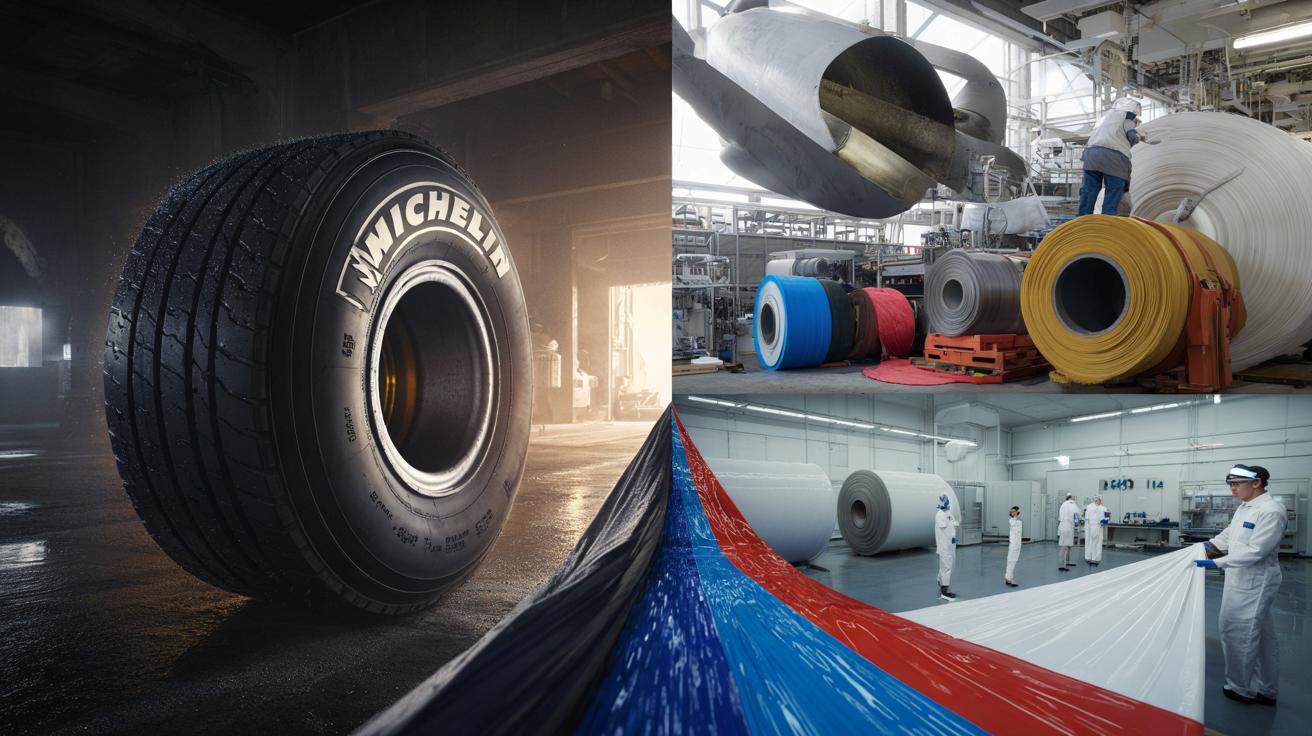
A French industrial icon best known for tyres is quietly stitching together a very different future across the Atlantic.
Michelin, the group behind the famous Bibendum mascot, is doubling down on high-tech textiles in the United States, betting hundreds of millions of euros on a fast-growing business that has nothing to do with wheels and everything to do with advanced materials.
Michelin’s quiet American shopping spree
Michelin has agreed to buy two US-based specialists, Cooley Group in Rhode Island and Tex Tech Industries in Maine, both deep experts in technical fabrics built for extreme conditions.
Sources close to the deal point to a combined price tag likely between €460 million and €645 million, or more than €500 million at the midpoint, funded entirely from Michelin’s cash pile rather than fresh borrowing. The transactions are expected to close by mid‑2026, subject to regulatory approval.
Michelin is redirecting hundreds of millions of euros from tyres into high‑performance textiles designed for rockets, hospitals and chemical plants.
For a company long defined by tyres, the move marks a clear step towards becoming a broader materials powerhouse with a strong footprint in North America.
Who are Cooley Group and Tex Tech?
Cooley: polymers for water, medicine and chemicals
Cooley Group is a century‑old manufacturer rooted in Pawtucket, Rhode Island. Its speciality: polymer‑coated fabrics engineered for highly demanding uses where failure is not an option.
Its products include:
- Membranes that line drinking‑water reservoirs and basins
- Flexible tanks and bladders for corrosive or hazardous liquids
- Coated textiles used in advanced medical environments, including surgical applications
- Sheets and coverings that must resist chemicals, UV and harsh weather for years
Cooley controls the full chain from weaving the base textile to extruding and coating polymers, giving Michelin access to integrated industrial know‑how that remains rare in the US.
Tex Tech: textiles for rockets and defence
Tex Tech Industries, founded in 1904 and based in Maine, sits at the more extreme end of the spectrum.
➡️ Wie Sie mit Salzmatratzen Flecken entfernen und Frische zurückbringen, sanfte Methode
➡️ Why non-electric pellet stoves are winning over more and more households in France
➡️ Der Trick, Nivea Creme gegen Augenringe zu nutzen und ab 50 jünger auszusehen ohne teure Produkte
It designs and manufactures technical textiles that can withstand fire, intense heat, friction and violent mechanical stress. Typical uses include:
- Thermal protection systems for launch vehicles and spacecraft
- Fire‑resistant seat fabrics and interior materials for commercial aircraft
- Components for defence equipment where lightweight strength and flame resistance are critical
- Protective gear and filtration media for harsh industrial environments
Both companies work in sectors where contracts are long term, specifications are strict and margins tend to be higher than in commodity materials.
From flexible fuel tanks to rocket insulation, Michelin’s new US assets sit squarely in the “no‑failure allowed” segment of industrial fabrics.
A new heavyweight inside Michelin’s portfolio
Cooley and Tex Tech will be folded into Michelin’s Polymer Composite Solutions division, a business that has quietly grown well beyond its origins in rubber compounds.
Combined, the two US groups are expected to add around $280 million (about €239 million) in annual revenue. Internally, that represents a near‑20% jump for Polymer Composite Solutions, big enough for Michelin to give the division its own reporting line alongside tyres.
That move matters. Financial segmentation sends a signal to investors that this is no longer a side project, but a pillar of the group’s long‑term strategy.
| Business line | Main focus | Typical customers |
|---|---|---|
| Tyres | Passenger, truck, aircraft, specialty tyres | Automakers, airlines, fleets, retailers |
| Polymer Composite Solutions | Technical textiles, high‑performance composites | Aerospace, defence, healthcare, infrastructure |
The acquisitions will be paid in cash, which suggests Michelin feels comfortable with its balance sheet and free cash flow, even while the tyre market remains competitive and capital‑intensive.
Beyond tyres: “Michelin in Motion 2030” kicks in
The deals also show how seriously the group is pushing its “Michelin in Motion 2030” roadmap, launched in 2021. Under that plan, the French manufacturer wants around 30% of its revenue to come from non‑tyre activities before the end of the decade.
The strategy revolves around three main pillars:
- Advanced materials, including composites and technical textiles
- Enhanced mobility services and digital experiences for customers
- Solutions supporting low‑carbon, sustainable transport and industry
Cooley and Tex Tech fit neatly into the first pillar. Both companies are built on deep polymer and textile know‑how, an area where Michelin already has more than a century of experience through its work on rubber and reinforcement materials for tyres.
These US acquisitions extend Michelin’s core skill – mastering polymers – into healthcare, aerospace, defence and environmental protection.
The new assets will sit alongside existing brands such as Orca, a European name in technical coated fabrics, creating a transatlantic network able to serve global customers with local production.
A stronger North American footprint
Anchoring in New England’s industrial corridor
Both Cooley and Tex Tech are firmly embedded in New England’s industrial ecosystem, close to clients in aerospace, defence, medical technologies and infrastructure.
For Michelin, that brings several advantages:
- Stronger access to US and Canadian institutional buyers, including defence and public agencies
- Local production in a region keen on reshoring critical supply chains
- Proximity to innovation hubs and engineering talent
- A natural bridge between its European bases and North American customers
The US is also tightening rules around the origin of materials used in strategic sectors such as defence and water infrastructure. Owning American manufacturing capacity helps Michelin qualify for contracts that require domestic sourcing.
Possible ripple effects on other Michelin businesses
The new textile capabilities could feed back into Michelin’s traditional activities.
For example, advanced heat‑resistant fabrics from Tex Tech might find their way into next‑generation tyre manufacturing equipment, or into reinforced components for electric vehicles where temperature management is critical.
Cooley’s experience in watertight membranes might complement Michelin projects in hydrogen storage, flexible fuel systems or infrastructure for renewable energy, such as floating solar platforms or water treatment basins.
A tyre giant in a changing global market
The timing of the move also relates to the changing economics of tyres. The global tyre market is worth roughly $265 billion today and is forecast to approach $395 billion by 2030, driven by vehicle growth in emerging economies and new needs from electric vehicles.
Yet the business is capital heavy, technologically demanding and facing growing regulatory pressure on environmental impact, from particle emissions to recycling.
Michelin currently sits at the top of the sector, ahead of Bridgestone and Goodyear by estimated tyre revenue. But competition from Asian manufacturers and new Chinese players is intensifying, especially in standard passenger tyres where pricing power is limited.
Facing tougher competition and green regulations in tyres, Michelin is hedging its bets with higher‑margin, less commoditised materials businesses.
By expanding into composites and textiles for aerospace, defence and medical uses, the group gains access to markets with slower product cycles, strong certification barriers and deeper customer relationships.
What technical textiles actually bring to the table
For non‑specialists, the term “technical textiles” can sound vague. In practice, it covers fabrics and composites designed less for looks and more for performance.
Key characteristics of the materials produced by companies like Cooley and Tex Tech often include:
- High resistance to fire and extreme temperatures
- Mechanical strength under repeated stress or impact
- Chemical resistance to acids, fuels, solvents or biological agents
- Controlled permeability to air, liquids or gases
- Long lifetime in outdoor or harsh environments
In aerospace, a failed protective layer can destroy a spacecraft or aircraft. In hospitals, a compromised barrier fabric can spread infection. In environmental uses, a leak in a reservoir liner can contaminate groundwater. That is why these textiles command a premium compared with ordinary fabrics.
Risks and upside for Michelin’s US expansion
The bet is not risk‑free. Integration of two specialised US manufacturers into a large French group will need careful handling, from labour relations to client management. Losing key engineers or damaging long‑standing customer ties could erode the very value Michelin is buying.
Another concern lies in cycles: defence and aerospace orders can be lumpy, and public infrastructure budgets often suffer from political wrangling. Revenue streams may not be as steady as the regular replacement of car tyres.
On the upside, the acquisitions provide Michelin with a hedge. If electric vehicles, shared mobility or regulatory changes alter tyre demand patterns more sharply than expected, a broader portfolio in advanced materials can stabilise earnings.
For investors and industry watchers, the message is clear: the group that built its name on rubber circles is now weaving a sizeable part of its future from high‑tech textiles made in the US, in sectors where resilience, safety and performance matter as much as grip once did on the road.