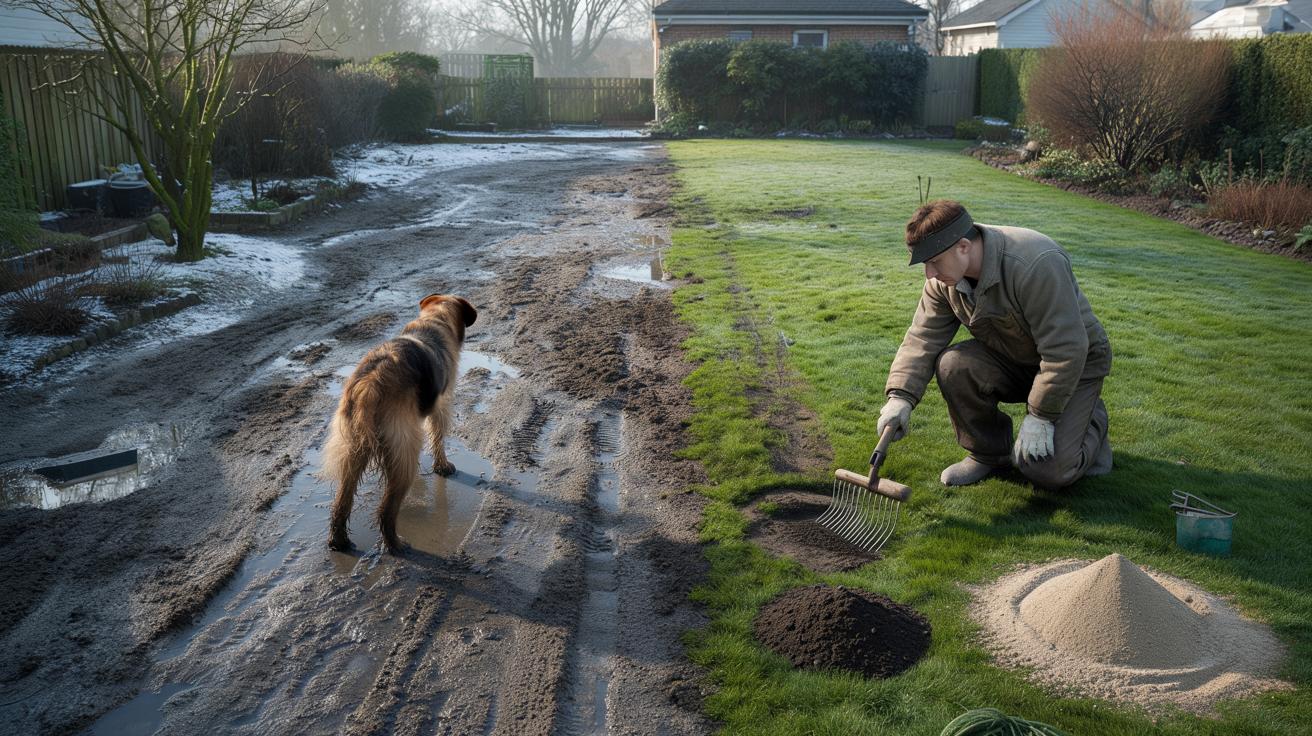
The scene feels inevitable: relentless rain, grey skies, and a garden reduced to a muddy obstacle course. Yet professional gardeners insist that a lawn doesn’t have to become a swamp each time the weather turns. With a few targeted habits and some clever tweaks to the ground itself, the grass can stay firm underfoot, even in January.
Why your winter lawn turns into mud
Before changing anything, gardeners start with a diagnosis. A muddy lawn is rarely just “bad luck with the weather”.
Most often, three factors gang up together: soil type, poor drainage, and repeated trampling when the ground is saturated.
Mud is usually a symptom of a suffocating, compacted soil that can no longer absorb or move water away.
Heavy clay soils, common across many parts of the UK and northern US, are the usual suspects. Their tiny particles hold water tightly. When winter rain arrives, the ground quickly becomes saturated and water lingers at the surface.
Walk across that wet ground too often, and every step compresses the soil further. Pores that should hold air and let water drain close up. The result: puddles that never seem to disappear, brown patches, bare earth, and eventually a sticky mess.
Shaded gardens also suffer more. Without much sun or wind to dry the surface, the wet layer lingers. Add a dog that races across the same route every morning, or children using the lawn as a shortcut, and a muddy strip forms almost automatically.
How gardeners improve drainage before winter
Professional gardeners don’t wait for a storm. They start months earlier by working on the structure of the soil beneath the grass.
Aeration: punching holes to let the ground breathe
One of the most common techniques is aeration. This means perforating the lawn with small holes using a mechanical aerator, a hand tool, or even a garden fork.
➡️ Wie Sie mit einem DIY-Korb für Waschtücher die Wäschekammer ordentlich und dekorativ gestalten
➡️ Dieses Accessoire, das im Winter kaum jemand wäscht – und es sind weder Kleidung noch Bettlaken
➡️ Warum Haustiere bestimmte Räume bevorzugen, obwohl die Temperatur gleich ist
➡️ Warum kleiner anfangen langfristig erfolgreicher ist
➡️ Wie Sie Ihr Auto im Winter schneller enteisen – mit einem einfachen Hausmittel
By creating thousands of tiny channels, aeration helps water soak in, rather than sit on top and turn into mud.
On small lawns, a simple garden fork can do the job. Push the tines in 10–15 cm deep every 10–15 cm, rock it slightly back, then move on. It is slow, but effective.
On large or badly compacted lawns, many gardeners recommend a hollow-tine aerator. Instead of just piercing the ground, it removes small plugs of soil. This opens the structure more deeply and gives water and roots room to move.
Feeding the soil, not just the grass
Topdressing comes right after aeration. Gardeners spread a thin layer of material over the surface, brushing it into the holes.
- On heavy clay: a mix of sharp sand and compost
- On loamy soil: mainly compost or well-rotted manure
- On sandy ground: compost to help hold moisture evenly
These additions improve structure, make the soil more crumbly, and encourage worms and microbes. Over a few seasons, the lawn sits on a sponge-like layer that drains better and recovers faster after rain.
Fast action when the lawn is already a bog
Sometimes the weather wins and the lawn is already covered in puddles. Gardeners then turn to quick, temporary tricks that stabilise the ground while longer-term solutions kick in.
Using absorbent materials on problem patches
On the worst muddy spots, many professionals spread a layer of material that soaks up excess water and creates a firmer surface.
Sanded and mulched patches act like first aid for a drowning lawn, buying time until the soil can be fixed properly.
Common choices include:
- Sharp sand: improves drainage and firms the surface
- Fine gravel: creates grip and avoids slippery mud
- Wood chips or bark: especially useful on paths or around play areas
These treatments are not a cure; they are more like a bandage. Gardeners often remove or rake them in later, then work on aeration and organic matter to address the deeper issue.
Stabilising traffic routes with permanent structures
Where feet or paws always pass along the same line – from back door to shed, for example – turf rarely stands a chance. In those places, gardeners often stop fighting nature and build a proper route.
Two common solutions stand out:
| Solution | How it helps |
|---|---|
| Plastic stabilising grids | Clip together over a prepared base, filled with gravel or soil, creating a firm, drainable surface that can even be grassed. |
| Stepping stones or “Japanese steps” | Flat stones set on a sand bed allow clean passage and reduce pressure on surrounding turf. |
Gardeners dig out around 10 cm of soil, lay a base of sharp sand or fine gravel, level it, then install the grids or stones. Water can still move through, but boots no longer churn the soil.
Planting allies that drink up excess water
Where an area stays wet no matter what, some gardeners change strategy: instead of forcing a perfect lawn, they recruit plants that love damp feet.
Moisture-hungry trees and shrubs act like living pumps, pulling litres of water from the ground every day in the growing season.
On large plots, trees such as willow, alder, birch and poplar are often used around the edges of wet lawns or near natural dips. Their extensive root systems help stabilise the soil and gradually dry it out.
In smaller gardens, shrubs and perennials adapted to moist ground work well along soggy borders. Think dogwood, astilbe, hosta or iris. Some gardeners even turn the muddiest corner into a small rain garden, designed to collect and slowly release excess water rather than fight it.
Preventing the return of the mud year after year
Once the emergency has passed, the real goal is to stop the same mess forming every winter.
Reducing compaction from daily life
Professional gardeners talk a lot about traffic management. It sounds technical, but in practice it means simple changes:
- Keep people and pets to clear, stable paths when the lawn is soaked
- Move football goals or play equipment a few metres each season
- Avoid mowing when the ground is very soft, as heavy mowers sink and compact
Just redirecting the main routes can give grass time to recover and roots space to grow deeper, which in turn improves drainage.
Installing proper drainage on stubborn plots
On some sites, especially where gardens sit in a natural dip or where builders left compacted rubble under the turf, surface fixes don’t go far enough. At that point, many gardeners call in landscape specialists.
They may install French drains – trenches filled with gravel and perforated pipe – to carry water away from the lawn. Others reshape the ground slightly so water flows toward a soakaway or planted wet zone instead of pooling in the centre.
Drainage work costs money and time, but on chronically waterlogged lawns it can be the difference between permanent mud and year-round use.
What “good drainage” really looks like in practice
The term gets used constantly, yet many homeowners are unsure what it means on the ground. A well-drained lawn does still get wet in winter. The difference is in how quickly it recovers.
After heavy rain, water should start sinking away within hours, not sit for days. Boots may press the grass down, but they do not leave deep, shiny footprints filled with water. On a scale of sponge to concrete, the best lawns feel like a firm mattress: springy, not squelchy.
Gardeners often test this by digging a small hole about 30 cm deep and filling it with water. If that water disappears within a couple of hours in wet weather, drainage is usually acceptable. If it stays like a mini pond, soil structure or underlying layers likely need work.
Choosing where to accept change
Not every patch of lawn has to remain lawn. Many gardeners quietly admit that the easiest solution for the worst mud zones is to stop forcing grass there.
A muddy, shaded corner under trees can become a woodchip play area, a paved seating spot, or a planted bed with ferns and moisture-loving flowers. The rest of the lawn then has a better chance of staying green instead of turning brown and bare.
Thinking this way shifts the goal from a perfect, uniform carpet to a garden that matches the reality of the site. Once soil structure has been improved, traffic managed, and wet spots given their own role, winter rain still arrives. The difference is that the lawn behaves more like a resilient surface and less like a field at a music festival.