Across the UK and US, gardeners reach for the secateurs as soon as winter eases, keen to tidy borders. With hydrangeas, that impulse can be costly: some types love a strong late‑winter haircut, others lose almost every flower if you cut at the wrong time.
Why pruning hydrangeas is trickier than it looks
Hydrangeas are often sold under simple labels, so people treat them all the same. That’s where things go wrong. These shrubs do not all form their flower buds in the same way.
Two big groups exist from a pruning point of view:
- those that flower on new wood (shoots produced in spring of the current year)
- those that flower on old wood (stems formed the previous summer)
Hydrangeas that bloom on new wood can be cut back hard in late winter. Those that bloom on old wood mostly should not.
If you confuse the two, you either end up with leggy shrubs and weak growth, or with lush foliage and no flowers at all. The trick is learning which plants belong in each side of that divide.
First step: work out whether yours flower on new or old wood
Look closely at the stems in late winter. On hydrangeas that flower on old wood, you will see plump little buds sitting just below last year’s dried flower heads. On new‑wood types, last year’s stems are often bare or dotted with smaller buds, and the bulk of the flowering shoots will emerge fresh in spring.
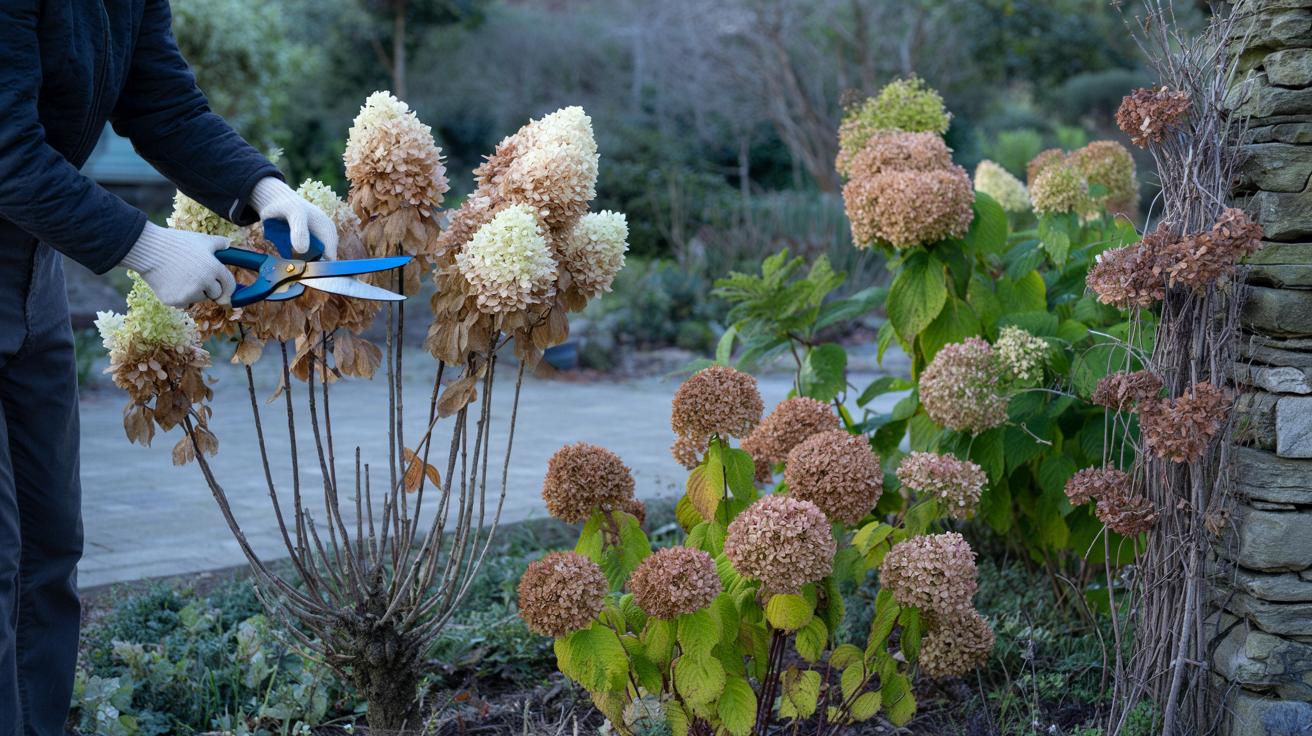
Garden organisations such as the Royal Horticultural Society advise leaving those dried flower heads on through winter. They act like tiny hats, shielding the buds beneath from frost and wind. Cut them off too early and a cold snap can burn the future bloom.
If you are unsure what kind of hydrangea you have, treat it as an old‑wood variety and prune lightly. You will keep your chances of flowers.
The 2 hydrangeas you can prune confidently in late winter
Hydrangea paniculata – the panicle hydrangea
Panicle hydrangeas carry large, conical flower heads in cream or white, often flushing pink as the season ends. The shrub itself is upright, woody, and far more sun‑tolerant than the classic blue mophead in many front gardens.
➡️ Der geniale Hotel-Trick, um Duschwände streifenfrei zu reinigen und wieder transparent zu machen
This species flowers on new wood. That means the buds that will open in July and August are formed on shoots that only appear in spring. Cutting back in February or March does not remove the upcoming flowers; it triggers strong new growth that will carry them.
A simple pruning routine for Hydrangea paniculata in late winter:
- remove dead, damaged or crossing branches at the base
- shorten remaining flowering stems to two or three pairs of healthy buds
- keep a balanced framework of main branches so the shrub does not become lopsided
Strong pruning produces fewer but larger flower panicles. Lighter pruning leaves a taller shrub with more, slightly smaller blooms. Either way, late winter is the right moment, just before new growth starts to push.
Hydrangea arborescens – including ‘Annabelle’
Smooth hydrangeas such as Hydrangea arborescens ‘Annabelle’ are those plants with huge, rounded white flower balls that sometimes flop after heavy rain. They, too, flower on new wood.
Here, a firm cutback in late winter is not only allowed, it is useful. By shortening stems hard, you encourage thicker, sturdier shoots that cope better with the weight of the summer blooms.
Cut Hydrangea arborescens to around 20–30 cm from the ground in late winter to help prevent those giant flower heads collapsing.
Again, remove any weak, thin stems completely and leave a neat clump of strong shoots. As temperatures rise, new canes will surge from the base and carry the season’s flowers with surprising speed.
The 5 hydrangeas you should not prune hard in late winter
Hydrangea macrophylla – classic mopheads and lacecaps
These are the hydrangeas most people picture: big ball‑shaped flowers in pink, blue or purple, or flatter lacecap heads ringed with showy florets. They are sold everywhere and widely planted along house walls and in cottage gardens.
Hydrangea macrophylla forms its flower buds on stems produced the previous summer. Those buds sit just below last year’s now‑dry flower heads. Cut those stems back hard in January or February and you literally remove the entire next crop of blooms.
The right timing for shaping these shrubs is different:
- light clean‑up in late winter: remove only dead wood and spent flower heads, snipping just above the top pair of healthy buds
- structural pruning straight after flowering in summer, ideally before the end of July
This schedule gives the shrub time to grow new stems in late summer and autumn, which then carry next year’s buds.
Mountain hydrangeas – compact cousins with flat flowers
Closely related to macrophylla types, mountain hydrangeas stay more compact and often have delicate, flat lacecap blooms. Their flowering behaviour is the same: buds form on old wood.
They benefit from similar care: gentle tidying in late winter and more decisive cuts right after flowering. In colder areas, leaving the dried heads on until spring offers extra protection from frost, which can be harsh at higher altitudes or in exposed gardens.
Hydrangea quercifolia – the oakleaf hydrangea
Oakleaf hydrangeas are grown as much for their foliage as their flowers. The leaves resemble those of an oak tree and turn shades of burgundy and rust in autumn. The creamy conical blooms appear on old wood.
Heavy winter pruning on these shrubs removes not only flower buds but also spoils the natural, slightly arching shape. Restrict pruning to:
- cutting out dead or damaged stems in late winter
- occasional light shaping just after flowering, if needed
Hydrangea petiolaris – the climbing hydrangea
Climbing hydrangeas cling to walls, fences and tree trunks using aerial roots. They carry flat, lacy flower heads along their woody framework. Again, most of those flowers arise from buds on last year’s growth.
These climbers do not need regular heavy pruning. Late‑winter work should focus on safety and structure only: remove branches that pull gutters, invade roofs or trap windows. Any serious reshaping is best carried out just after flowering, so the plant has time to set new buds on the regrowth.
Repeat‑flowering hydrangeas
Some recent varieties rebloom, producing a first flush on old wood and then another on new wood. Marketing often highlights their long season, but their pruning needs can confuse gardeners.
On repeat‑flowering hydrangeas, many of the earliest, showiest blooms still form on old wood, so harsh late‑winter pruning cuts that display away.
For these varieties, content yourself with removing dead stems and trimming out only the oldest, most congested wood. Allow a mix of one‑year and older stems to remain. The plant will then flower on both types of growth as the season progresses.
Quick comparison: when to prune which hydrangea
| Type | Flowers on | Late‑winter pruning? |
|---|---|---|
| Hydrangea paniculata | New wood | Yes, hard pruning encourages strong flowering shoots |
| Hydrangea arborescens | New wood | Yes, cut back to low framework |
| Hydrangea macrophylla | Old wood | Only light deadheading and removal of dead stems |
| Mountain hydrangeas | Old wood | Light tidying; main cuts after flowering |
| Hydrangea quercifolia | Old wood | Minimal pruning, mainly dead or awkward stems |
| Hydrangea petiolaris | Old wood | Safety and shape only, after flowering for big cuts |
| Repeat‑flowering cultivars | Both old and new wood | Very light pruning, keep a mix of stem ages |
Frost, mulch and those ugly brown flower heads
Many gardeners want a tidy garden in winter and feel embarrassed by brown hydrangea flowers. Yet leaving them on until late winter provides real benefits.
The papery bracts trap snow and frost, acting as a barrier that protects fragile buds on old‑wood varieties. In cold regions, a low mulch of leaves or compost around the base of the shrubs adds another layer of protection for the roots and new shoots.
If a severe late frost still blackens buds in spring, resist the urge to cut back immediately. Wait a few weeks. Often, dormant buds lower on the stems will break and give at least some flowering, especially on vigorous plants.
Common mistakes and how a single season can teach you
Two errors come up again and again in gardeners’ stories: cutting all hydrangeas to ankle height “for neatness”, and pruning old‑wood types in late winter because that’s when other shrubs get done. Both usually mean a flowerless summer.
One practical way to learn without risking everything is to experiment:
- on a group of similar plants, prune one according to the correct guidance and leave one mostly untouched
- note flowering times, flower size and stem strength during the season
This small test shows how each pruning style affects the plant. After a year or two, patterns become obvious, and you will feel much more confident with your secateurs.
For newer gardeners, getting comfortable with terms like “new wood” and “old wood” also helps. New wood is simply this year’s growth, still green or lightly woody. Old wood refers to last year’s growth and beyond, usually thicker and more rigid. Understanding that difference turns a confusing list of rules into a logical system you can apply across your whole garden, not just to hydrangeas.