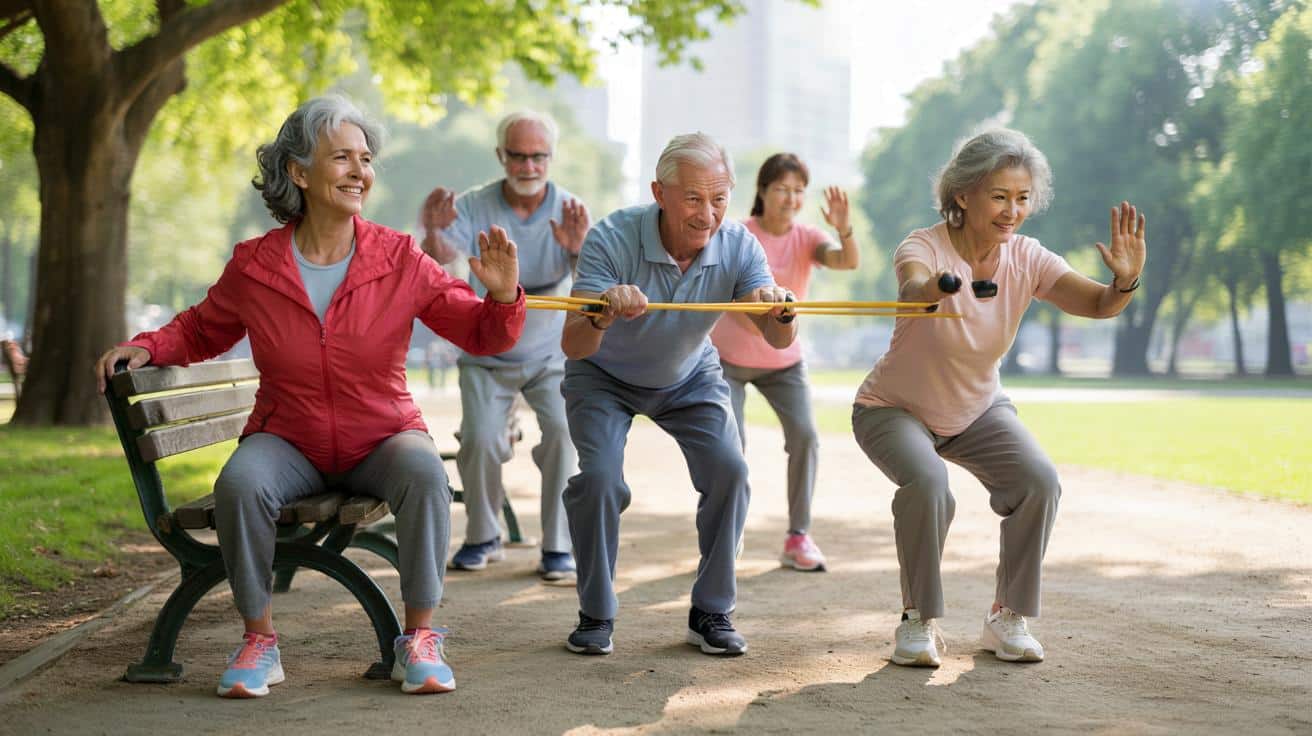
The first time I saw them was on a Tuesday morning in the park, just after the rush-hour buses had emptied out. A small group of people, grey hair, colourful trainers, laughing more than sweating. One woman in a red windbreaker was moving slowly, arms raised like she was pushing away invisible walls. No music. No machines. Just breath, focus and an almost stubborn calmness in the middle of the city noise.
I stopped, watched for a few minutes, and realised something: none of them were swimming, none of them were power walking. And yet their faces said, “This is doing me good.”
The instructor caught my eye and smiled.
“Come back when you’re 60,” she called out. “You’ll understand.”
Why experts are turning to gentle strength, not endless cardio
For years, the health advice for people over 60 was simple: walk more, maybe swim a bit. Cardio, cardio, cardio. Then researchers started looking closely at what really keeps older adults independent, sharp and able to live the life they want.
What came out on top was neither long walks nor pool laps. It was something quieter and less obvious: **moderate, regular strength and balance training**, often done with slow, controlled movements. Think chair squats, light weights, resistance bands, tai chi or gentle bodyweight work. Not bodybuilding. Just waking up the muscles that protect you from falls, fractures and loss of autonomy.
In a large study from the University of Sydney, adults over 65 who did muscle-strengthening exercises at least twice a week had up to 23% lower risk of early death. That’s not a small difference, that’s the line between staying active and slowly giving up ground year after year.
Take Marianne, 68, who spent decades being told “just walk”. She walked. Her knees hurt anyway, stairs became scary, and she stopped going on hikes with friends. After a fall in her kitchen, her GP referred her to a physio-led group that focused on slow squats to a chair, heel raises by the countertop, and simple core work. Six months later, she was walking less distance than before, but she could step onto a bus without grabbing both rails. Her world got bigger, not smaller.
The logic is brutally simple: as we age, we don’t lose our heart first, we lose our muscles. When muscles shrink and weaken, balance suffers, joints take more load, and everyday tasks become mini workouts. Washing a window feels like a marathon. Health experts now say the foundation for people over 60 is not endless walking, it’s protecting and rebuilding lean muscle and balance.
*Cardio still matters, but without strength and stability, it just shines a spotlight on what the body can no longer do safely.*
The best activity after 60: slow strength that respects your joints
So what do experts actually recommend? Not bootcamp, not triathlons, not chasing your 30-year-old self. The sweet spot is a mix of **gentle resistance training and balance work**, done two to three times a week, at a pace where you can talk but still feel your muscles working.
That can look surprisingly simple. Standing up and sitting down from a chair ten times, twice a day. Holding onto a countertop and lifting your heels. Sitting on the edge of your bed and gently tightening your belly and glutes. Using a light resistance band to open your chest or strengthen your back. Slow tai-chi-style sequences where one foot is always a little bit uncertain, training your body to correct, to stabilise, to trust itself again.
A lot of people over 60 feel guilty because they “don’t do enough sport”. Yet when they finally try strength and balance sessions, they’re shocked by two things: how little equipment is needed, and how quickly daily life feels easier. The real trap is when someone believes walking the supermarket aisles is “good enough exercise” and avoids anything that feels like training muscles.
Let’s be honest: nobody really does this every single day. Life gets in the way, energy dips, the grandkids arrive unannounced. That’s why consistency means “most weeks”, not perfection. Missing a session is normal. The mistake is deciding “oh well, too late now” and stopping completely.
“If I could give only one prescription to my patients over 60,” says German geriatric specialist Dr. Eva König, “it wouldn’t be a pill. It would be two sessions a week of slow, progressive strength and balance training. It keeps people in their homes and out of hospital.”
- Chair-based exercises: safe way to strengthen legs and core without fear of falling.
- Light weights or bands: maintain muscle without stressing the joints.
- Balance drills (one-leg stands, heel-to-toe walk): directly reduce fall risk.
- Gentle classes (yoga, Pilates, tai chi for seniors): add flexibility and social contact.
- Short, regular sessions: 10–20 minutes, two or three times a week, beat rare, heroic efforts.
Choosing your “forever activity” after 60
At some point we all reach that quiet crossroads where the question changes from “How do I look?” to “How do I want to live?” You start noticing who in your circle can still carry a shopping bag, climb a small hill, or get off the floor after playing with a grandchild. You see that the winners are not the ones who ran marathons at 40, but the ones who kept moving in a thoughtful, sustainable way.
The best activity after 60 is not the trendiest, or the one that makes for the best social media post. It’s the one that keeps your muscles talking to your brain, your balance awake, your joints supported, and your world open. Swimming and walking are great tools, but they’re not the full toolbox.
Maybe your version looks like a twice-weekly senior fitness group at the community centre, plus a few chair exercises at home. Maybe it’s tai chi in the park, a resistance band hanging on the wardrobe door, and ten slow squats before your morning coffee. Or a guided online class you do in your living room with the curtains half closed because you still feel a bit silly.
What matters is not perfection, but this quiet decision: “I’m going to keep some strength. I’m going to train my balance. I’m not giving my independence away without a fight.” That small, stubborn promise to yourself can change the next twenty years more than any miracle supplement ever will.
| Key point | Detail | Value for the reader |
|---|---|---|
| Strength and balance beat pure cardio | After 60, preserving muscle and stability reduces falls, fractures and loss of autonomy more than just walking or swimming | Helps you focus your limited time and energy on what really protects your independence |
| Simple, regular sessions work best | Two to three short sessions per week with chair exercises, bands, light weights or tai chi are enough to see benefits | Makes the goal realistic and achievable, even with fatigue or a busy life |
| Choose a “forever activity” | Find a gentle strength and balance routine you can keep doing for years, not weeks | Supports long-term health, confidence and daily comfort, not just short bursts of motivation |
FAQ:
- Question 1Isn’t walking enough for my health after 60?
- Answer 1Walking is great for your heart and mood, but it doesn’t stop the age-related loss of muscle and balance on its own. Adding even 15–20 minutes of strength and balance work twice a week covers that missing piece.
- Question 2What if I’ve never done any sport in my life?
- Answer 2Starting after 60 is absolutely possible. Begin with chair-based movements and balance exercises holding onto a support. Progress slowly, and if you can, get one or two sessions with a physio or qualified trainer for guidance.
- Question 3Do I need to join a gym and lift heavy weights?
- Answer 3No. Many people over 60 get excellent results with bodyweight, resistance bands, water bottles or small dumbbells at home. The key is feeling your muscles work, not chasing big numbers on a barbell.
- Question 4How do I know if I’m doing too much?
- Answer 4You should feel comfortably tired, not wiped out. Mild muscle soreness the next day is fine, sharp joint pain or dizziness is a red flag. You should still be able to talk in full sentences while exercising.
- Question 5Can I combine swimming or walking with strength training?
- Answer 5Yes, that’s an excellent mix. Keep your walks or swims for endurance and pleasure, and add two short sessions a week focused on strength and balance. That combination is what many experts now call the gold standard after 60.
➡️ Warum ein wöchentliches Ölbad Ihre Haare stärkt und wie Sie es zu Hause richtig anwenden
➡️ Weder Alufolie noch Frischhaltefolie: die beste Methode, Salat frisch zu halten, ohne dass er welkt
➡️ Diese Bäckereikette verkauft das ungesündeste Brot warnt UFC Que Choisir
➡️ Warum ein Spazierclub für Senioren im Winter 2025 die Gesundheit fördert, mit Routentipps