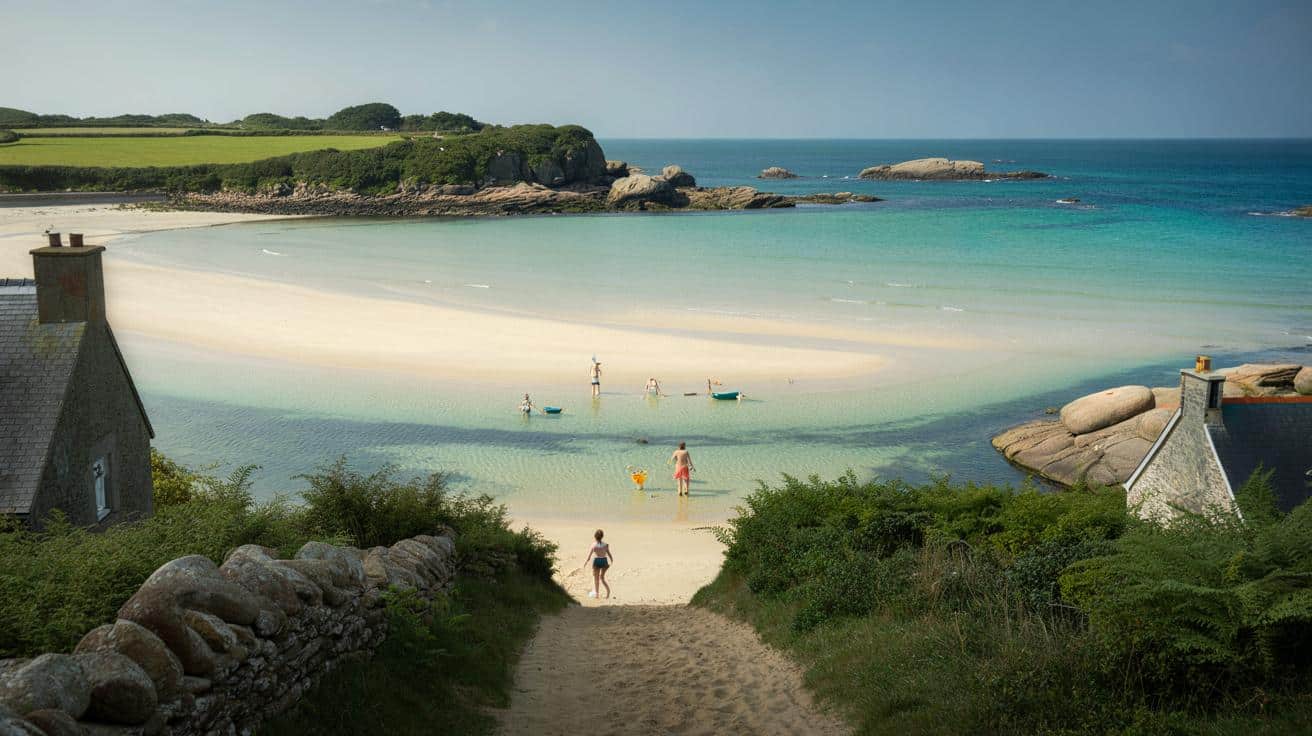
The first time you see the Guillec, you almost think you’ve taken the wrong road. A narrow lane between stone farmhouses, hedges tangled with ferns, a patch of grey Breton sky that doesn’t look like holidays at all. Then the wind changes, carrying that faint, salty smell, and a pale strip of sand appears at the end of the path. Your brain still expects a classic northern beach: big waves, brownish water, a stubborn drizzle.
And yet, a few meters further, the landscape suddenly flips. Turquoise lagoon, sand so white it squeaks under your feet, flat water protected by granite boulders sculpted by the tide. Kids splash around in the shallows as if they’d been teleported somewhere near Guadeloupe.
You’re still in Brittany. But your eyes refuse to believe it.
Where the wild north hides a Caribbean mirage
Standing above the mouth of the Guillec river, the first shock is the color. The sea glows in layers of blue, from transparent mint near the shore to deep teal beyond the rocky islets. On a sunny day, it feels unreal, like someone slipped an Instagram filter over the landscape. You’d swear the water should be warm, just from looking at it.
Behind you, fields, gorse, and low stone walls remind you you’re in the far north of Finistère. In front of you, this lagoon-style cove unfolds, protected by a ring of rocks that calms the waves and traps the light. The contrast is almost comical. A wild, almost raw setting… that hides a postcard cliché.
If you arrive at low tide, the beach stretches out like a white runway. Sandbanks emerge, drawing sinuous paths between pools of clear water where children crouch with nets and buckets. You hear that particular mix of seagulls, laughter and clinking shells that only exists on this type of shallow shore.
A local woman in a wool sweater watches her dog run through the water and smiles when she sees tourists staring, stunned. “You didn’t expect that, did you?” she says. She’s right. Most people discover the Guillec thanks to a friend’s photo, a half-secret tip whispered over an apéro: “Go to this river mouth near Sibiril, you’ll think you’re far away.”
We’ve all been there, that moment when you almost don’t want to share a place for fear of spoiling it.
The “Caribbean” impression comes from a simple trick of nature. The Guillec river carries fine sand and deposits it where it meets the sea. The shallow depth and very clear water let sunlight bounce off the white bottom. Add the pale granite reflecting light from the sides and the effect is intense, almost exaggerated. On days with no wind, the surface turns into a liquid mirror, and the boats anchored there seem to float on air.
Yet the frame remains totally Breton: big tides, sudden squalls, the horizon dotted with lighthouses and rocky teeth. That’s what makes this beach so fascinating. It doesn’t try to pretend it’s another country. It’s just the north coast, caught for a few hours under the right angle of light.
➡️ Socke im trockner rettet die welt
➡️ So lernen sie mit selbstmitgefühl fehler zu akzeptieren und an herausforderungen zu wachsen
How to experience the Guillec without breaking the spell
The best way to arrive is on foot, quietly. Park a little before the river mouth and follow the small paths that wind between houses and hedges. The sound of cars fades away, replaced by the rustle of wind in the grass and the distant murmur of waves. You walk a few minutes, feel the ground become slightly sandy, and then the view opens in front of you like a curtain lifting.
Choose a tide time that lets you see both faces of the place. Around mid-tide descending, the lagoon effect is already there and the sandbanks start to draw their curves. On the way back, closer to high tide, the sea comes to lick the grass and the Guillec looks like a sheltered bay. Two moods, one walk.
Let’s be honest: nobody really studies tide tables every single day. You look at the weather, you throw a towel in the bag, and you go. Yet for the Guillec, the tide changes everything. At very low tide, the lagoon feels endless but the water can be far. At very high tide, the strip of sand narrows fast and families end up squeezed against the dune, towels almost touching.
The common mistake is arriving in the middle of a sunny afternoon in August, expecting peace and pure magic. The place is still beautiful, of course, but the atmosphere shifts. If you can, aim for a morning with soft light or the end of the day, when the sun drops behind the fields and the sky turns blush-pink over the water. The beach breathes differently then.
“On some evenings in September, there are only three or four of us on the whole beach,” says Yann, who grew up in the area. “The water keeps a bit of the summer warmth, the wind falls, and the sea turns that electric blue. You almost hear yourself think.”
- Come on foot or by bike for the last stretch: the approach path is part of the charm.
- Bring layers: a fleece or windbreaker, even on a sunny day. This is still the Channel, not the Caribbean.
- Pack simple gear: a mask and snorkel for kids, water shoes for rocks, a thermos for hot drinks when the wind picks up.
- Leave no trace: the beauty here is fragile. One plastic bag forgotten on the sand breaks the spell faster than a cloud.
- Plan a “plan B” activity nearby: a café stop in Saint-Pol-de-Léon, a walk among the artichoke fields, a lighthouse visit if the clouds close in.
A wild place that changes the way you look at Brittany
The Guillec beach plays with your expectations, and that’s maybe why it stays in your head so long. You arrive with the cliché of a rough, grey north. You leave with the memory of water so clear you could count the ripples in the sand underneath. Between the two, something shifts quietly. You realize that the same coastline that can be brutal in winter is capable of this tender, almost tropical light in summer.
*This is the plain truth hidden behind the “Caribbean” label: the Guillec is first of all a wild Breton corner, with its moods, its low clouds, its powerful tides.* The magic comes from the collision of these two images. A remote estuary, simple, almost rural… and this lagoon shock when the sun hits right. You walk away with photos, yes, but also with a feeling: that the most beautiful landscapes are often those that don’t quite fit the postcard slot.
The kind you talk about in a half-whisper, wondering if you should really tell everyone where they are.
| Key point | Detail | Value for the reader |
|---|---|---|
| Hidden Caribbean effect | Shallow, clear water over white sand at the Guillec river mouth creates turquoise lagoon colors on sunny days | Helps you choose the right light and tide to experience the “wow” moment fully |
| Wild Breton setting | Rural access paths, granite rocks, big tides and changing weather frame the beach in a raw, authentic landscape | Sets realistic expectations and reinforces the charm beyond simple postcard photos |
| Timing and approach | Arriving on foot, aiming for mid-tide and morning or evening light transforms the visit | Gives you a practical mini-strategy to enjoy the place without crowds or disappointment |
FAQ:
- Is the Guillec beach really as turquoise as in the photos?On bright days with a medium to low tide, yes. The combination of pale sand, shallow water and light reflection can look surprisingly tropical, especially when the sea is calm.
- Can you swim comfortably there, or is the water too cold?The water is fresh, you’re in northern Finistère, but the sheltered shape of the river mouth keeps it a bit less icy than open beaches. In summer, most people swim without a wetsuit, at least for short dips.
- Is the area suitable for children?Yes, the gentle slope and shallow areas at low tide are great for kids, with room to play and explore. You still need to watch them closely, since currents change quickly with the tide.
- How do you get to the Guillec beach?The beach sits near the mouth of the Guillec river, between Sibiril and Cleder in northern Finistère. You reach it by small local roads, then finish on foot along paths that lead down to the shore.
- Is it crowded in summer?On sunny afternoons in July and August, yes, especially around high tide. If you want a quieter, almost “secret” feel, come early in the morning, later in the evening, or in June and September when the light is still beautiful but there are fewer people.