For many visitors, that first jet-lagged walk through Tokyo or Kyoto feels slightly surreal: millions of people, endless neon, takeaway drinks in hand – and nowhere obvious to throw anything away. What looks like a planning failure is, in reality, a conscious national choice wrapped up in security concerns and deep cultural habits.
The strange experience of having nowhere to throw rubbish
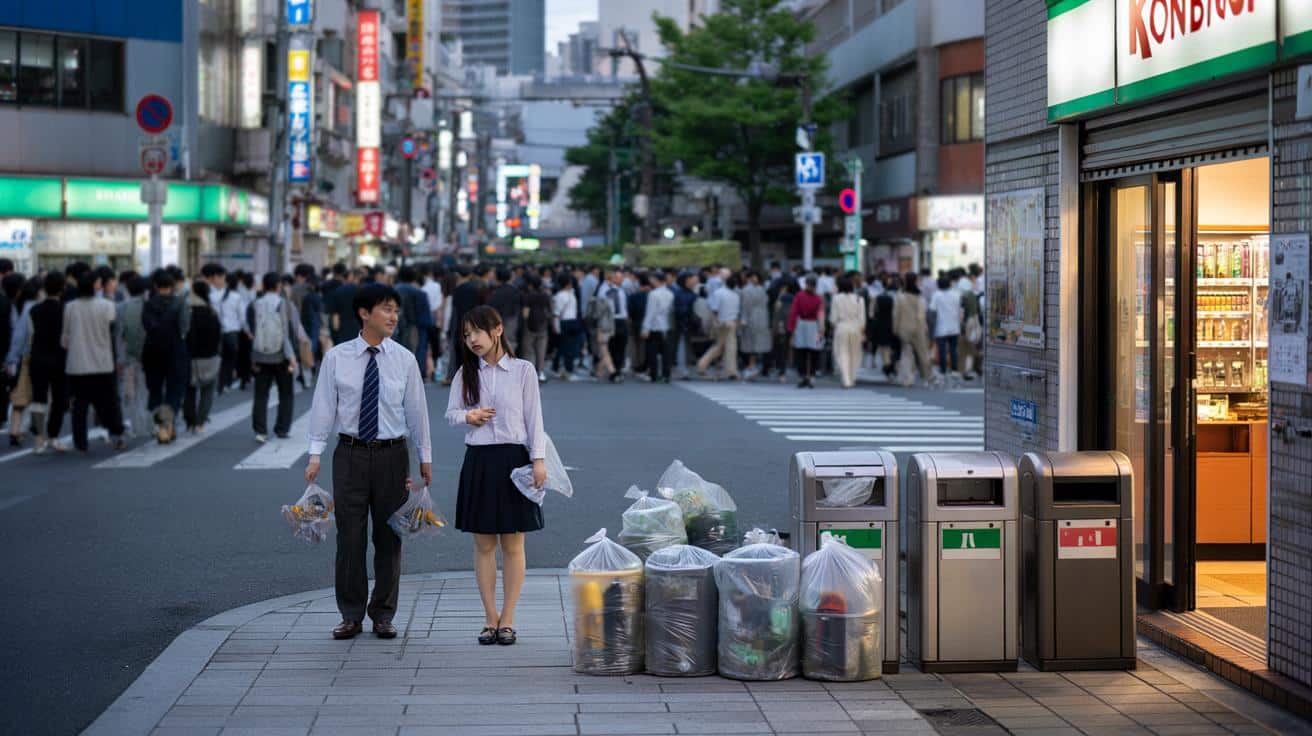
Walk a few kilometres through central Tokyo and you notice it: no overflowing bins, no leaning plastic bags, no stray cans. In Shibuya, where crowds pulse across the famous scramble crossing, you can stand surrounded by hundreds of people and still struggle to spot a public rubbish bin.
Convenience stores, or konbini, offer a partial safety net. Most have clearly marked containers for bottles, cans, and food packaging. The unwritten rule is simple: those bins are for waste bought and consumed there, not for whatever you picked up on the train two hours earlier.
First-time visitors often end up doing the same thing: stuffing empty drink bottles into backpacks, pocketing used tissues, and carrying sweet wrappers all day. Some tourists describe fishing several chewed pieces of gum out of a bag at night because they never found a bin. Surveys by Japan’s tourism agency have even ranked the lack of public rubbish bins as one of the top discomforts for foreign travellers.
The near-invisible bin system is not an oversight; it is the result of deliberate political and cultural decisions.
From terror fears to almost bin-free streets
The scarcity of street bins in Japan has roots in trauma. In 1995, members of the Aum Shinrikyo cult released sarin gas on Tokyo’s subway system, killing thirteen people and injuring thousands. In the years that followed, authorities looked closely at every potential hiding place in busy public spaces.
Public bins, especially enclosed ones, were seen as convenient spots to conceal dangerous items. Many were removed from train and subway stations, and from crowded areas around major hubs. A second wave of caution followed the 2004 Madrid train bombings, reinforcing the idea that less street infrastructure could mean fewer vulnerabilities.
Today, you will still find bins in some stations and around certain public buildings, but they are fewer in number, often transparent, and usually monitored by staff or CCTV. In many neighbourhood streets there are none at all; household rubbish is placed outside only on specific days and times, in designated spots, and removed quickly.
Cultural habits that make litter unthinkable
The security story explains why bins disappeared. It does not explain why the streets did not instantly fill with rubbish. For that, you have to look at Japanese social norms.
➡️ Warum ein wöchentliches Ölbad Ihre Haare stärkt und wie Sie es zu Hause richtig anwenden
➡️ So planen Sie ein Outdoor-Cardio-Training im Park und vermeiden Erkältungen im Herbst, sicher
➡️ Zehn dinge in ihrer küche die sie sofort entsorgen sollten und warum sie zum problem werden können
➡️ Wie ein wohlhabender veganer landlord seine mieter zwingt im eigenen garten fleisch zu grillen
Cleanliness as shared responsibility
From primary school onwards, children in Japan take part in daily or weekly cleaning sessions. Classrooms, corridors, toilets and playgrounds are tidied not by cleaners but by pupils and teachers together. The activity is called o-soji, literally “big cleaning”.
This practice does more than save money. It teaches that shared spaces belong to everyone, and everyone has a duty to keep them in good condition. The idea follows people into adult life: you respect the train carriage because you, or your child, may have to clean something similar later.
Religious traditions add another layer. In Shinto shrines, visitors wash hands and rinse mouths at small fountains before approaching the main hall. In Buddhism, physical cleanliness often links to mental clarity and respect. These influences feed into everyday expectations: eat at home, in restaurants, or stationary spots, not while walking down the street leaving crumbs and cups behind.
In Japanese cities, cleanliness is not a service provided by the state; it is a social contract upheld by almost everyone.
Unspoken rules in daily life
These expectations show up in small habits that surprise outsiders:
- People rarely eat full meals while walking, so there is less packaging to throw away mid-journey.
- Smokers often carry portable ashtrays rather than flicking ash or cigarette butts onto the pavement.
- Commuters keep small plastic bags in handbags or backpacks for used tissues, receipts, and snack wrappers.
- Local residents sometimes clean the bit of pavement or gutter in front of their home or shop each morning.
Breaking these unwritten rules is not just frowned upon; it can trigger visible disapproval. A dropped can or an abandoned coffee cup tends to attract a quick, sharp look from bystanders, even if nobody confronts the person directly.
How visitors can cope without bins
For tourists used to throwing rubbish away every few hundred metres, adapting takes a little planning. A few simple strategies make the experience less stressful.
Practical tips for travellers
- Carry a “trash pouch”: Pack a small, resealable bag in your daypack for tissues, wrappers and receipts.
- Use konbini smartly: If you buy a drink or snack there, finish it nearby and use the store’s separated bins.
- Spot vending machines: Many have a bin next to them solely for bottles and cans, not general waste.
- Plan for long journeys: On some trains and buses, bins are limited; keep rubbish until your hotel or station.
- Respect sorting rules: Where bins exist, they are often divided into categories such as burnable, plastic bottles, and cans.
Adapting to Japan’s no-bin life nudges visitors toward a slower, more intentional way of consuming on the go.
What Japan’s system gets right — and where it feels strict
The Japanese approach cuts visible litter dramatically. Street cleaning teams still exist, but they deal with dust, leaves and seasonal debris rather than mountains of takeaway packaging. Recycling rates are relatively high, helped by careful sorting and strict rules on household waste.
The system has costs. The expectation of self-restraint can feel intense, especially in summer heat when you are carrying sticky bottles for hours. For people with disabilities or parents juggling young children, the lack of bins can add real inconvenience. And the psychological pressure not to make a mistake with sorting or timing leads some residents to complain quietly about “waste anxiety”.
Could other countries adopt Japan’s bin-light model?
Cities in Europe and North America occasionally talk about copying Japan’s approach to reduce litter and security risks. Simply removing bins rarely works. Without similar social expectations, streets tend to become dirtier, not cleaner.
Experts say that if a city wanted to borrow elements of the Japanese model, it would need to combine physical changes with education and consistent enforcement. That might mean teaching children to help clean school areas, organising neighbourhood “clean days”, and creating strong social signals that dropping rubbish is unacceptable.
| Element of the Japanese model | What it achieves | Challenge elsewhere |
|---|---|---|
| Few public bins | Reduces targets for vandalism and concealment; cuts bin maintenance | Risk of more litter if social norms are weak |
| Children cleaning schools | Builds responsibility and respect for shared spaces | Needs buy-in from parents and staff unions |
| Strict household waste rules | Improves recycling and keeps streets clear on non-collection days | Can feel complicated or burdensome at first |
Key terms and real-life scenarios
Two concepts often come up when people talk about rubbish and behaviour in Japan:
- Gomi: A common word for rubbish or waste. You will see it on signs, such as “gomi o motte kaerimashou” — “please take your rubbish home”.
- Konbini: Small, 24-hour convenience stores selling everything from rice balls to socks. Their bins are a lifeline for respectful travellers.
Imagine you buy a takeaway coffee near Shibuya station and start wandering. You finish it ten minutes later and look for a bin. There is none. The Japanese way is to keep the empty cup until you either pass the original shop again, find a konbini where you buy something else and use the bin there, or get back to your accommodation. Dropping it on a bench or a wall simply is not on the menu.
Or picture staying in a residential Tokyo neighbourhood. Your host explains house rules for rubbish: burnables on Tuesday and Friday before 8 a.m., plastics on Wednesday, cans and bottles twice a month, all in clear bags, neatly stacked at the corner. Miss the time slot, and your rubbish stays indoors. This level of structure makes spontaneous dumping very unlikely.
For travellers willing to adjust, the experience can be unexpectedly empowering. You become aware of each bit of packaging you accept, each single-use item you pick up. You may buy fewer drinks just to keep your bag light. By the time you fly home, carrying your own rubbish no longer feels strange; it feels like a reasonable price for streets that stay remarkably, quietly clean.