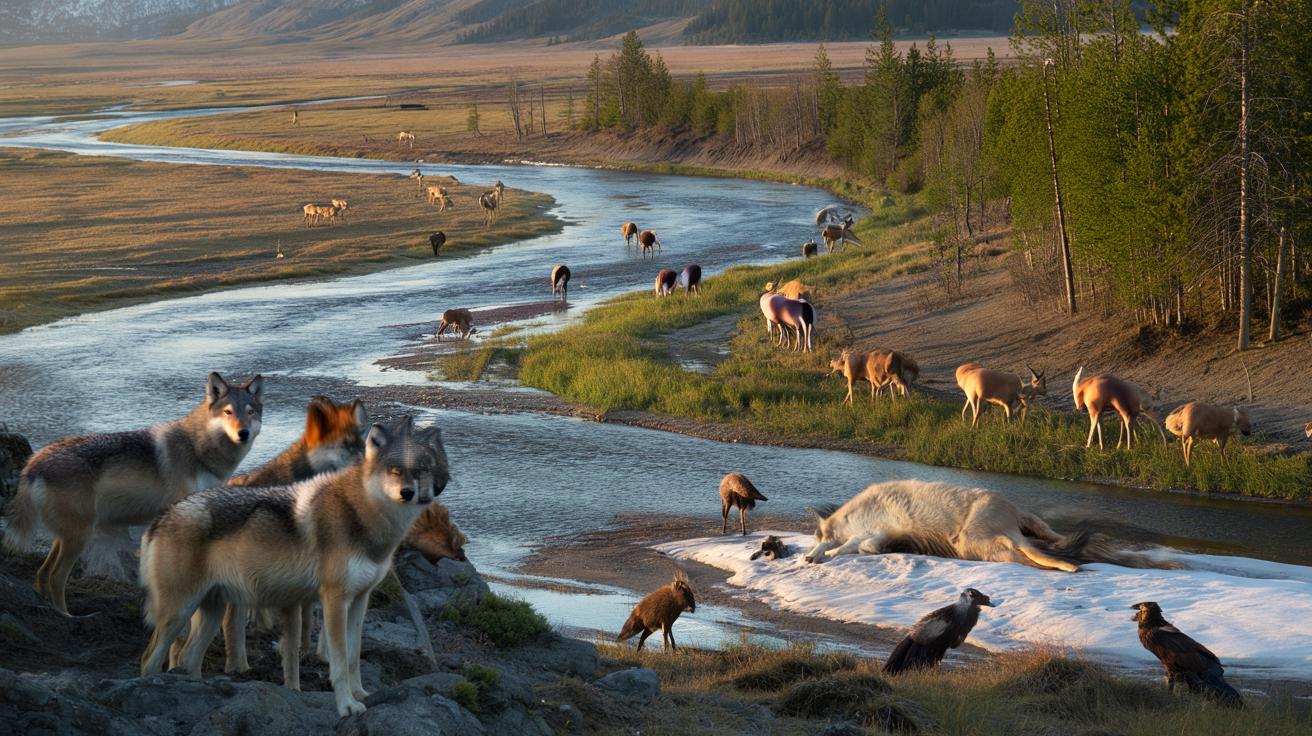
Yellowstone’s wolves have become an internet-era legend: top predators brought back from extinction in the park, supposedly triggering a sweeping “ecological miracle” from elk to willows to beavers. The science behind that story turns out to be far more tangled than the viral videos suggest.
The myth of the wolf that saved Yellowstone
Wolves were wiped out of Yellowstone by the early 20th century after government bounties and intensive hunting. Without them, elk numbers soared. Browsing pressure on young trees and shrubs, especially in river valleys, increased sharply. By the 1980s, parts of the park looked tired and overgrazed.
In the mid‑1990s, U.S. wildlife managers brought wolves back from Canada. The first years were dramatic. Elk numbers dropped. People noticed more young willows and cottonwoods along streams. Beavers started to recolonise certain valleys. A neat narrative emerged: wolves scared and killed enough elk to let plants regrow, which then boosted beavers, birds and insects.
Wolves were cast as the main character in a “trophic cascade” – a chain of cause and effect running from predators to plants.
That story appeared in documentaries, school textbooks and countless social media explainers. It was simple, hopeful and easy to repeat. An apex predator removed by humans, brought back by science, and nature heals itself. Few ecological stories have travelled so far or so fast.
What the data actually show
Long-term field studies do confirm that Yellowstone has changed since the 1990s. Elk numbers have fallen. Vegetation has shifted. Some riparian zones hold more shrubs and young trees than they did 40 years ago. Beavers have expanded in places. Carrion is more available to scavengers in winter.
Yet when researchers went back to the core data used to support the “wolf miracle”, they found a messier picture.
Mixed signals from the willows and cottonwoods
Some early papers claimed a striking surge in willow growth within a couple of decades after wolf reintroduction. Later teams re‑measured those plants and added more sites. The pattern was less dramatic and more variable than first suggested.
- Some stands of willow have grown taller and denser.
- Others show patchy change, or still struggle to regenerate.
- Growth trends can flip depending on which plots and years are compared.
Critics also highlighted a more technical problem: simple measurements such as shrub height were sometimes converted into more complex indices without much external validation. That kind of transformation can unintentionally amplify differences between sites and years, making vegetation recovery look stronger than it really is.
➡️ Was es laut Psychologie bedeutet, wenn jemand Ihnen im Gespräch konsequent nicht in die Augen schaut
➡️ Ein unterschätzter Faktor für mentale Erholung
➡️ So nutzen Sie Kaffee für eine belebende Kopfhautmassage und fördern glänzendes Haar, selbstgemacht
➡️ So schaffen Sie ein Paradies für Vögel ohne stundenlang im Garten zu arbeiten ganz einfach
➡️ Warum kleine Veränderungen nachhaltiger wirken als große Umbrüche
Ecologists now argue that plant recovery in Yellowstone is real in some places, weak in others, and not driven by wolves alone.
Elk decline: not just teeth and claws
The drop in elk numbers is central to the idea of a wolf‑driven cascade. Yet wolves are only one of several pressures acting on these herds.
Alongside predation, scientists point to:
- Human hunting outside park boundaries, which selectively removes animals.
- Harsh winters and drought years, which raise mortality and reduce calf survival.
- Other predators, including cougars and bears, that also take elk.
- Changes in habitat quality linked to fire history and hydrology.
When models include all these factors, wolves still matter, but their share of the impact shrinks. Yellowstone looks less like a simple wolf‑elk‑willow chain and more like a knot of interacting influences that vary from valley to valley.
Why simple ecological stories spread so fast
The “wolves saved Yellowstone” narrative ticks a lot of boxes for modern media. It has a villain (humans who eradicated predators), a dramatic turning point (reintroduction in the 1990s) and a satisfying resolution (a greener, richer park).
For conservationists, this story has been useful. It shows that policy can reverse past damage, and that predators are not just dangerous but ecologically valuable. For teachers, it offers a clean example of a trophic cascade.
The problem is not that the story is entirely wrong, but that it is too tidy for such a complex landscape.
Studies published over the past decade, including re-analyses on platforms such as ScienceDirect, are far less comfortable with the idea of a single, exceptionally strong cascade driven mainly by wolves. They point to the same datasets and ask harder questions about methods, sampling sites and time scales.
What wolves clearly changed
Even the sceptics agree that wolves have reshaped parts of Yellowstone in specific ways. Three effects stand out:
| Ecological effect | How wolves contribute |
|---|---|
| Carcass availability | Wolf kills leave food for scavengers such as ravens, eagles and coyotes, especially in late winter. |
| Elk behaviour | Elk move more, spend less time in risky open valleys and can browse more unevenly across the landscape. |
| Predator community | Wolves compete with coyotes and cougars, shifting how these species use space and prey. |
These effects are substantial, but none turns wolves into miracle workers. They are part of a larger web of influences, not puppeteers controlling every thread.
Wolves as players, not saviours
Many researchers working in Yellowstone now speak of wolves as “important participants” rather than “keystone saviours”. The distinction matters for how we think about conservation policy worldwide.
If people believe one charismatic species can fix everything, they may overlook other drivers of change: water management, land use outside park borders, climate shifts, even tourism pressure. Managers inside Yellowstone still have to consider controlled burns, river processes and visitor numbers, not just predator numbers.
Bringing back wolves has value, but restoring an ecosystem calls for attention to soils, rivers, climate and people at the same time.
The Yellowstone case has also influenced debates in Europe, where wolves are returning to countries such as France, Germany and Italy. Some advocates argue that predators will automatically reverse overgrazing in mountain pastures. The American experience suggests that expectations need to be realistic, and that support for local farmers and herders remains crucial.
Key terms that shape the debate
Three expressions come up repeatedly in discussions about Yellowstone and can be confusing without context.
- Trophic cascade: a chain reaction that starts at the top of the food web and affects levels below, such as predators changing prey behaviour and, in turn, vegetation.
- Keystone species: a species whose impact on its environment is disproportionately large compared with its abundance. Removing it can cause major shifts.
- Riparian zone: the strip of land along rivers and streams where water levels, soils and plants are tightly linked.
Yellowstone’s wolves are often presented as a textbook keystone species causing a classic trophic cascade, especially in riparian zones. Current evidence suggests their influence is real but not uniform or all‑powerful.
What Yellowstone teaches about managing wild places
For park managers, the wolf story offers both encouragement and caution. Reintroducing a missing predator did change Yellowstone. Yet it did not rewind the clock to some pristine past, and it did not remove the need for tough decisions.
Consider two practical scenarios. In a warming climate, drought could weaken willows regardless of elk numbers, limiting beaver habitat even with wolves present. At the same time, if surrounding states increase hunting quotas near park boundaries, elk behaviour and numbers may shift again, altering vegetation trends all over. No single knob controls the system.
Visitors drawn by the “wolf miracle” narrative can still learn a lot on the ground. Watching a pack move through a snowy valley shows how predators shape prey behaviour in real time. Looking closely at a riverbank reveals how floods, beavers, elk and plant genetics all combine to create that strip of life. The complexity on display is less tidy than the viral videos, but it is also far more interesting – and far more honest about what real ecological recovery looks like.