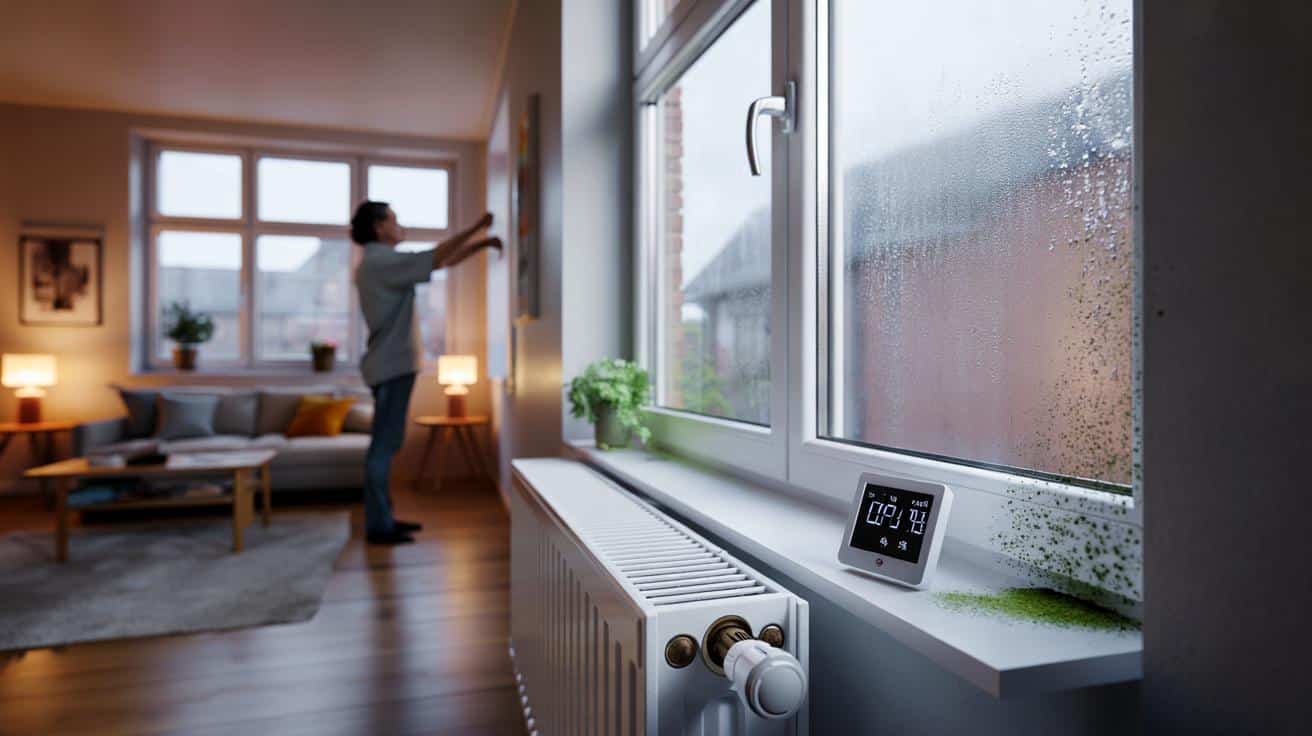
The winter rain is tapping softly against the window, the kind of steady drizzle that turns cities grey and laundry into a lost cause. Your radiator hums in the corner, but the room still feels a little damp, like the air is holding its breath. On the windowsill, a blackish halo has appeared in the corner – small at first, then bigger every week. You wipe it away with a cloth and cleaner. Two days later, it’s back, uglier and darker.
You raise the heating, then turn it down again when the bill crosses your mind. You open the window “just for a minute” and forget it for half an hour. The glass fogs up, the walls stay cold, and that smell – that slightly musty smell – starts to settle in. Somewhere between saving energy and staying healthy, there’s a number hiding on your thermostat.
The question is: which one.
Why temperature matters more than you think
Most people think mold is a “dirty bathroom” problem, something that happens only in badly kept flats. In reality, mold is often a temperature problem. A few degrees too low, and the walls cool down so much that water from the air quietly settles on them. You don’t see it at first. You just feel the room as a bit clammy, a bit uncomfortable.
That’s why experts across Europe repeat almost the same rule: keep lived-in rooms around **20 to 22 °C**. Bedrooms can be slightly cooler, roughly 18 °C, but not fridge-cold. Below that, especially in older buildings, walls cool down fast. Warm, humid air from cooking, showering or even breathing hits those cold surfaces, and that’s exactly where mold starts to grow.
Think of a typical winter evening in a small city flat. The kitchen door open, pasta boiling, sauce simmering, the extractor fan on “later, when I remember”. The living room is heated to 19 °C because energy prices are scary, the bedroom door is half closed, the bathroom has no window. The family spends hours breathing, talking, drying laundry on a rack. Invisible clouds of moisture float from room to room.
On the outside wall behind the wardrobe, the temperature is several degrees lower than the rest of the room. The air next to that wall cools down, can’t hold all that water anymore, and tiny droplets form. You never see them. You just see, months later, that grey-green shadow blooming quietly behind your clothes, and you wonder where it came from.
What’s happening is pure physics, not bad housekeeping. Warm air can hold more moisture than cold air. When warm, moist indoor air hits a cold wall or window, the temperature of that air drops quickly. At a certain point – the dew point – it can’t keep all its water, so it releases it straight onto the surface. *That’s the moment mold wins*. The trick is to stop the wall from getting too cold and the air from getting too wet. That’s why a stable, slightly higher room temperature is often safer than saving every possible degree and living in a cold, damp box.
The right settings: not too cold, not tropical
So what temperature should you actually set on your heating to avoid mold? The sweet spot most building and health experts recommend is **about 20 °C in living rooms**, 18–19 °C in bedrooms, and never below 16 °C in any regularly used room. Those numbers sound boring, but they’re the quiet heroes against condensation. At these temperatures, the walls are warm enough that moisture is less tempted to cling to them.
If you have thermostatic radiator valves with numbers instead of degrees, check the manual or a quick online chart. Often, level “3” roughly equals 20 °C. The key is constancy. Instead of turning the heating fully off during the day and blasting it in the evening, keep a low but steady setting. That helps walls stay warm and dry rather than swinging between warm and icy.
➡️ Diese einfachen Schritte helfen, eine Wanddekoration aus Holz im Wintergarten zu gestalten
➡️ Der kleine Satz, der verhindert, dass Sie sich nach einem Fehler stundenlang quälen
A classic mistake is the “weekend cabin” strategy in a normal home: you freeze the flat during the day to save money, then come home, crank the heating, and sit in a sauna with cold walls. The air warms up quickly, you feel better, but the masonry is still cold from hours of no heating. The warm, humid evening air hits those cold walls and windows, and condensation forms faster than you can light a candle.
We’ve all been there, that moment when you find wet window frames in the morning and think, “That’s just normal in winter.” It isn’t. It’s a warning sign. Those drops on the glass mean the air is saturated. If water is sitting on your windows every morning, chances are parts of your wall are also repeatedly damp. That’s exactly the microclimate where mold feels at home.
Let’s be honest: nobody really measures room humidity every single day. Yet a cheap hygrometer (often under 15 euros) can change how you see your space. Once you see 70% humidity on a cold evening, you understand why your walls struggle. Ideally, indoor humidity should float between 40% and 60%. Below that, your nose gets dry; above that, the mold party starts.
“People think turning the heating down is always healthier and cheaper,” says one Berlin-based building engineer. “But if rooms drop below 18 °C for long periods, especially on outside walls, the risk of mold increases sharply. The real goal is balance: moderate warmth, regular airing, and no extreme swings.”
- Target about 20 °C in living rooms for a healthy baseline.
- Keep bedrooms cool but not icy: roughly 18 °C, not under 16 °C.
- Watch humidity: aim for 40–60%, especially in winter.
- Avoid big temperature jumps between day and night.
- Look for early signs: foggy windows, musty smell, dark corners.
Living with your heating, not against it
Once you’ve chosen your target temperature, daily habits do the rest. Short, strong airing is your best ally. Open windows fully for 5–10 minutes two or three times a day, especially after cooking and showering. Let the moist air escape quickly, then close the windows and let your heating recover the warmth. That way, you trade humid air for drier outside air without cooling down the entire building structure.
Try to keep doors between very warm and very cold rooms closed. When steamy bathroom air wanders into a cool bedroom, that’s prime condensation territory. Heating each room mildly and consistently is safer than having one tropical living room and one polar bedroom where your breath turns into indoor weather.
Many tenants feel stuck between landlord rules, high bills, and health concerns. Maybe the windows are old, the walls already show stains, or the building has a reputation for mold. In such cases, your behavior won’t fix everything, but it can still reduce the damage. Dry laundry in one well-heated, well-ventilated room, not in the cold hallway. Pull big wardrobes a few centimeters away from outside walls so air can circulate behind them.
If you share a flat, talk about heating habits. One person who likes 15 °C in their room and keeps the door open can affect the humidity and temperature in the whole apartment. It’s not about winning the thermostat war. It’s about understanding that the invisible climate in your home is shared – and that mold doesn’t stay politely on its own side of the wall.
Sometimes, the real battle is not against mold, but against habits we learned from our parents or from “energy saving” tips in hard times. Your grandmother might have survived icy bedrooms with an extra blanket, but she also lived in a different type of building, with draughty windows and massive stone walls that “breathed” more than modern insulation does. Our sealed, energy-efficient homes keep heat in – and moisture, too.
When you start seeing your heating as a tool to protect your health and your building, the numbers on the thermostat look different. That 20 °C is not a luxury, it’s a shield against hidden moisture. The small rituals – airing, checking humidity, wiping early spots – turn into quiet forms of care. For your lungs. For your walls. For the next person who will live where you live now.
| Key point | Detail | Value for the reader |
|---|---|---|
| Recommended room temperatures | 20–22 °C in living rooms, 18–19 °C in bedrooms, never below 16 °C in used rooms | Gives a clear thermostat target to lower mold risk |
| Humidity control | Keep indoor humidity between 40–60% with short, strong airing and, if needed, a hygrometer | Helps prevent condensation on walls and windows |
| Stable heating habits | Avoid big temperature swings, lightly heat all rooms, keep furniture from outside walls | Protects building structure, saves repair costs, improves comfort |
FAQ:
- Question 1What exact temperature should I set on the heating to avoid mold?
- Question 2Is it dangerous to turn the heating off completely when I’m at work?
- Question 3Why do I still get mold even though I heat my flat properly?
- Question 4Does sleeping in a very cold bedroom really increase mold risk?
- Question 5Are dehumidifiers a good alternative to heating more?