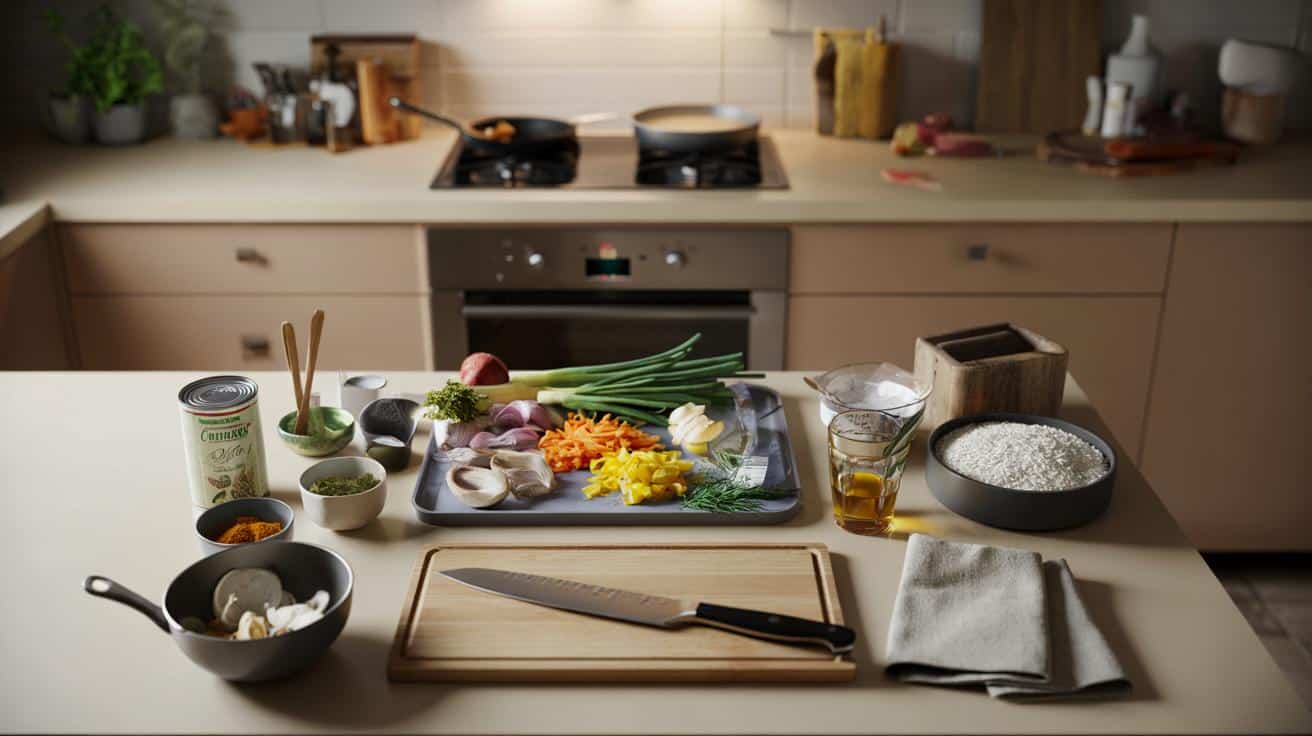
There’s this tiny moment in every kitchen when things quietly flip from calm to chaos. You open the fridge, pull out three ingredients, drop a cutting board somewhere, your phone lights up with a message, and suddenly a simple pasta night turns into a battlefield of sticky spoons and open packages. You didn’t plan a complicated recipe. You just wanted to eat.
Then you look around and the countertop has disappeared under onion skins, splashes of sauce, and that mysterious puddle near the sink.
The funny thing is, that tipping point is almost always the same.
And it comes down to one simple habit most people skip.
The one habit that decides if your kitchen stays calm or explodes
Watch someone who cooks a lot, really watch them. There’s a detail that separates them from the rest of us: they don’t start cooking the second they enter the kitchen. They pause. They clear a little space. They lay things out.
The simple habit that prevents unnecessary chaos while cooking has a quiet name: **mise en place**.
It sounds fancy, almost chef-like, but at home it’s incredibly basic.
Before the heat goes on, everything is out, portioned, washed, chopped, and waiting.
Not during the recipe. Before.
Imagine you want to cook a quick vegetable curry after work. You’re hungry, tired, scrolling through the recipe on your phone. Without mise en place, you turn on the pan immediately, toss in oil, start slicing onions while the oil smokes, dig through cupboards for spices with half a carrot in your hand, answer a WhatsApp message, and by the time you come back, the onions are black and you already feel behind.
Same recipe, same you, different habit. This time, you start with a cold pan. You chop the onion, garlic, carrot and pepper first. You line up the spices in small bowls, open the coconut milk, measure the rice. Only when everything is ready do you turn on the heat. The whole dish feels strangely slower, yet it finishes earlier. And your counter doesn’t look like a food crime scene.
Because that’s what mise en place really changes: timing. Cooking chaos isn’t just about mess, it’s about stress. The pan asks for your attention, the knife asks for your attention, the boiling pot screams for your attention. When ingredients are prepped and waiting, there’s only one “voice” speaking to you at a time.
Kitchens get wild when you’re trying to chop, search and rescue something from the fridge while something else is already burning. With this one habit, the whole drama disappears before it can even start.
*You’re no longer chasing the recipe; the recipe finally follows you.*
How to do mise en place without feeling like a TV chef
At home, mise en place doesn’t have to look like a cooking show with twenty perfect glass bowls. It starts with a simple rule: no heat before prep. For one evening, try this experiment. Do not turn on the stove or oven until every ingredient is out, washed, cut and measured.
Lay a clean kitchen towel or tray as your “stage”. On it, group everything you’ll use. Vegetables cut, spices measured with a teaspoon, liquids already opened. Knife and cutting board rinsed, trash bowl ready for peels. Only then, fire.
➡️ So erkennen Sie ob Ihre Heizung wirklich effizient arbeitet einfacher 2 Minuten Test
➡️ Ihre Lieblingsfarbe sagt viel über Ihre Persönlichkeit aus laut Psychologie
➡️ Dieses LIDL-Angebot für 23,73 € ist schon jetzt unser Küchen-Liebling des Jahres
➡️ Diese kleine Veränderung beim Kochen verbessert die Geschmacksentfaltung spürbar
➡️ Menschen, die beschäftigt wirken, aber wenig schaffen, folgen oft diesem Muster
Many people think this adds time, so they skip it. The reality is, most of us already waste that time in small panicked trips between fridge, drawer and sink. The mess grows because tasks overlap and your brain jumps between them.
A gentle warning here: the first few times, you’ll probably forget an ingredient. That’s normal. You’ll turn on the heat, feel proud, then remember the salt or the herbs still sitting in the fridge door. Don’t see that as failure, just as a clear signal of where your habit needs adjusting. Let’s be honest: nobody really does this every single day. The goal isn’t perfection, it’s a little less chaos every week.
“Since I started doing mise en place at home, I don’t cook faster, I cook calmer,” a friend told me recently. “The funny part is, my sink is no longer overflowing by the time I sit down to eat.”
- Prep with a “trash bowl” on the counter so peels and scraps don’t spread everywhere.
- Use any small cups, mugs or jars for ingredients, you don’t need matching bowls.
- Keep one damp cloth and one dry one nearby: one for quick wipes, one for hands.
- Group ingredients by step: what goes into the pan first, what comes later.
- Leave 20% of your counter completely empty as your “working runway”.
When one small ritual changes how your whole kitchen feels
Once you get used to this tiny ritual before cooking, something subtle happens in your kitchen. The place that used to feel like a daily battlefield becomes a bit more like a studio. You arrive, you set up, you breathe, then you start.
The sink fills less quickly. Your cutting board travels less. Your hands know where the salt is without searching three drawers. You still make a mess, of course, but it’s a controlled, almost friendly one. And you finish cooking with enough energy left to actually enjoy what you’ve made, instead of staring at the chaos wondering how such a simple meal managed to explode across four square meters of countertop.
We’ve all been there, that moment when you promise yourself you’ll “get more organized next time”. This one habit is that promise, translated into a physical gesture. It’s not glamorous. It won’t go viral on TikTok. Yet it quietly changes the way your evenings feel.
Maybe your next recipe doesn’t need new ingredients or a better pan. Just five extra minutes before the heat goes on – and a kitchen that finally stays on your side.
| Key point | Detail | Value for the reader |
|---|---|---|
| Mise en place before heat | Prep and lay out all ingredients before turning on stove or oven | Less stress, fewer burnt pans, smoother cooking flow |
| Dedicated prep “stage” | Use a towel or tray to gather everything you’ll need | Reduces clutter, keeps the counter visually clear |
| Simple support tools | Trash bowl, two cloths, small cups for ingredients | Minimizes mess and clean-up time after the meal |
FAQ:
- Question 1Do I really need mise en place for very simple meals?
- Question 2How long should good mise en place take for a weekday dinner?
- Question 3What if I don’t have enough bowls for all my ingredients?
- Question 4Can mise en place help when I cook with kids or guests around?
- Question 5How do I stick to this habit when I’m exhausted after work?