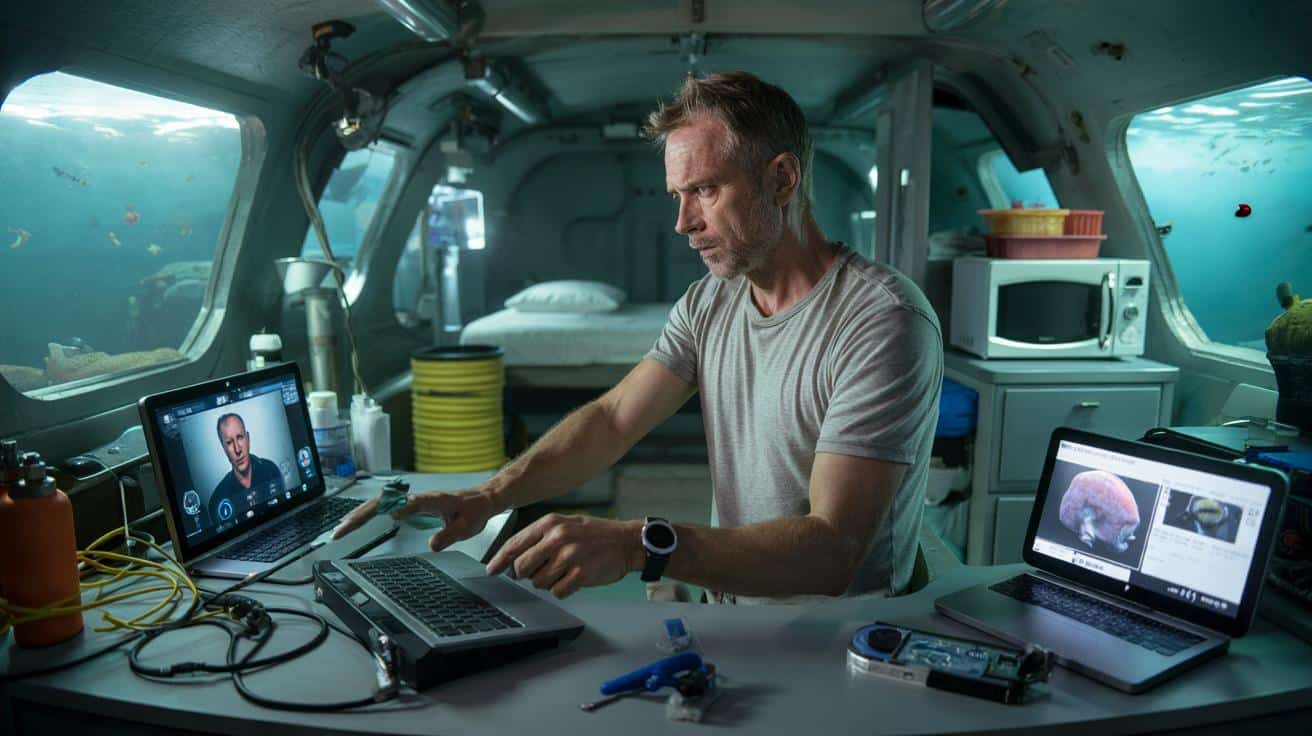
Far from the surface, this scientist is pushing his body and mind in a sealed underwater habitat, chasing data, not glory.
The man who chose to live underwater
The record-breaking researcher is Joseph Dituri, a scientist and professor at the University of South Florida, better known online as “Dr Deep Sea”.
Based in Key Largo, Florida, he has committed to spending 100 consecutive days living beneath the surface at a depth of around 10 metres, without returning to normal atmospheric pressure.
His temporary home is the Jules’ Undersea Lodge, an unusual underwater hotel built in a lagoon. Guests normally scuba dive down to their rooms for a night or two. Dituri has turned the same space into a long-term science lab and living pod.
After 74 days in this pressurised chamber, Dituri broke the world record for the longest continuous stay underwater without depressurisation.
The previous record, set by Tennessee professors Bruce Cantrell and Jessica Fain, stood at 73 days, 2 hours and 34 minutes, also in the same lodge. Dituri has already pushed past that mark, and he plans to remain submerged for a full 100 days as part of his mission, “Project Neptune 100”.
Why spend 100 days underwater?
Dituri’s project is not just about endurance. His main goal is to understand how long-term exposure to elevated pressure affects the human body and mind.
As a retired US Navy officer with a background in saturation diving and deep-sea work, he is using his unusual experiment to gather data that could benefit future divers, submariners, and even astronauts.
He sees the underwater habitat as a test bed for living in extreme environments, similar in spirit to missions on the International Space Station.
➡️ Wenn Sie dazu neigen, Kleidung auf dem Stuhl zu stapeln, erklärt die Psychologie warum
➡️ Eine Familie teilt, wie sie mit Holzresten eine Kinderrutsche baut, sicher und robust
➡️ Diese Routine hilft, Finanzen zu ordnen, indem du Listen fühlst, nicht liest
The scientific questions behind the mission
Researchers involved in Project Neptune 100 are monitoring several aspects of Dituri’s health and behaviour, including:
- Cardiovascular function under prolonged pressure
- Sleep quality and circadian rhythm without direct sunlight
- Cognitive performance and memory under isolation
- Mood, stress levels and psychological resilience
- Changes in vision, breathing and immune response
He undergoes regular tests, such as blood pressure readings, blood analyses, cognitive assessments, and psychological questionnaires. Some of these are done remotely with doctors on the surface, using telemedicine tools.
In addition, Dituri is interested in how increased pressure and slightly higher oxygen levels may influence ageing, inflammation, and brain health. The underwater habitat functions as a kind of low-level hyperbaric environment, which may have subtle physiological effects.
A strict routine under the sea
To last 100 days in a 9-metre-deep capsule, Dituri relies on a carefully designed daily routine. The structure of his day keeps both his body and mind engaged.
Life inside the Jules’ Undersea Lodge
The lodge itself is compact, more like a small caravan than a luxury suite. Space is tight, air is recycled, and there are no windows with sweeping ocean views, just portholes looking out into the greenish water of the lagoon.
Within that space, Dituri follows a schedule that balances research, education, physical training and rest:
| Time of day | Main activities |
|---|---|
| Morning | Medical checks, data logging, light exercise |
| Midday | Remote teaching sessions with students, scientific work |
| Afternoon | Experiments, writing, communication with surface team |
| Evening | Strength and mobility training, reading, rest |
He sticks to a high-protein diet built around salmon and eggs, with all food heated in a microwave. No open flames are allowed in the pressurised habitat, so cooking options are limited.
Exercise sessions mostly consist of push-ups, resistance band training and bodyweight moves. These help counter the tendency to lose muscle strength when living in a confined, low-activity environment.
He also schedules one-hour naps to manage fatigue and keep his mood stable, especially on days when the psychological load feels heavier.
Teaching thousands of students from below the surface
Despite his isolation, Dituri is far from cut off. A major part of his mission is educational outreach.
From his small underwater desk, he connects with classrooms around the world via video calls. During his first 74 days, he has already spoken to more than 2,500 students, sharing stories about marine science, physics, and the realities of life in an extreme environment.
The underwater lab acts as a live classroom, turning a remote lagoon into a global science lesson.
Teachers use his mission to talk about topics such as pressure, buoyancy, oxygen, mental health and climate change. For children, seeing a real person living underwater adds vivid context that textbooks rarely provide.
“Peopling the oceans” – a long-term vision
Dituri often says that he wants to “people the oceans”, not in a science-fiction sense of underwater cities tomorrow, but as a long-range vision of humans living closer to the seas they depend on.
He argues that more permanent or semi-permanent underwater stations could help researchers track coral health, pollution and changing marine ecosystems. They could also act as training grounds for future deep-sea missions or offshore energy workers.
From his perspective, living underwater is a way of demonstrating that humans can inhabit extreme coastal environments while still caring for them.
Benefits and risks of prolonged underwater living
Staying under pressure for months is not risk-free. Potential issues include sinus problems, changes in lung function, and increased strain on the cardiovascular system. Psychological effects such as loneliness, irritability or sleep disruption are also concerns.
On the positive side, controlled hyperbaric conditions may promote better oxygenation of tissues, support healing, and influence certain neurological conditions. Long missions like Dituri’s give scientists rare opportunities to examine these trade-offs in detail.
What “without depressurisation” really means
For casual scuba divers, an underwater stay usually ends with a slow rise to the surface and, sometimes, decompression stops. Dituri’s situation is different.
The cabin where he lives is pressurised to match the pressure at nearly 10 metres of depth. He remains under that pressure full time. He does not return to normal surface pressure at night or between tasks.
Only when he completes the 100-day mission will he go through a controlled process to bring the pressure in the habitat back to surface level. That shift must be carefully managed to avoid decompression sickness, often called “the bends”.
This approach resembles saturation diving, used in the offshore industry, where workers live in pressurised chambers for weeks and are decompressed only once at the end of a rotation.
What this means for future extreme missions
Experiments like Project Neptune 100 echo challenges faced in other tough environments, especially space. Astronauts also live in cramped habitats, follow strict routines, and undergo constant scientific monitoring.
Lessons from Dituri’s mission may influence the design of underwater laboratories, submarine operations and even Mars training simulations on Earth. Data on long-term isolation, pressure, sleep disruption and telemedicine feed into broader research on human performance in hostile settings.
For anyone considering a career in marine science or engineering, his experience offers a concrete example of how far fieldwork can go. It is not just about boats and shorelines; sometimes the job means living inside the ocean itself, trading sunlight for science, at least for a hundred days.