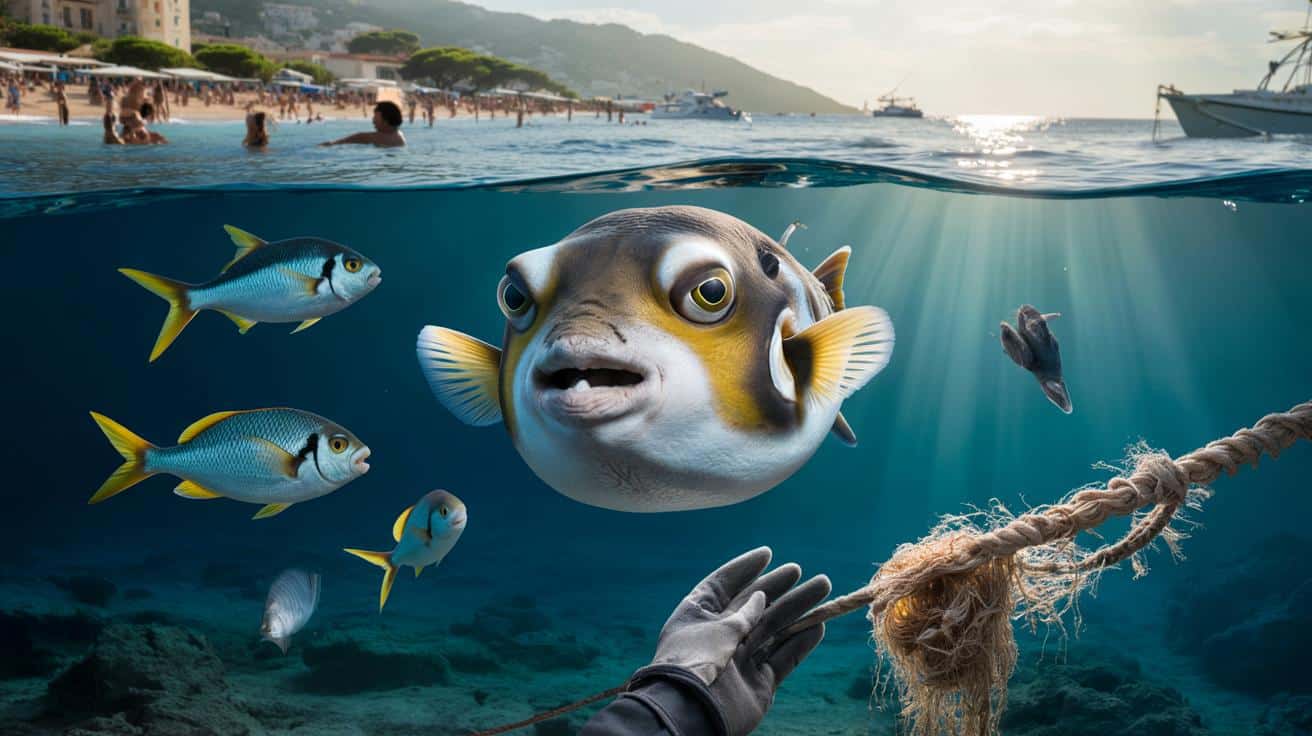
Once considered a distant tropical oddity, a highly toxic pufferfish has now settled in European waters, raising safety concerns for swimmers, fishers and fragile sea ecosystems already pushed to the limit by warming seas and pollution.
A deadly visitor with a deceptively cute face
The species at the centre of growing concern is Lagocephalus sceleratus, often called the silver-cheeked pufferfish. At first glance it looks almost cartoonish, with big eyes and a rounded body. Yet behind that innocent appearance lies one of the most poisonous fish known to science.
Croatian researchers from the Juraj Dobrila University of Pula and the Institute of Oceanography and Fisheries in Split have confirmed its presence in the Mediterranean, adding fresh data to a worrying trend that has been unfolding for nearly two decades.
The same fish that fascinates divers in the Indian and Pacific oceans is now turning into a public safety issue on crowded European beaches.
This species is native to tropical and subtropical waters of the Indian and Pacific oceans. It is not supposed to be a regular inhabitant of the Mediterranean. Yet repeated observations show it is not just passing through. It is settling, spreading and changing the rules of the game for native marine life.
A neurotoxic fish that can kill within hours
What makes Lagocephalus sceleratus so dangerous is not its size or its teeth, although those are problematic as well. The real threat lies in its chemistry.
The fish contains tetrodotoxin, a powerful neurotoxin concentrated in its organs and sometimes in its flesh. Tetrodotoxin is the same substance that makes the Japanese delicacy fugu so risky to eat. In the wrong dose, it blocks nerve signals and can stop a person from breathing.
- Onset: symptoms can appear within 30 minutes of ingestion
- Early signs: tingling around the mouth and fingertips, nausea, dizziness
- Progression: muscle weakness, difficulty speaking, loss of coordination
- Severe stage: paralysis of breathing muscles, cardiac irregularities, possible death
There is no widely available antidote to tetrodotoxin; treatment mostly relies on rapid hospital care and life support while the toxin is cleared by the body.
For coastal communities unfamiliar with this fish, the danger is obvious. A toxic animal that resembles other edible species can easily end up in a frying pan or on a restaurant plate. In regions where people are encouraged to eat invasive fish to reduce their numbers, that confusion can be deadly.
➡️ Diese einfache Regel beim Online-Einkauf verhindert spontane Fehlkäufe
➡️ Das Geheimnis des Imkers, um Honig das ganze Jahr über flüssig zu halten
➡️ Die 10 Gemüse, die Nässe besser wegstecken und trotz Regen reiche Ernten liefern
➡️ Wie Sie mit einem DIY-Regal für Parfums das Badezimmer luxuriöser und funktional gestalten
➡️ Ich verwende kein Reinigungsmittel mehr – dieses Getränk lässt Glas glänzen wie neu
➡️ Laut Psychologie machen glückliche Menschen diese 5 Dinge völlig anders
A bite strong enough to sever fingers
The silver-cheeked pufferfish has another hidden weapon: its jaws. Like many pufferfish, it has a beak-like mouth formed from fused teeth. That beak can crush shells and crabs with ease.
Reports from the eastern Mediterranean describe serious injuries to fishers who tried to unhook the animal with bare hands. In some cases, bites have led to partial loss of fingers. For anyone handling fishing gear, grab-lines or nets, this is no trivial threat.
From the Suez Canal to European beaches
The question troubling scientists is how this tropical species reached the Mediterranean in the first place. The answer, they say, lies in a man-made corridor: the Suez Canal.
Since the canal linked the Red Sea and the Mediterranean in the 19th century, hundreds of so-called “Lessepsian migrants” have made the journey north, riding currents and taking advantage of warmer water driven by climate change.
| Key fact | Details |
|---|---|
| First Mediterranean record | Early 2000s, following migration via the Suez Canal |
| Current range | From Turkey and Egypt to Tunisia and the French coast near Narbonne |
| Main drivers | Warmer water, lack of predators, high reproductive rate |
| Primary concerns | Human poisoning, injuries, ecological disruption, economic losses for fisheries |
Since its first confirmed sightings in the Mediterranean around 2003, the silver-cheeked pufferfish has expanded rapidly. It has been recorded along the coasts of Turkey, Egypt, Israel, Lebanon, Cyprus, Greece, Tunisia and more recently in the western basin, including off southern France.
Scientists describe the species as “invasive” not only because it is new to the region, but because it spreads fast and disrupts local food webs.
Why experts are so worried about its spread
Ecologists see several red flags in the biology of Lagocephalus sceleratus. It reproduces efficiently, tolerates a range of conditions and has very few natural enemies in the Mediterranean. Predators that might eat it risk being poisoned themselves.
The fish also competes with local species for food. It feeds on crustaceans, molluscs and smaller fish that already face pressure from overfishing and habitat loss. Every new mouth added to this competition can tip the balance further against native species.
For commercial fisheries, this invasion adds a headache. Pufferfish can damage nets with their teeth, ruin catches by tearing into valuable fish and scare consumers away if they start appearing on market stalls.
Researchers such as Croatian marine biologist Neven Iveša argue that coastal authorities need to act before the problem becomes unmanageable, calling for coordinated monitoring, rapid reporting of new sightings and clear rules for handling the fish safely.
What coastal communities are being told to do
Some Mediterranean countries have already issued guidance for fishers and the public. The key messages are surprisingly practical, and they focus on harm reduction rather than eradication, which is seen as unrealistic at this stage.
- Do not eat unfamiliar pufferfish, even if others claim they know how to prepare it
- Use gloves and tools when removing fish from hooks or nets
- Report catches or sightings to local fisheries offices or marine institutes
- Keep the fish away from pets and children on beaches or piers
- Seek medical help immediately for any suspected poisoning
A single mistake in identification or preparation can turn a cheap family meal into a medical emergency.
How tetrodotoxin actually works in the body
For many, tetrodotoxin is a mysterious word associated with exotic food scandals. In medical terms, it is a sodium channel blocker. That means it stops nerve cells from sending electrical signals.
When someone eats contaminated fish, the toxin reaches the bloodstream and begins binding to these channels on nerve endings. Signals from the brain no longer reach the muscles properly. The person may stay fully conscious while their body gradually stops responding.
This mismatch between clear thinking and growing paralysis is one reason poisoning cases are so distressing. Without rapid intensive care, including assisted ventilation, the risk of death rises sharply.
Climate change and invasive species: a dangerous mix
The spread of the silver-cheeked pufferfish is not an isolated story. Warmer Mediterranean waters have opened doors for many species previously confined to hotter seas. Canals, shipping routes and aquaculture all provide pathways.
Scientists increasingly use the region as a living laboratory to study how marine ecosystems respond to overlapping stresses: heatwaves, acidification, plastic pollution and now invasive predators and competitors. The arrival of a highly poisonous fish is one more piece in a complex climate-era puzzle.
What beachgoers and seafood lovers need to know
For holidaymakers and local residents, the idea of a deadly fish in familiar waters sounds dramatic. In practice, risk varies a lot by region and activity. Swimmers are not in direct danger from the toxin unless they attempt to handle or provoke the fish. The greater concern lies with fishing, spearfishing and unregulated seafood consumption.
A practical rule of thumb for consumers is simple: buy from trusted fishmongers who can identify species correctly, and avoid eating unknown fish offered informally on beaches or from small, unlabelled stalls. In some countries, sale of pufferfish is outright banned except under strict licensing.
For anglers and spearfishers, awareness matters even more. A fish that looks unusual, with a rounded body and the ability to inflate when threatened, should trigger caution. Cutting lines, using pliers and keeping hands away from the mouth may feel excessive, but they can prevent painful injuries.
As the Mediterranean changes, knowing what lives in it becomes part of basic coastal safety, much like checking the flag for rip currents or jellyfish alerts.
The rise of Lagocephalus sceleratus shows how a single species can raise questions that go far beyond biology: from food safety and healthcare readiness to cross-border cooperation and long-term adaptation to a warmer, more connected sea.