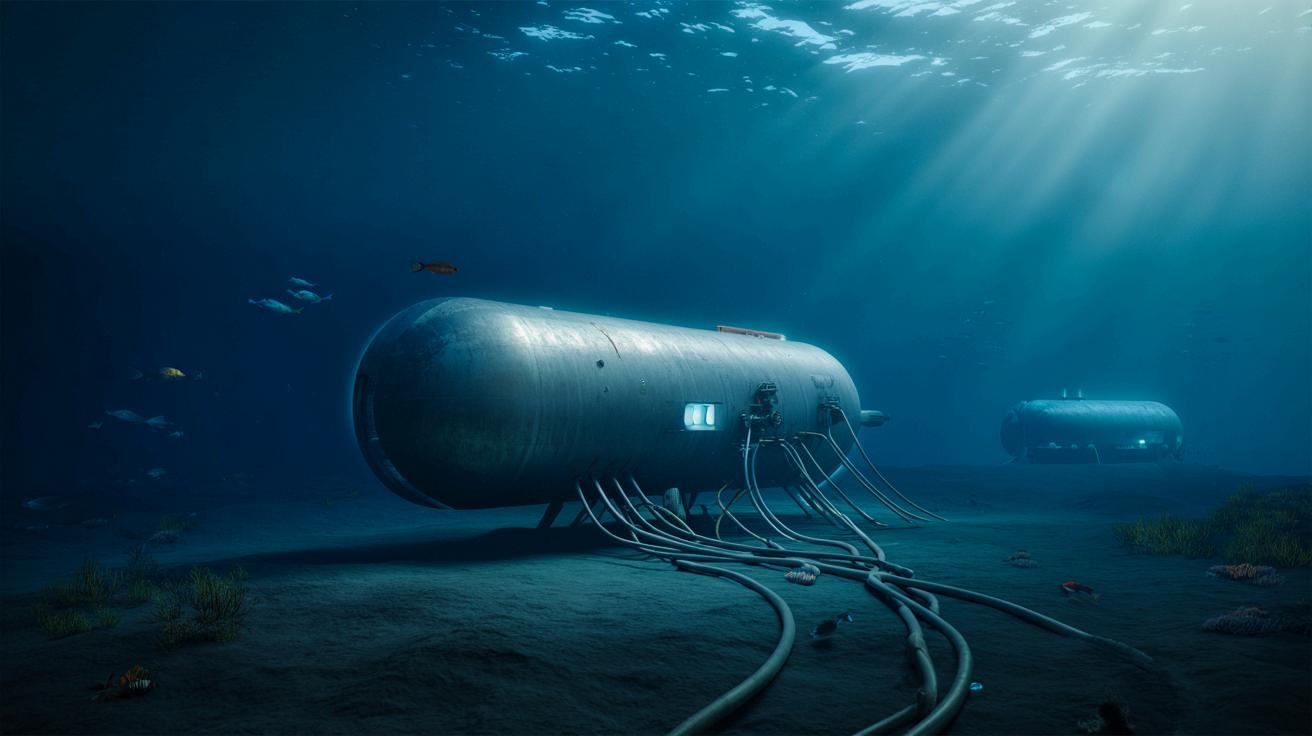
While most of us rang in 2026 on dry land, a Norwegian coastal town is preparing for something far more unusual: a full-scale factory hiding on the seabed, built not to drill for oil or gas, but to turn saltwater into fresh, drinkable water.
A desalination plant that lives underwater
The project, called Flocean One, is billed as the world’s first fully sub-sea desalination plant. Instead of sitting on valuable shoreline, it will operate between 300 and 600 metres below the surface, off the coast of Mongstad in western Norway.
From the outside, the unit looks more like an industrial submarine than a traditional water facility: a large, metal capsule anchored to the seabed, connected by pipes and cables to the shore.
Flocean One aims to use the natural pressure of the deep ocean to produce fresh water with far less energy and infrastructure than conventional plants.
The first commercial unit is scheduled to come online in 2026. The concept has already caught global attention: US magazine TIME listed Flocean among the best inventions of 2025, making it one of the rare water projects to break into a rankings list usually dominated by gadgets and AI tools.
Turning the ocean from obstacle into ally
Traditional desalination plants fight against physics. They pump huge volumes of seawater from the coast, filter out sand and organic material, then use high-pressure pumps to force water through fine membranes. That process, called reverse osmosis, is energy-hungry and expensive.
Flocean’s engineers flipped the logic. Instead of building powerful pumps, they went looking for pressure that already exists in nature.
Using deep-sea pressure instead of giant pumps
At several hundred metres below the surface, seawater is naturally under intense pressure. That pressure is strong enough to push water through reverse-osmosis membranes without the need for industrial-scale compressors.
By placing the plant in that zone, the system lets the ocean do the hard work. Electricity is still needed to control the membranes, operate valves and bring the fresh water back to shore, but the most energy-intensive stage is dramatically reduced.
➡️ In Bulgarien könnte ein rätselhafter Fels im Wald die älteste Sternenkarte der Geschichte sein
➡️ Wie Sie mit einem DIY-Regal für Waschmittel die Wäschekammer funktional und stilvoll gestalten
➡️ Trainieren im Freien: Mit einem Baum effektiv Arme und Schultern stärken
According to the company’s data, energy use can drop by roughly a third to half compared with a typical land-based desalination plant.
The location also brings another hidden advantage. At 300 to 600 metres, sunlight no longer reaches the water. Without light, algae and many bacteria struggle to grow, so the incoming seawater contains far fewer organic impurities. That means less pre-treatment, fewer chemical additives and less maintenance for filters.
A modular capsule that “breathes” like a whale
Flocean One is designed as a self-contained, modular capsule. A single unit targets a daily output of around 1,000 cubic metres of fresh water. That’s modest by the standards of the largest Middle Eastern plants, but the system is conceived to scale horizontally.
Multiple capsules can be grouped on the seabed and connected like batteries. A cluster of units could ramp capacity up to around 50,000 cubic metres per day, enough to cover the needs of a mid-sized city or a large industrial site.
- Single unit: around 1,000 m³ of fresh water per day
- Multi-unit park: up to 50,000 m³ per day
- Estimated coverage: about 37,500 people per capsule
Instead of municipalities buying and running the equipment, Flocean follows a “Build-Own-Operate” model. The company installs and maintains the capsules and sells the produced water as a service. For local authorities, that reduces upfront capital costs and the risk of running complex offshore technology.
A response to rising global water stress
The timing is no accident. The UN warns that by 2030, global demand for fresh water could exceed available resources by about 40 percent. Population growth, irrigation, industry and shrinking aquifers all contribute to a growing structural gap, not just occasional droughts.
Desalination has long been seen as a way to close that gap, but the current generation of plants poses challenges: high electricity use, large coastal footprints, noise and brine discharges that can harm marine life near shore.
Flocean claims up to eight times lower capital expenditure per cubic metre, a 95 percent reduction in land use and less need for heavy pre-treatment infrastructure compared with conventional coastal facilities.
Crucially, the dense salty brine left after desalination is not discharged in shallow bays, where it tends to suffocate marine ecosystems. Instead, waste streams are managed in deeper waters, away from fragile coastal habitats and without chemical additives, according to the project’s technical brief.
What one underwater capsule can actually supply
The numbers put the idea into perspective. Based on typical per-person consumption used in planning models, each capsule could supply drinking and basic household water for around 37,500 people. Ten such units, arranged in a subsea field, would cover the daily needs of roughly 350,000 residents.
For many island nations, coastal cities or tourist hubs that swell dramatically in summer, that kind of flexible capacity is attractive. Units can be added over time as demand rises, without years of battles over building on beaches or protected dunes.
Norway first, but eyes on the Mediterranean and beyond
The first full-scale plant will sit off the municipality of Alver, near Mongstad, a region better known for oil infrastructure. Local authorities plan to plug Flocean’s output into the existing drinking-water network once the system is fully tested.
International interest is already forming. The technology has attracted investment from Xylem, a major US-based water technology group, with joint work aimed at industrial-scale deployment. Project scouting is under way in the Mediterranean, the Red Sea, the Indian Ocean, the Caribbean and Pacific islands.
| Aspect | Flocean-type plant |
|---|---|
| Location | 300–600 m below sea level, offshore |
| Land footprint | Very small shore station only |
| Energy needs | Reduced by 30–50% vs classic reverse osmosis plants |
| Investment model | Service-based (Build-Own-Operate) |
| Main risk factors | Offshore operations, deep-sea maintenance, regulatory approvals |
Promises, risks and unanswered questions
The idea of using deep-sea pressure is elegant, but it comes with challenges. Installation and maintenance at 600 metres require specialised vessels, remotely operated vehicles and skilled offshore crews. Storms and changing currents may affect cables and moorings, even if the capsules themselves sit far below the waves.
Regulators will also want reassurance. While brine is released far from beaches, its long-term effect on deep ecosystems still needs careful monitoring. Even small temperature or salinity shifts can affect species that live in these dark, stable environments.
If this model scales, future water security could depend not only on reservoirs and rivers, but on silent facilities fixed to the seabed.
Energy sources matter as well. Norway can feed these units with relatively low-carbon electricity from hydropower and wind. In regions that still rely heavily on coal or oil for power, desalination of any kind risks pushing emissions up unless paired with renewable generation.
What “reverse osmosis” really means in plain language
Reverse osmosis sounds complex, but the principle is simple. Imagine a very fine sieve that only lets water molecules through, blocking salt and other minerals. If you push seawater hard enough through that sieve, you get fresh water on the other side and a concentrated salty mix left behind.
On land, machines supply that push using electric pumps. In Flocean’s design, the ocean’s own pressure provides much of the force, which is why depth matters so much. The deeper the capsule, the stronger the natural push across the membrane.
How this could change real-life situations by 2035
Picture a medium-sized Mediterranean island in the mid-2030s. Its tourism sector has bounced back, summers are longer and hotter, local reservoirs are struggling. Instead of building a huge, noisy facility on the shoreline, the island government signs a 20-year contract for five underwater units a few kilometres offshore.
On land, residents mainly see a small operations building, some pipes and a substation. Out at sea, shipping lanes are adjusted, but swimmers and fishermen barely notice. Underwater, a group of capsules quietly convert seawater into a reliable, predictable stream of potable water, scaled up or down according to seasonal needs.
If the Norwegian pilot performs as planned, this type of scenario will no longer sit in the realm of science fiction. It could become one piece in a broader toolkit that includes smarter irrigation, water reuse and better leak management in ageing networks.
For now, all eyes in the water sector are on that quiet stretch of seafloor off Mongstad, where the first industrial test of deep-ocean desalination is about to show whether the sea can help solve one of humanity’s most pressing resource questions.