Scientists have been wrestling for more than a century and a half with the fossils of these ancient giants, trying to work out what kind of life could have stood taller than a house in a world where plants barely brushed the ankles.
Strange towers on a treeless Earth
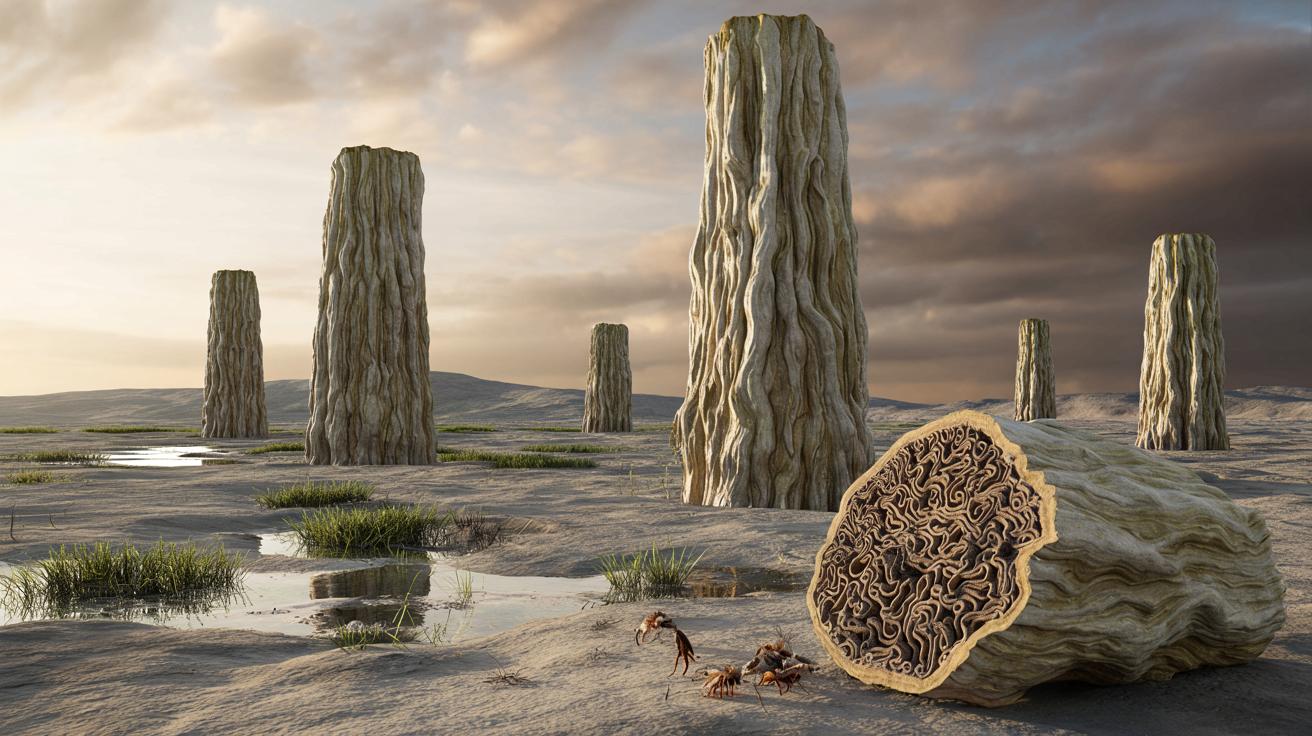
Roll the clock back some 400 million years, to the Devonian period. Continents looked harsh and almost empty. The first small plants hugged the ground, forming low mats and tufts around streams and swamps. There were no forests, no flowers, no birds, no dinosaurs. Above this modest green carpet rose bizarre vertical columns, some more than 7.5 metres tall.
These were Prototaxites, huge structures that looked, at first glance, like tree trunks driven into a mostly barren landscape. They were first described in 1843, and by 1859 they had a name that suggested a link to conifers: “primitive yew”. That label did not survive long.
Prototaxites looked like a tree, behaved like something else, and fits neatly into none of today’s major life groups.
Paleobotanists quickly realised they were not dealing with an early tree. The fossils showed no leaves, no branches, and none of the regular internal patterns seen in primitive wood. Instead, cut surfaces revealed a speckled, tube-filled interior unlike any familiar plant.
Inside a fossil that defies categories
Modern imaging and chemical analysis have given researchers a sharper view of these ancient giants. Thin slices of fossil show a network of microscopic tubes that criss-cross and ramify. At first, these tubes tempted scientists down the fungal route: they recalled fungal hyphae, the microscopic threads that make up a mushroom’s body.
A new wave of research, including a detailed study in Science Advances, has shaken that idea. When scientists compared Prototaxites with true fossil fungi from the same rock layers, they found key differences that are hard to ignore.
- The tubes in Prototaxites branch in a disordered, almost chaotic pattern.
- Fungal filaments typically show more organised, directional growth.
- No reliable trace of chitin, the hallmark compound in fungal cell walls, turned up in Prototaxites samples.
- Chitin was preserved in other fungi at the same sites, suggesting it would have survived if it had been present.
The fossil lacks chitin, the structural material that gives mushrooms and moulds their rigidity, even though neighbouring fossil fungi still show it.
This mismatch leaves researchers with two main options: either Prototaxites was an exceptionally odd fungus that broke most of the rules, or it belonged to a separate branch of life that no longer has any living representatives.
➡️ France set to triple its renewable power capacity and chase Europe’s top tier by 2035
➡️ Eine Studie zeigt: Warum Tiere ihren Nachwuchs fressen – und damit paradoxerweise ihre Art sichern
➡️ Your heating is set to 19°C or 20°C but you’re still cold? Why that’s normal and what you should do
➡️ Warum diese alltägliche gewohnheit mehr über deine gesundheit verrät als jeder ärztliche check
➡️ Wie Sie mit kaltem Wasser Ihre Kopfhaut beleben und die Poren für bessere Pflege öffnen
Neither plant nor fungus – maybe something else entirely
When biologists talk about kingdoms of life – animals, plants, fungi, and various groups of microbes – they assume that nearly every fossil can be slotted somewhere in that framework. Prototaxites stubbornly resists that neat filing system.
Some scientists suggest it might represent a “ghost lineage”: a major branch that flourished early in Earth’s history and then vanished without leaving clear descendants. Others keep the door open for a fungal identity, but one that would sit on a dead-end branch far from any mushroom or mould we know today.
What makes the debate so intense is that Prototaxites was not a trivial organism. It dominated the landscape. In many early Devonian sites, these towers were the tallest structures on land by a wide margin.
In a time when most plants were ankle-high, Prototaxites stood like solitary pillars across floodplains and marshy ground.
How did these giants live?
Earlier studies of the carbon isotopes inside Prototaxites hinted at a lifestyle similar to modern decomposers. The chemical signatures varied widely, as though the organism had fed on many different sources of organic matter. That pattern fits better with a heterotroph – something that eats existing organic material – than with a photosynthetic plant making its own food from sunlight and air.
If Prototaxites did feed on dead material, it may have played a role a bit like today’s large fungi, breaking down early soils and primitive plant remains. Yet the scale is puzzling. Why would a decomposer need to grow several metres high in a world with so little competition for space and light?
| Feature | Typical plant | Typical fungus | Prototaxites |
|---|---|---|---|
| Main food source | Sunlight via photosynthesis | Dead or living organic matter | Signals point to organic matter |
| Key wall material | Cellulose | Chitin | No clear match to either |
| Growth form | Roots, stems, leaves | Hyphal threads, fruiting bodies | Massive vertical column of tangled tubes |
| Role in ecosystem | Primary producer | Decomposer, symbiont, parasite | Likely major decomposer, details uncertain |
A lost ecosystem engineer
Whatever its precise identity, Prototaxites shaped early land ecosystems. By standing tall, it may have trapped wind-blown spores and dust, altering how nutrients moved across the landscape. Its decaying bodies would have added organic matter back into young soils, influencing the chemistry of streams and wetlands.
Its presence also raises questions about the animals of the time. Small arthropods – distant relatives of insects and spiders – were among the earliest land animals. Some might have grazed on the surfaces of these columns or burrowed within them, turning Prototaxites into miniature high-rise habitats in an otherwise low, sparse environment.
These ancient towers probably acted as hubs where moisture, microbes and small animals gathered long before the first forests spread.
How scientists study a life form with no living cousin
Working out what Prototaxites was means combining several lines of evidence, each with its own limits.
- Microscopy: Thin sections under a microscope show the internal networks of tubes and help compare them with known groups.
- Geochemistry: Ratios of carbon and other elements hint at how the organism fed and what environment it lived in.
- Sediment context: The rocks around the fossils reveal whether they grew in place, were transported, or decayed where they fell.
- Ecological modelling: Computer models test whether a decomposer of this size could survive with the limited plant biomass of the Devonian.
Each method narrows the possibilities but has blind spots. Soft tissues rarely survive. Organic molecules degrade over hundreds of millions of years. And there is always the risk of forcing Prototaxites into modern categories that do not really apply.
Terms that help make sense of this mystery
Two scientific ideas often come up in discussions of Prototaxites and are worth unpacking:
Ghost lineage. This is a group of organisms inferred from evolutionary trees and fossil ages, but with no direct fossil record of its early members. In this case, the strange combination of traits in Prototaxites suggests a deep branch of life that left few clear traces before dying out.
Multicellularity. Many organisms are single-celled, but some lineages evolved bodies made of many cooperating cells. Prototaxites shows a high level of organisation for such an early time on land, offering clues about how complex bodies can arise under very different environmental pressures.
Why these ancient giants matter today
Reconstructing organisms like Prototaxites does more than satisfy curiosity. It gives researchers test cases for how life responds when it encounters a new frontier. Early land surfaces were harsh, with strong UV light, limited soils and big temperature swings. Large, strange bodies like these columns show that life does not always take the routes we might expect from looking only at present-day plants and fungi.
Palaeoclimate models also use data from these fossils. By estimating how much carbon a giant decomposer could process, researchers can refine simulations of Devonian carbon cycles. That period saw major shifts in atmospheric oxygen and CO₂, partly driven by the spread of land life. Understanding the role of a tall, widespread decomposer helps tighten those calculations.
For readers interested in practical parallels, soil scientists sometimes look at modern fungi and lichens as rough analogues. These organisms help stabilise bare ground, release nutrients from rock and shape the first thin skin of soil. Prototaxites may have done something similar on a much grander scale, suggesting that when life colonises new terrains – from volcanic islands to, one day, Martian regolith – large, structure-building decomposers could again be key players.
The fossils of Prototaxites sit in museum drawers as slices of mottled stone, yet they point to a phase of Earth’s story when the rules of living on land were still being written. Their towering forms hint that early ecosystems may have been more experimental, and more alien, than the quiet plant carpets many schoolbook illustrations suggest.