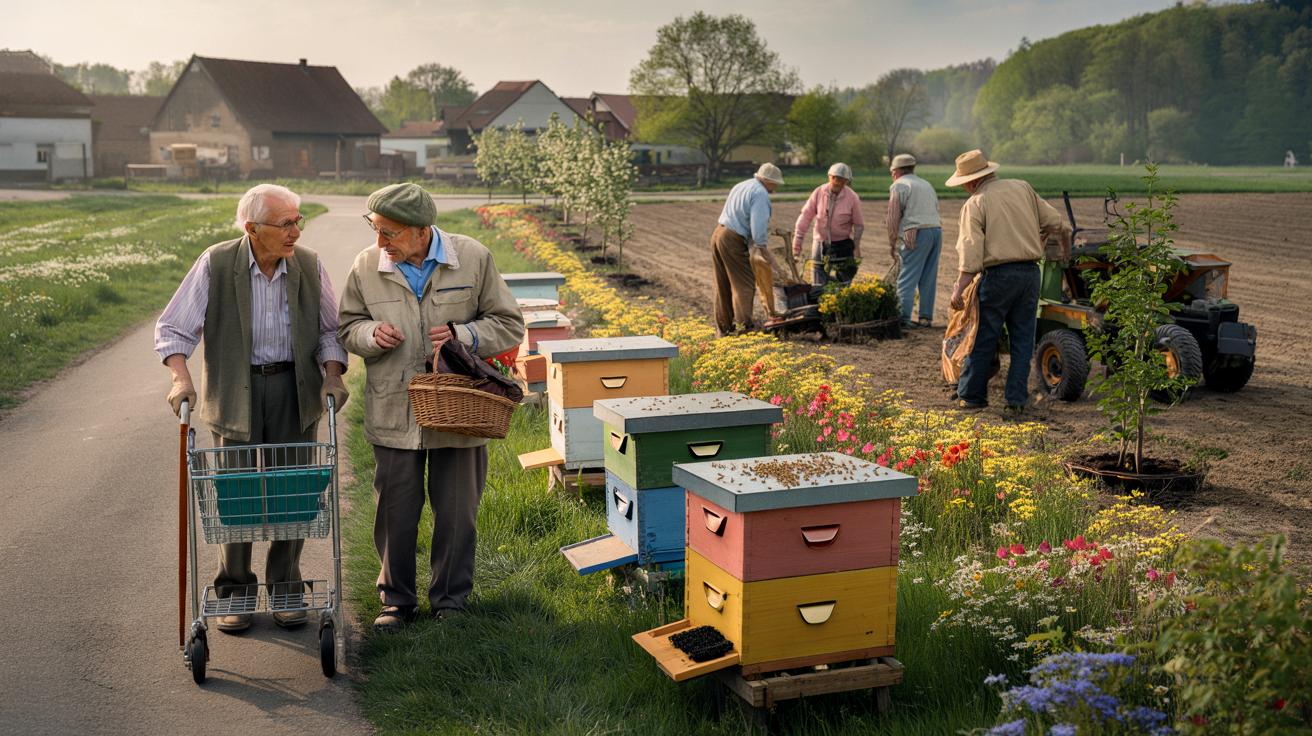
On a Tuesday morning in late spring, the village square smells faintly of coffee and beeswax. On one side, the pensioners lean on their walking sticks and shopping trolleys, eyeing the construction work planned for a new parking lot. On the other side, a handful of hobby beekeepers in faded jackets unload wooden hives from a rattling trailer. The mayor watches, half-interested, half-worried about the upcoming local elections.
A retired electrician grumbles that the soil has become “dead as a plastic bag”. A beekeeper nods, taps a hive, and quietly suggests a swap: fewer cars, more flowers, less noise, more life. Someone laughs, someone shakes their head, and someone pulls out their phone to film.
The argument about three parking spots slowly turns into a conversation about saving the whole landscape.
Almost by accident.
Wenn Bienenstöcke auf Gehstöcke treffen
On the edge of many German villages, a strange alliance is forming. There are the Imker, lugging heavy frames, talking about Tracht und Varroa, and there are the Rentner, who suddenly have time to notice that the swallows don’t come back like they used to. Both groups move slowly, for different reasons, but they look at the same fields.
They see corn deserts where orchards once bloomed. They see hedges ripped out “for efficiency”. They hear fewer birds, fewer insects, more tractors, more silence.
In a small town in Brandenburg, this alliance has a name: “Rentner retten Raps”. The idea started at the bakery queue. A beekeeper complained that his colonies were starving between two short flowering periods. A retired teacher, who remembered the old meadows full of clover, suggested planting strips of flowers along the bike path. By autumn, thirty retirees were collecting seed packets, calling landowners, and knocking on doors.
The result: five kilometers of mixed flower strips and three new community apiaries next to an old sports field.
What sounds romantic is actually brutally pragmatic. Beekeepers need diverse nectar sources across the season. Retirees need meaningful routines, social contact, and a reason to get up and go outside. Farmers need allies when they want to try something different from pure monoculture. Politics tends to react to loud, organized groups.
When these three interests overlap, the countryside starts to shift, field by field.
Wie Rentner und Imker ganz konkret anpacken
The first step is rarely a heroic action. It’s more often a simple walk. A beekeeper invites the local senior group to visit the hives. They come with sunhats, folding stools, and a little skepticism. Then someone opens a hive, the warm, sweet air rises, and suddenly everyone leans in.
From that moment, bees stop being an abstract “species in danger” and become neighbors with a buzzing address.
The second step is what happens after the coffee and cake. Retirees start to tell stories about the fruit trees they had as children, the wild hedges, the field paths where they courted their first love. A beekeeper listens and quietly asks: “Which of those places still exists?” The answer is almost always the same: almost none.
This is where energy appears. Not rage-shouting-on-the-internet energy, but quiet, stubborn village energy that writes letters to the council, negotiates with landowners, and attends those long, boring planning meetings.
The third step is turning memories into ground work. Flower strips along paths, old apple varieties re-planted on community land, unused plots turned into bee gardens. One retiree volunteers to water in dry weeks. Another keeps an eye out for vandalism. A third one, the former accountant, controls the invoices for seeds and tools.
Let’s be honest: nobody really does this every single day.
*But once the first strip of land is blooming, it becomes hard to go back to grey gravel and lifeless grass.*
Was wir alle von dieser Allianz lernen können
One practical method that works in many villages is the “Patenschaft” model. A beekeeper or local nature group identifies small potential spaces: a roadside verge, the edge of a schoolyard, a piece of municipal land behind the sports hall. Then retirees adopt these micro-areas. They don’t need to dig for hours. They remove rubbish, loosen the soil with simple tools, sprinkle regional wildflower seeds, and visit once a week with a watering can.
A dozen of these micro-oases create a continuous buffet for bees and other pollinators.
The biggest mistake is overambition. People start with a massive project, get exhausted, and give up. Or they want instant success, and when the first year’s flowers look a bit patchy, they feel they’ve failed. Nature doesn’t run on our calendars. She takes her time, reshuffles, surprises.
A more forgiving approach: start small, talk often, celebrate tiny wins. The first bumblebee spotted by a grandparent and grandchild can mean more than a perfectly planned concept paper.
“Früher habe ich einfach geschimpft, dass alles kaputt geht,” sagt Horst, 76, ehemaliger Schlosser und frisch gebackener Blühflächen-Pate. “Jetzt pflanze ich eben. Schimpfen allein füttert keine Bienen.”
➡️ Warum ein Spritzer Essig Ihre Kaffeemaschine entkalkt und wie Sie sie für sauberen Kaffee reinigen
➡️ The crousty, new fast-food star: is it really healthier than kebabs or burgers?
- Ein gemeinsamer Spaziergang: Rentner erzählen, wo früher Obstbäume, Hecken, Teiche waren.
- Eine simple Karte des Dorfes: markierte Orte, an denen Mini-Blühflächen realistisch sind.
- Ein Kalender im Gemeindehaus: Wer gießt wann? Wer spricht mit welchem Landwirt?
- Ein Imkertelefon: Eine Nummer, unter der jemand Fragen zu Bienen, Pflanzen, Giftstoffen beantwortet.
- Ein jährliches “Honig & Geschichten”-Treffen: Verkostung, Fotos der Blühflächen, neue Ideen.
Wenn das Land wieder atmet
At some point, a quiet tipping point arrives. The conversation in the village pub changes. People complain less about “die da oben” and talk more about “unser Streifen am Feldrand”. The beekeeper who was once seen as a slightly eccentric guy with weird hats becomes a local expert. The pensioner who used to sit alone by the window now coordinates watering schedules through a handwritten notice on the supermarket board.
No one has “saved the planet”. Yet the air vibrates a little differently.
Children begin to associate summer with the hum of insects again, not just with tablets and traffic noise. Farmers notice that the angry letters reduce when they leave a bit of space for wildflowers. The mayor suddenly has a positive story to tell in the regional press. Retirees feel needed. Beekeepers feel heard. The soil, which had become just a brown surface, slowly regains depth, smell, and surprise.
This is not nostalgia. It’s a careful reboot of a broken relationship between people and land.
Every village, every small town has its own version of this story waiting in the wings. Somewhere there is a retiree with time and memories, and an Imker with buzzing boxes and worries for the next drought. When these two sit at the same table, with coffee stains and seed catalogues between them, the map of the countryside begins to change.
The question is not whether they can save the land completely. The question is how long we want to watch it fade before we pull on our walking shoes and join them.
| Key point | Detail | Value for the reader |
|---|---|---|
| Lokale Bündnisse | Imker und Rentner verknüpfen Erfahrung, Zeit und Fachwissen | Zeigt, wie man im eigenen Umfeld aktiv werden kann |
| Mini-Blühflächen | Kleine, gut betreute Flächen statt riesiger, überfordernder Projekte | Macht Naturschutz alltagstauglich und überschaubar |
| Emotion & Routine | Erinnerungen der Älteren werden zu konkreten wöchentlichen Aufgaben | Verbindet Sinn, Gemeinschaft und messbare Effekte |
FAQ:
- Wie finde ich Imker in meiner Nähe?Frag im örtlichen Bauernladen, im Rathaus oder bei regionalen Imkervereinen; viele haben heute Webseiten oder Facebook-Gruppen.
- Können Rentner körperlich solche Projekte stemmen?Ja, wenn die Aufgaben klein geschnitten sind: Gießen, Dokumentieren, Sprechen mit Nachbarn, statt schwerer Erdarbeiten.
- Stören Bienenstöcke die Nachbarn?In der Regel nicht, wenn Standorte klug gewählt werden und die Nachbarschaft informiert und einbezogen wird.
- Braucht man viele Flächen, um etwas zu bewirken?Dutzende kleiner Blühinseln entlang von Wegen und Gärten sind oft wirkungsvoller als eine große, vernachlässigte Fläche.
- Was, wenn die Gemeinde kein Interesse zeigt?Starte auf Privatgrund, dokumentiere Erfolge mit Fotos und Beobachtungen, und geh dann mit konkreten Ergebnissen auf die Gemeinde zu.