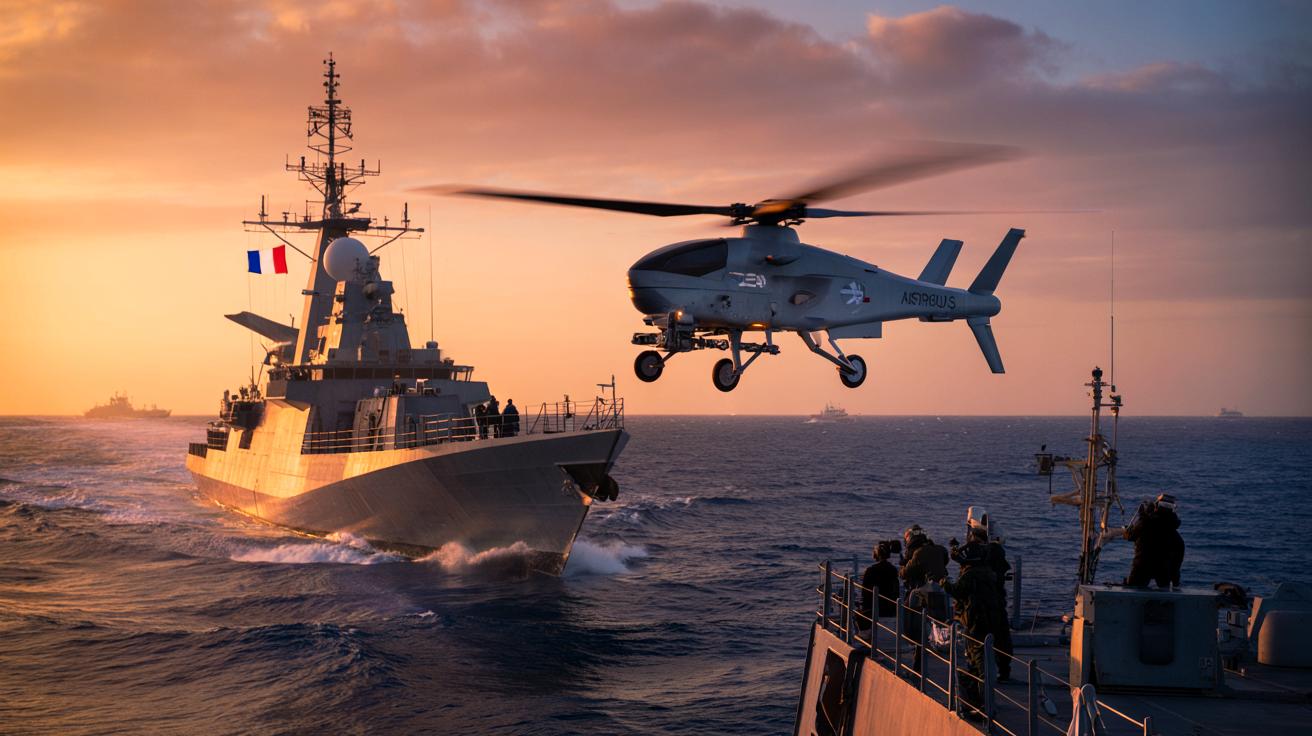
Far from flashy airshows and public ceremonies, France has just locked in a decision that shifts its navy from cautious observer to early adopter in a tightly watched segment of military technology: shipborne rotary-wing drones designed as true extensions of warships, not just gadgets bolted on the deck.
France’s discreet leap into naval drone leadership
On 14 January 2026, at Airbus Helicopters’ site in Marignane, France’s defence procurement agency (DGA) awarded a production contract for six VSR700 unmanned aerial systems to Airbus Helicopters and Naval Group.
The French Navy will be the first customer in the world to field this new type of drone as an operational capability, with the first systems slated to enter service from 2028.
France is moving from latecomer to reference customer by becoming the launch navy for the VSR700, a naval drone designed from day one as part of the ship rather than a bolt-on asset.
Six systems might sound modest, but for the programme it marks the shift from prototype to series production. It gives the navy enough platforms to run real missions, develop tactics and gather years of feedback at sea.
What makes the VSR700 different
A drone built as an extra “sensor mast” for frigates
The version ordered by France is dedicated to ISR: intelligence, surveillance and reconnaissance. In practice, the drone will act as a high-end sensor platform that flies far beyond the ship’s own radar horizon.
Each VSR700 system will be able to carry a suite of equipment tailored to maritime missions:
- Maritime surveillance radar to detect contacts well beyond visual and radar range of the host ship
- Electro‑optical/infrared turret for day and night identification of vessels, small craft or coastal activity
- AIS receiver to intercept and analyse automatic identification system signals from civilian ships
Naval Group will integrate the drone fully into the ship’s combat architecture, via its Steeris Mission System. That means the VSR700 will appear in the combat management system like any other core sensor.
Onboard, the VSR700 will be treated less like a visiting aircraft and more like another radar or sonar node plugged directly into the combat system.
➡️ This Boeing 737 looks like no other you’ve ever seen – it’s been rebuilt for Canada’s Arctic
➡️ “Uninhabitable by 2100”: the countries condemned by extreme rainfall
➡️ So schützen Sie Ihren Bart mit natürlichen Ölen und vermeiden Reizungen beim Styling
➡️ Blutzuckerspiegel optimieren: Dieser simple Trick mit Apfelessig vor dem Essen wirkt wahre Wunder
➡️ Laut Psychologie zeigen Menschen mit tiefem Selbstwert diese kleinen aber klaren Zeichen
Data from the drone’s radar or cameras should feed in real time to operators, who can fuse it with information from other sensors and weapons. That integration is exactly where many rival systems have struggled.
Not replacing the helicopter, extending it
France is not ditching its crewed naval helicopters. The VSR700 is meant to complement them, not knock them out of the sky.
Armed helicopters will keep their toughest jobs: anti-submarine warfare, boarding operations support, medical evacuation or rapid insertion of special forces. The drone steps in where endurance and patience matter more than complex manoeuvres.
- VSR700: long endurance surveillance, wide-area patrol, persistent monitoring of a suspicious vessel
- Crewed helicopter: intervention, weapon delivery, hoisting, complex coordination with boarding teams
Airbus has already demonstrated manned‑unmanned teaming between the VSR700 and crewed helicopters through its “HTeaming” concept. In simple terms, the drone can scout ahead or monitor flanks while the crewed helicopter focuses on tactical decisions.
From civilian airframe to hardened naval system
A proven light helicopter as starting point
Unlike some clean-sheet drones, the VSR700 is based on an existing civilian platform: the Cabri G2, a light helicopter designed by French firm Hélicoptères Guimbal.
Using a certified airframe cuts technical risk. The Cabri is well known for its stability and safety in training roles. Airbus and Naval Group then adapted it heavily for military and naval needs under the French SDAM (Système de Drone Aérien pour la Marine) programme.
That adaptation involved corrosion protection, shipboard landing capability, automatic take-off and landing routines, and a new mission system capable of handling sensitive sensors and secure datalinks.
Starting from a proven civilian helicopter allowed engineers to focus energy on autonomy, integration and military resilience rather than reinventing basic flight characteristics.
Extensive trials pushed the system near its operational limits before the green light for series production, something defence officials stressed as key to avoiding nasty surprises once at sea.
Industrial challenge: from prototype to repeatable production
Building one or two demonstrators is one thing. Producing a series of military drones with consistent quality and robust certification is another.
For the VSR700, Airbus Helicopters has set up a dedicated industrial organisation tailored to unmanned systems. The aim is to achieve repeatable production, cyber‑secure software baselines and room for rapid upgrades.
In the drone market, many ambitious concepts stall at the demonstrator stage. France’s order pushes the VSR700 into the small club of systems that actually reach navy decks in numbers.
A multi-mission platform with civilian and export potential
Beyond spy missions: logistics and disaster relief
While the first French VSR700s are optimised for ISR, the architecture remains multi‑role. With other payloads or kits, the drone could handle a broader set of tasks:
- Light logistics between ships or from shore, carrying urgent spare parts, medical supplies or documents
- Armed reconnaissance, if future customers request weapons or electronic warfare pods
- Civil uses: wildfire observation over remote terrain, post‑disaster damage assessment, or wide-area search for missing boats
This flexibility matters for export. Many navies cannot afford a dedicated helicopter on every ship, but still want an embarked aerial capability. A modular drone that can shift from security patrols to humanitarian missions raises its appeal.
Who is watching, who is buying
As of early 2026, France is the only country to have placed a firm order for the VSR700. That alone makes the French Navy a reference user that others will watch closely.
Several foreign navies have already evaluated or observed the drone in trials or demonstrations:
| Country / organisation | Status | Use case or context |
| France – French Navy | Firm order (6 systems) | Shipborne ISR, SDAM programme |
| United Kingdom – Royal Navy | Operational trials | Evaluation of shipborne rotary drone |
| Italy – navy | Interest / study phase | Capability studies for naval ISR |
| Spain – navy | Interest / observation | Maritime surveillance options |
| Potential export clients | Preliminary talks | Naval ISR, logistics, multi‑mission roles |
France’s order acts as a trigger: it provides a real reference case, with ships, crews and operational reports, rather than isolated test flights.
A crowded but narrow market of naval rotary drones
Four main families of competitors
The market for shipborne rotary‑wing drones is highly specialised. Drones must cope with pitching decks, salty air, strong winds and tight hangar spaces. Only a handful of systems have reached operational maturity.
Key players today include:
- Schiebel Camcopter S‑100 (Austria) – The most widely exported, with around 300 units sold to roughly twenty navies, but limited payload and more modest integration with heavy combat systems.
- Northrop Grumman MQ‑8 Fire Scout (USA) – Based on a Schweizer helicopter, capable and well-armed but relatively heavy and expensive, which led to a cutback in US Navy use.
- Rotary UAV Panther (Israel Aerospace Industries) – Focused on ISR and special operations, with limited numbers outside state‑to‑state partnerships.
- Chinese VTOL naval drones – Several designs exist, but details, export track records and NATO‑equivalent operational references are scarce.
The VSR700 aims for a middle ground: more capable and better integrated than light drones like the S‑100, lighter and cheaper than heavyweight systems such as Fire Scout.
For Western navies, the key is not just flight performance but deep, cyber‑secure integration into modern frigates’ combat systems. Many drones can technically land on a deck; far fewer can be treated as native sensors and effectors.
What this shift means for naval operations
A new daily routine for French crews from 2028
From 2028, crews on selected French warships will have to adapt to having an extra virtual crewmember permanently on call.
A typical scenario could look like this: a frigate receives an alert about suspicious activity near a busy shipping lane. Instead of dispatching its only crewed helicopter, the command launches the VSR700. The drone flies low and slow, quietly mapping traffic, zooming in on vessels that switch off their AIS or alter course oddly.
If a contact turns threatening, the ship can then send its armed helicopter, already briefed with fresh imagery and radar tracks from the drone. That cuts reaction times and reduces risk to human crews.
Key terms and real-world risks
Two acronyms will appear often around this programme:
- ISR (intelligence, surveillance, reconnaissance) – A broad label for gathering information, whether through radar, cameras, signals interception or other sensors, usually ahead of a possible crisis.
- VTOL (vertical take‑off and landing) – The ability to take off and land vertically, crucial for operations from small warship decks without a runway.
The spread of such drones is not risk‑free. They depend on secure datalinks that can be jammed or spoofed. They add complexity to already busy flight decks. And they raise questions around rules of engagement when sensors are far from human eyes.
On the other hand, they sharply reduce the need to send people into harm’s way just to “go and look”. When combined thoughtfully with crewed helicopters, satellites and surface patrols, naval drones like the VSR700 can change how a navy monitors vast sea areas, especially for missions short of open conflict such as counter‑piracy, sanctions enforcement or search and rescue.