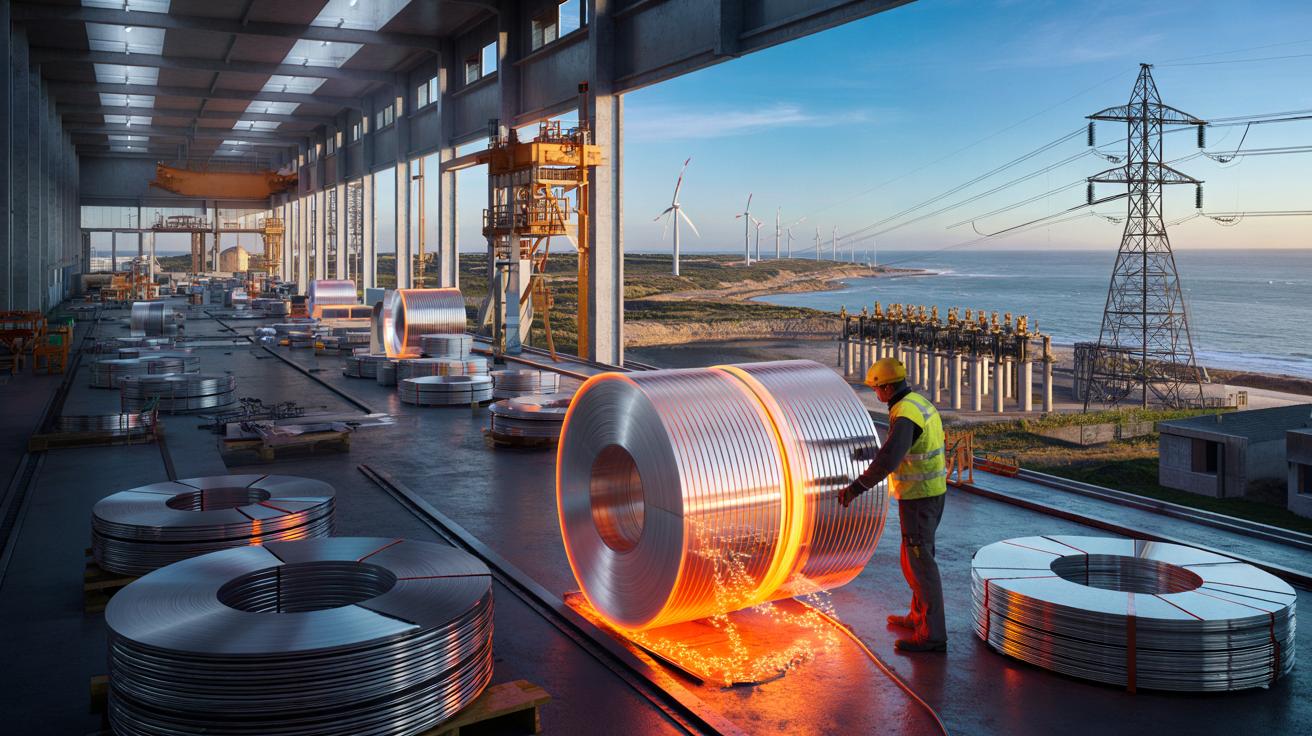
On an industrial strip near Dunkirk, a long-familiar steel site is being quietly retooled for an electric future.
In the coastal town of Mardyck, in northern France, steel giant ArcelorMittal is pouring hundreds of millions into a factory that will not make beams or car chassis, but something far thinner and more strategic: electrical steel for the motors and transformers of a decarbonised Europe.
A €500 million bet on the next big materials race
ArcelorMittal has launched a new electrical steel production line in Mardyck, near Dunkirk, backed by an investment of €500 million. It is the group’s largest industrial commitment in Europe for a decade, and a signal that the battle over the green transition is shifting from finished cars and wind turbines to the metals hidden inside them.
Three production lines are due to be in operation by the end of 2025, rising to five by 2027. From those lines will come ultra-thin, high-performance steel strips that form the metallic core of electric motors and generators made across Europe.
ArcelorMittal is concentrating its entire European output of electrical steel in France, aiming to lock down a critical link in the energy transition supply chain.
The timing is calculated. The global electrical steel market, worth about $38.2 billion (around €32 billion) in 2023, is projected to climb to roughly €57 billion by 2032. ArcelorMittal wants a bigger slice of that growth, closer to its European customers and less exposed to Asian competitors.
From blast furnaces to magnetic cores
A reshaped European steel giant
ArcelorMittal itself is the product of earlier waves of consolidation. Born in 2006 from the merger of Arcelor and India’s Mittal Steel, the group became the world’s largest steelmaker, headquartered in Luxembourg and operating from legacy sites stretching from the old blast furnaces of Lorraine to coastal plants like Dunkirk.
Since then it has weathered brutal market cycles, successive restructurings and the rise of Chinese behemoths such as China Baowu, which overtook it in crude steel output in 2020. The Mardyck investment reflects a pivot: less dependence on commodity steel, more focus on specialised products tied to electrification and energy efficiency.
What electrical steel actually is
Electrical steel looks nothing like the chunky girders people typically associate with steelworks. It comes in very thin, carefully treated strips, engineered to guide magnetic fields while keeping energy losses low.
These strips are stacked by the hundreds or thousands to form the stators and rotors inside electric motors, or the cores of transformers and generators. If the steel is poor quality, motors heat up, transformers waste power and wind turbines lose efficiency.
➡️ This simple move with your rugs before winter boosts warmth and cuts energy bills
➡️ Stop letting fog ruin your commute: the surprising trick to keep your windscreen clear all winter
➡️ Besser als Nivea Diese Anti Falten Creme von Action überzeugt im Labortest
➡️ Warum du dich ruhiger fühlst, wenn du langsamer isst
➡️ Wie Sie erkennen, ob Sie jemandem helfen wollen oder nur Anerkennung suchen
➡️ Here are the 5 best spreads according to Yuka so you can indulge without feeling guilty
Without advanced electrical steel, there are no efficient motors, no reliable transformers and no durable wind turbines.
Two physical features matter most: how much energy is lost when magnetic fields flip direction, and how much the metal resists being magnetised sideways. Both depend on chemistry, ultra-precise rolling and heat treatment.
Inside the Mardyck plant: an integrated production chain
Mardyck’s new unit is designed as an integrated line that can take in coils of conventional steel and ship out finished electrical steel tailored to motor and transformer makers.
Three core lines in phase one
The first phase revolves around three key lines:
- a preparation line
- a continuous annealing and coating (varnishing) line
- a slitting line
On the preparation line, incoming coils are cleaned and conditioned. During annealing, the steel is heated in a controlled way to reshape its internal grain structure, giving it the magnetic properties required. The coating step adds a thin insulating varnish so that stacked sheets do not short-circuit each other. Finally, the slitting line slices the strip into precise widths dictated by motor and transformer designs.
The output is a range of grades and thicknesses. For electric cars, sheets typically measure 0.2 to 0.35 millimetres thick. Industrial motors, generators and wind turbines use similar materials, sometimes even thinner for high-end applications.
This new facility complements ArcelorMittal’s existing electrical steel plant in Saint-Chély-d’Apcher in southern France. Together, Mardyck and Saint-Chély should bring the group’s European electrical steel capacity to around 295,000 tonnes a year, all produced in France.
| Site | Product focus | Approximate annual capacity |
|---|---|---|
| Mardyck (Nord) | Electrical steel for EVs, industry, renewables | 155,000 tonnes |
| Saint-Chély-d’Apcher (Lozère) | Specialised electrical steel grades | 140,000 tonnes |
Millions of motors hidden in 155,000 tonnes a year
Once fully ramped up, Mardyck alone is expected to ship around 155,000 tonnes of electrical steel per year. At current prices, that volume could generate between €153 million and €204 million in annual revenue, depending on product mix.
Behind that figure sit millions of electric motors and transformers. The logic is straightforward:
- thinner electrical steel means lower magnetic losses
- lower losses mean higher efficiency
- higher efficiency means better range for electric vehicles and lower operating costs for industrial users
The material acts as a silent efficiency booster. It does not consume energy, but it reduces how much is wasted as heat and stray magnetic fields. For a single car, the gain may look modest. Scaled across entire fleets or industrial sites, the impact on electricity demand is significant.
Electrical steel behaves like a hidden energy policy lever: small improvements in losses translate into large savings on the grid.
A construction project and a jobs story
From old halls to new lines
The Mardyck upgrade has been a sizeable construction project in itself. Up to 400 people worked on it at peak, from design and civil engineering to line installation and testing. Part of the job involved rehabilitating existing industrial halls, while other parts required new buildings and infrastructure.
More than 300 external companies took part, a mix of local subcontractors and specialist equipment suppliers. For ArcelorMittal, the start-up phase is also a test of whether it can deliver complex industrial investments on time in a tight market for skills and equipment.
Training an electrical steel workforce
On the operations side, about 175 people already work on the electrical steel activity across Mardyck and the nearby Dunkirk site, handling production, maintenance, quality, energy management and digital systems. When phase two is completed, around 200 employees should be dedicated to this line of business.
The day-to-day running of the lines is overseen by department head Gaëlle Le Papillon. Teams were built partly from existing staff and partly through external hiring. More than 12,000 hours of training have been delivered, some of it on the long-established Saint-Chély plant, where experienced workers passed on their know-how.
Strategic backing from Paris and a regional ecosystem
The French state is supporting the project with €25 million under the France 2030 programme, which targets industrial capacities deemed strategic for the energy transition. For Paris, ensuring that Europe has domestic supplies of key materials is as much about industrial sovereignty as climate policy.
Mardyck plugs into a broader regional push. The Hauts-de-France region is trying to build a full e-mobility value chain, from battery gigafactories and electric drivetrains to materials like electrical steel. In that puzzle, the Mardyck plant supplies the metallic heart of the motors that carmakers want to assemble locally.
French policymakers see electrical steel as a choke point: without it, building large volumes of electric vehicles in Europe becomes far harder within a decade.
Why grids and “smart” networks are driving demand
Electric vehicles might grab headlines, but they are only part of the story. The projected rise of the electrical steel market to around €57 billion by 2032 is also driven by the modernisation of power grids.
Grid operators are rolling out “smart” infrastructure: transformers that can handle variable flows from wind and solar, digital meters, power electronics and sensors. All of this requires transformers and inductive components made with high-grade electrical steel that can cope with frequent load changes while limiting losses.
As electrification spreads into heating, transport and industry, grids need to carry more power with higher reliability. Physics leaves little room for substitution. Copper can be swapped for aluminium lines in some cases, but the magnetic cores of transformers and motors still rely on specialised steels.
Key concepts behind the Mardyck bet
Understanding losses and efficiency
Three kinds of losses explain why electrical steel matters so much:
- Hysteresis losses: energy lost every time the magnetic field in the steel flips direction.
- Eddy current losses: tiny circulating currents inside the metal that turn electricity into heat.
- Mechanical losses: vibration and noise from magnetically driven forces.
By carefully choosing the alloy, controlling the crystal orientation and making the strips thinner, manufacturers cut those losses. Coatings help too, preventing electrical shortcuts between layers.
A modest percentage point gain in motor or transformer efficiency can, over years of operation, translate into thousands of euros saved on electricity for a single industrial installation, and far more across a city’s grid.
Risks and scenarios for Europe’s materials strategy
There are still risks around the Mardyck project and Europe’s wider strategy. Demand for electric vehicles could slow if subsidies are cut or if charging infrastructure lags. Asian producers might decide to flood the market with cheap electrical steel, squeezing margins.
On the other hand, if policies on heat pumps, electric trucks and data-centre power upgrades tighten, demand for high-grade electrical steel could outpace current capacity, pushing up prices and making local supply even more valuable.
In a high-demand scenario, plants like Mardyck become bottlenecks that determine how fast European grids and vehicle fleets can be upgraded. In a weaker scenario, they still matter as training grounds for skills and as testbeds for more efficient steelmaking technologies that can later migrate to other products.
For local communities, the project shows how a traditional heavy industry site can pivot from basic steel to a more specialised role in the energy transition, keeping industrial jobs alive while quietly shaping how electricity will flow across Europe in the 2030s.