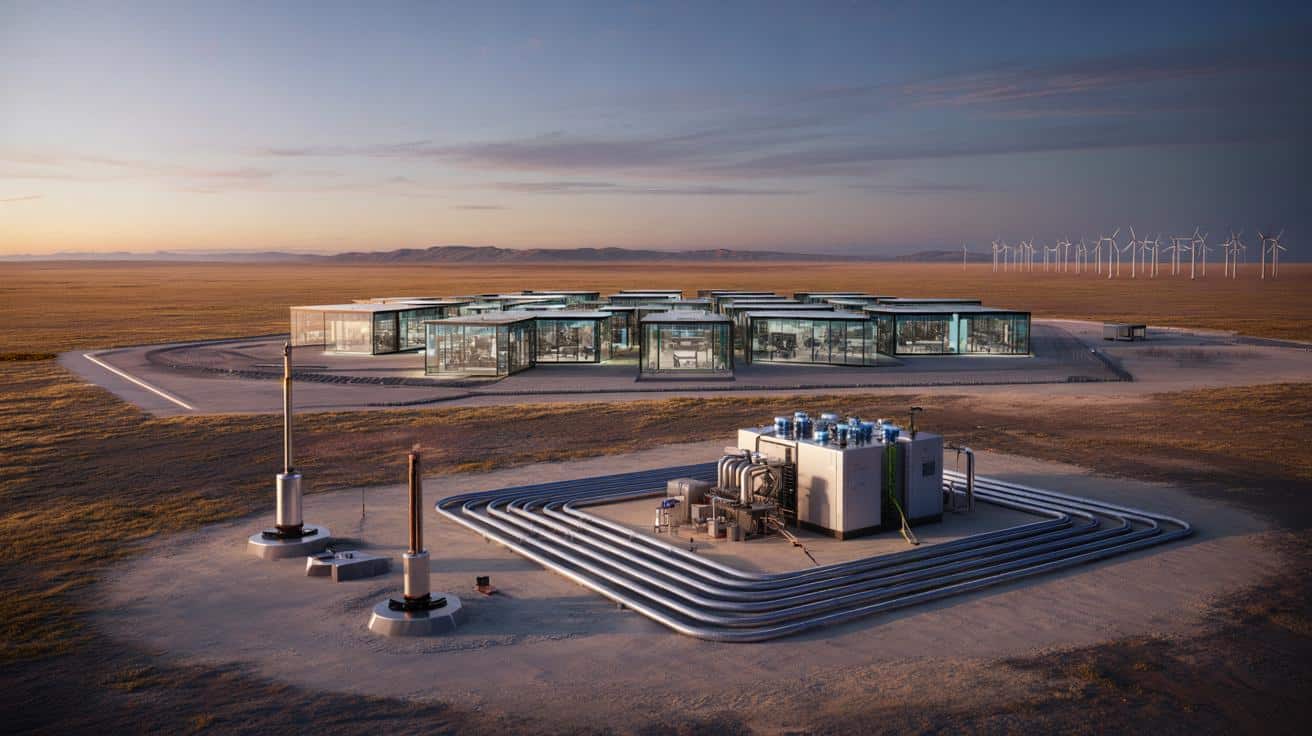
As US data centres scramble for reliable low‑carbon power, a once‑niche technology is suddenly getting serious attention: enhanced geothermal systems, a method that turns ordinary hot rock into a controllable underground boiler.
From volcanic hotspots to engineered heat mines
Traditional geothermal power thrives where the planet’s heat leaks close to the surface. Think Iceland, New Zealand, or parts of California, where steam naturally rises from the ground. Those places are rare, and their capacity is limited.
Most regions sit above hot rock that is much deeper and drier. Too deep to tap cheaply, at least until recently. Enhanced geothermal systems (EGS) attempt to change that equation.
The basic idea looks deceptively simple. Developers drill several kilometres into hot, solid rock. They then fracture that rock in a controlled way and circulate water through the new cracks. The water heats up, returns to the surface, and drives a turbine.
Think of EGS as drilling a giant metal straw into the crust and turning the rock itself into a rechargeable underground radiator.
Because the heat comes from Earth’s interior, not from sunshine or wind patterns, it doesn’t fade at night or during calm days. Once a project is running, the power output can remain steady for years, with only gradual adjustments as the reservoir evolves.
Stanford study: round‑the‑clock power, at fossil‑beating prices
A research team led by Stanford University has put numbers on what this could mean. Their analysis suggests that large‑scale EGS, deployed with modern deep‑drilling techniques, could deliver clean electricity day and night at a cost significantly below fossil fuels.
The study points to potential cost reductions of around 60% compared with conventional gas or coal plants once projects scale and drilling becomes more efficient. That estimate rests on progress already visible in oil and gas fields, where high‑precision drilling and tools such as high‑power lasers or advanced drill bits are slashing time and expense.
Another result stands out. A grid that leans on geothermal for a slice of its power needs fewer wind turbines, solar panels and batteries to stay reliable.
➡️ Warum du nie kalte Milch in heißen Tee gießen solltest, Chemiker erklären warum
➡️ Warum viele Menschen ab 40 plötzlich schlechter schlafen und welche Rolle Hormone dabei spielen
➡️ Warum sich Erinnerungen an Gerüche besonders stark einprägen und sogar Jahrzehnte überdauern können
➡️ Warum Haustiere bestimmte Räume bevorzugen, obwohl die Temperatur gleich ist
The researchers found that supplying around 10% of a country’s electricity from geothermal could cut wind capacity needs by roughly 15%, solar by 12% and battery storage by 28%.
For grid planners wrestling with intermittency, that steady “anchor” source has real value. It reduces the amount of overbuilding needed in solar and wind, and it trims the vast fields of batteries that would otherwise be required to balance supply and demand.
How an enhanced geothermal site actually works
From drill rig to constant power station
An EGS plant starts with one or more deep wells, typically 3,000 to 8,000 metres below the surface. At such depths, rock temperatures can reach 150°C to 300°C even in geologically “boring” regions, simply because the crust behaves like a giant hotplate.
Once the drill reaches the target depth, engineers use high‑pressure fluid injections to create or open fractures in the rock. The aim is to carve out a permeable heat exchanger underground: a network of cracks where water can flow and soak up energy.
Cold or lukewarm water is then pumped down an injection well. It migrates through the fractured rock, heats up, and comes back up through one or more production wells.
At the surface, that hot water or steam passes through a heat exchanger that drives a turbine. Electricity flows to the grid, and the cooled water is re‑injected, closing the loop.
- Depth: 3–8 km below the surface
- Rock temperature: typically 150–300°C
- Operation: 24/7, independent of weather
- Main inputs: drilling, pumps, water, and power electronics
Unlike a wind farm or a solar array, the visual footprint is modest. A handful of wellheads, pipelines, and a power block sit on a compact patch of land. The hot reservoir itself lives entirely out of sight.
Why US data centres are suddenly paying attention
AI’s appetite clashes with grid limits
US data centres, especially those serving artificial intelligence workloads, now run almost non‑stop. Their electricity demand is spiking faster than many utilities expected. In several states, cloud providers are competing with households and factories for grid capacity, and local opposition to new transmission lines is stiff.
Solar and wind help, but their variability forces data centres either to rely heavily on fossil backup or to overbuild renewables and storage. Both options are expensive and politically sensitive.
Geothermal, by contrast, aligns neatly with what these facilities want most: uninterrupted, predictable output, ideally close to the servers themselves.
For a hyperscale data campus in remote Texas or Nevada, a few deep geothermal wells could function like a private baseload plant with zero direct emissions.
Because EGS can, at least in theory, be deployed in many regions that lack natural geysers, tech companies no longer have to cluster only in rare geothermal hotspots. A site near a fibre backbone but far from strong grid infrastructure could still be viable if it sits above sufficient heat at drillable depths.
Smaller surface footprint, fewer local conflicts
Land use has become a flashpoint for renewable projects. Onshore wind faces complaints about views and noise. Large solar fields can stir pushback from farmers and conservation groups.
Stanford’s analysis highlights that an EGS plant needs far less surface area for each unit of electricity it produces compared with wind and solar. Most of the infrastructure fits on a concentrated industrial pad.
For communities nervous about losing agricultural land or open space, that compactness can matter. It also means shorter cabling within the site and fewer maintenance roads cutting through the landscape.
How does geothermal stack up against nuclear?
Nuclear plants set a high bar for firm, low‑carbon electricity. Their thermodynamic efficiency typically sits around 33–37%, rising to roughly 40% for the most advanced designs, thanks to higher operating temperatures and refined steam cycles.
EGS efficiency looks modest by comparison. With rock temperatures between 150°C and 300°C, overall electric efficiency often lands in the 10–23% range. The gap reflects basic thermodynamics: the greater the temperature difference between the heat source and the environment, the better the theoretical efficiency.
That means that for the same amount of heat drawn from the ground, a nuclear plant would convert roughly three times as much energy into electricity.
Yet geothermal offers a different bundle of trade‑offs. It carries no risk of core meltdown. It generates no long‑lived radioactive waste. And construction timelines tend to be measured in years rather than decades.
While a new nuclear reactor can take 12–23 years from planning to connection, a commercial‑scale EGS plant can be drilled, built, and commissioned much faster, with a lower upfront price tag.
Several energy modelers now treat EGS as a credible partner technology. In some scenarios, it partially replaces nuclear build‑out. In others, it reduces pressure on solar, wind and battery storage by providing a flexible, dispatchable base.
Technical hurdles that still need solving
Fractures, earthquakes and reservoir life
EGS remains young. Only a handful of pilot projects worldwide have moved beyond the demonstration phase, and they sometimes run into issues that echo shale gas operations.
Creating fractures in hot rock can trigger small seismic events. Most are too weak to be felt at the surface, but a few European projects have been halted after residents reported shaking. Regulators now demand careful monitoring and traffic‑light systems that shut down injections when seismic readings spike.
The longevity of an engineered reservoir also matters. If water finds shortcuts through large fractures, the rock may cool too quickly, cutting the plant’s life. Engineers are working on better modelling tools and real‑time imaging to steer fracture growth and maintain balanced flow.
Drilling costs and next‑generation tools
The most expensive part of an EGS project usually lies in drilling through kilometres of hard rock. That is where technology transfers from the oil and gas sector make a big difference.
Directional drilling, rotary steerable systems and high‑temperature sensors allow operators to hit precise targets deep underground. Experimental approaches use laser‑assisted drilling or plasma‑based rock breaking to speed progress and reduce bit wear.
Stanford’s team and other researchers suggest that if these methods keep advancing, EGS could achieve broad economic viability around the mid‑2030s. For an energy system that often plans decades ahead, that horizon is not far away.
Key terms that shape the debate
| Term | Meaning |
|---|---|
| Enhanced geothermal system (EGS) | Engineered geothermal plant that creates its own fractures in hot rock to circulate water and extract heat. |
| Baseload power | Electricity that runs steadily 24/7, supporting the minimum level of demand on a grid. |
| Capacity factor | Share of maximum output that a plant actually produces over time; high for geothermal, lower for wind and solar. |
| Carnot efficiency | The theoretical upper limit of efficiency for converting heat into work, based on temperature differences alone. |
These concepts matter for data‑centre operators weighing contracts for the 2030s. A high capacity factor and dependable baseload power give operators confidence that servers can run flat‑out without bouncing between different energy sources.
Scenarios for future US data‑centre hubs
Consider a hypothetical AI campus in the US Midwest. Today, it might draw most of its energy from a mix of gas plants, regional wind farms and some on‑site solar. The operator faces volatile power prices and growing political pressure to reduce emissions.
In a decade, if EGS matures as the Stanford analysis suggests, that same campus could anchor a deal with a geothermal developer. A set of deep wells drilled nearby would provide a fixed block of round‑the‑clock power. Solar on the roofs would still cut daytime peaks, and batteries would smooth short‑term fluctuations, but the site would lean far less on gas.
In another scenario, a coastal data‑centre cluster with limited land could benefit from the compact footprint of geothermal. Rather than spreading solar panels over valuable real estate, operators would concentrate their energy supply on a small pad, leaving most of the area free for buildings and cooling infrastructure.
None of this removes the need for robust transmission or strong efficiency measures in IT hardware. But it changes the menu of credible options on which US and European planners can draw.
Risks, benefits and the bigger energy puzzle
EGS is not a silver bullet. Project failures, seismic concerns, water management and local acceptance can all slow deployment. The technology also competes for skilled drillers and equipment with oil and gas, at least in the near term.
Yet the benefits stand out. No air pollution at the point of generation. Tiny fuel costs once wells are complete. A resource that, on human timescales, can be treated as effectively inexhaustible if reservoirs are designed and managed carefully.
For the United States, where AI data centres and electrification plans are pushing grids to their limits, enhanced geothermal energy offers something unusual: a chance to add flexible, controllable clean power without covering vast landscapes in steel and glass.
The next decade will show whether drilling rigs and deep‑rock physics can carry that promise from scientific studies into the daily reality of servers, homes and factories running on quiet heat from beneath our feet.