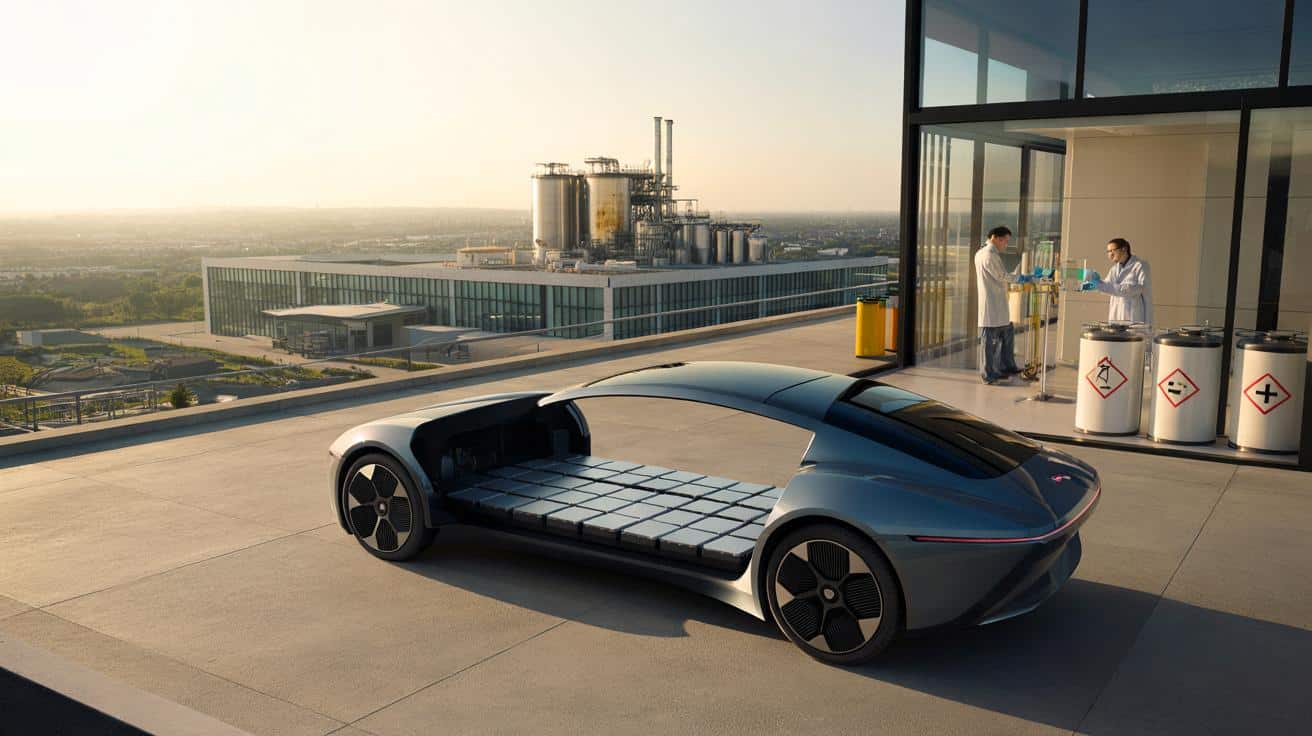
France is backing a little-known battery material that might decide who controls the next generation of EVs. While the headlines focus on gigafactories and lithium mines, a new French-led venture is trying to secure something far more specific – the solid electrolyte that sits at the heart of tomorrow’s all-solid-state batteries.
France’s new move in the battery race
At Rueil-Malmaison, just west of Paris, a company called Argylium has officially launched operations with a very clear target: dominate the European market for sulfide solid electrolytes, often shortened to SSE. These compounds are a core ingredient in all-solid-state batteries, the technology widely seen as the likely successor to today’s lithium-ion packs.
Behind Argylium stands a heavyweight Franco-Belgian alliance. On the French side, Axens and IFP Énergies nouvelles bring ten years of research, industrial know-how and a deep patent portfolio. On the Belgian side, Syensqo, recently spun off from Solvay, contributes decades of chemical and materials expertise.
France wants to lock down a critical piece of the solid-state battery chain, without which mass-market EVs in the 2030s may be unthinkable.
The strategy is simple to express and difficult to execute: become Europe’s reference supplier for sulfide solid electrolytes at industrial scale, while putting French sites at the centre of that value chain.
Why this obscure material matters for future cars
From flammable liquids to solid conductors
Today’s lithium-ion batteries use a liquid electrolyte. This fluid lets lithium ions move between the anode and cathode when you charge or discharge the cell. The problem is straightforward: the liquid is flammable and can react violently in case of shock, puncture or overheating.
Those safety concerns force manufacturers to add separators, complex cooling systems and strict limits on fast-charging, all of which add cost and weight and slow charging speeds.
All-solid-state batteries replace this liquid with a solid material that conducts lithium ions. Among the different families of solid electrolytes, Argylium is betting on so-called “argyrodites”, sulfur-based compounds with promising properties for high-performance EV packs.
- They remove most of the flammable solvent found in classic electrolyte liquids.
- They tolerate higher temperatures and tougher operating conditions.
- They support cell designs with higher energy density – more energy stored for the same weight.
Argylium is aiming for cells around 500 Wh/kg by 2028–2030. Many current EV batteries sit closer to 200–300 Wh/kg. If those targets hold, that could mean either much longer driving range for the same battery weight, or lighter packs for the same range.
➡️ Sophie Adenot: the extraordinary path of France’s next female astronaut
➡️ Weder Kühlbox noch Thermotasche: Lidl bringt die Frische-Erfindung, die diesen Sommer alle wollen
➡️ Warum dein zuhause dich manchmal kränker macht als jede schichtarbeit im großraumbüro
➡️ Warum ein leerer Kalender am Jahresanfang produktiver ist als jede To-do-Liste
➡️ Der präzise Guide zu Grunderwerbsteuer-Entlastungen für Erstkäufer in abkühlenden Märkten
The company also talks about charging times under ten minutes, a psychological and technical barrier that would push electric cars much closer to the refuelling experience of petrol models.
The invisible bottleneck inside solid-state batteries
When carmakers talk about solid-state packs, they usually mention big brands or new factories. What often goes under the radar is the supply of the electrolyte itself. Without a reliable stream of SSE, there is no industrial-scale solid-state battery production.
The companies that can produce sulfide solid electrolytes not by the kilo, but by the tonne, will quietly control a strategic choke point in the EV supply chain.
This is exactly where France wants to place itself. By hosting the first European player capable of manufacturing these materials at meaningful scale, it hopes to gain leverage over future electric vehicle programmes, not just in France but across the continent.
Inside Argylium’s Franco-Belgian machine
A two-headed leadership team
To run the venture, the partners chose a duo with very different but complementary backgrounds.
- Alessandro Chiovato, the new chief executive, is a chemist by training. After more than twenty-five years at Solvay and Syensqo, he knows both the science of advanced materials and the commercial realities of the battery market.
- Valérie Buissette, the technical director, is a materials scientist with a long track record on all-solid-state batteries. Trained at École Polytechnique and ESPCI in Paris, she has spent the last decade moving solid-state concepts out of the lab.
The pair must connect academic research, pilot production and future contracts with carmakers that think in gigawatt-hours per year, not in lab samples.
Two French sites as full-scale testbed
Argylium is already relying on more than fifty experts split across two locations in France, each with a specific role in the roadmap:
- Paris hosts the research centre and so-called “kilo-lab”, where new electrolyte formulations are developed and produced on a kilogram scale.
- La Rochelle, on the Atlantic coast, houses the pilot unit. There, processes are scaled up, equipment is tested and the first pre-industrial batches are made.
The constant back-and-forth between these sites allows quick iterations: a material improved in Paris can be tested in larger quantities in La Rochelle within weeks, not years.
A four-stage plan to dominate Europe
From lab samples to tens of thousands of tonnes
Argylium’s roadmap is structured into four clear phases designed to move from grams to industrial tonnage.
| Phase | Objective | Scale |
|---|---|---|
| 1 – Product & validation | Finalise product range and qualify materials with battery makers | Pilot units, kilos to small tonnes |
| 2 – Raw material security | Secure lithium sulfide and expand pilot capacity | Several tonnes per year |
| 3 – Demonstration plant | Build an industrial demo unit and ship first commercial volumes | Hundreds of tonnes per year |
| 4 – Full industrialisation | Reach large-scale production and license technology | Tens of thousands of tonnes per year |
The second phase highlights a sensitive point: access to lithium sulfide, a key ingredient in sulfide electrolytes. Rather than rely blindly on imports, Argylium plans its own pilot unit dedicated to this material, aligning with the broader French push for supply security.
By the final phase, the model shifts. Instead of building every factory itself, Argylium would supply technology and licenses to partners, particularly battery and automotive players, spreading its process across Europe while keeping intellectual property at home.
Strategic sovereignty: why Paris and Brussels care
Europe does not want another lithium-ion scenario
The strong backing from French and European authorities is not just about high-tech hype. It is driven by concerns over strategic dependence. Today, much of the value in lithium-ion batteries is captured in Asia, especially in China, South Korea and Japan.
Policymakers fear a repeat scenario with solid-state batteries, where European cars end up powered by foreign-designed and foreign-made cells. Supporting Argylium is a way to anchor at least one critical link of the future chain on European soil.
By controlling sulfide electrolyte production from lithium hydroxide to final argyrodite powders, France hopes to reduce both cost and vulnerability to external shocks.
The integrated model, from raw chemical inputs to finished electrolyte, also helps stabilise pricing and timelines for European carmakers planning their 2030 platforms right now.
A market set to explode over the next decade
Billions on the table for solid-state technology
According to figures from Global Market Insights, the global solid-state battery market could jump from about $1.1 billion in 2024 to $17.7 billion in 2034. That implies a near tripling roughly every three years.
Three major demand drivers stand out:
- Electric vehicles, where carmakers are hungry for longer range without heavier packs.
- Consumer electronics, from smartphones to wearables, that need safer, more compact and longer-lasting batteries.
- Stationary storage, pairing with solar and wind farms, which requires batteries that can cycle thousands of times with minimal degradation.
In this context, sulfide solid electrolytes tick several boxes at once: high energy density, improved safety and charging promises in the 10–15 minute window. Europe already accounts for about 22% of the global solid-state market, bolstered by public investments exceeding €1 billion in recent years.
What this means for future European cars
Possible scenarios for the 2030 showroom
If Argylium hits its 500 Wh/kg and sub-10-minute charging targets, a typical European family EV in the early 2030s could look very different:
- A compact hatchback might offer 700–800 km of range instead of 400–450 km today.
- Battery packs could be 30–40% lighter, improving handling and efficiency.
- Fast-charging stops on a motorway could shrink to the time needed for a quick coffee break.
One more subtle effect lies in design freedom. With safer, solid-state cells, carmakers may reduce the amount of passive protection and cooling hardware, freeing space for passengers or cargo and cutting costs in the long run.
Risks and technical hurdles still on the table
The path is far from guaranteed. Sulfide electrolytes can be chemically tricky, especially in contact with moisture, and managing interfaces between solid electrolyte and electrodes remains a major challenge. Scaling from lab batches to hundreds of tonnes without losing performance is another test.
There is also geopolitical risk. As other regions, particularly Asia, push their own solid-state technologies, price pressure could intensify. If public support in Europe weakens, the capital-heavy industrial stages might slow down, leaving the field open to foreign competitors.
For readers less familiar with the jargon, two terms matter here. Energy density describes how much energy a battery can store per unit of weight; higher energy density means longer range for the same mass. Electrolyte is the “highway” inside the battery that lithium ions use to move; replacing a flammable liquid highway with a stable solid one reshapes how the whole system is engineered.
Put together, these choices over a seemingly niche material – sulfide solid electrolyte – could decide where European cars source their most critical components ten years from now, and how much room France gains to negotiate its place in the global EV race.