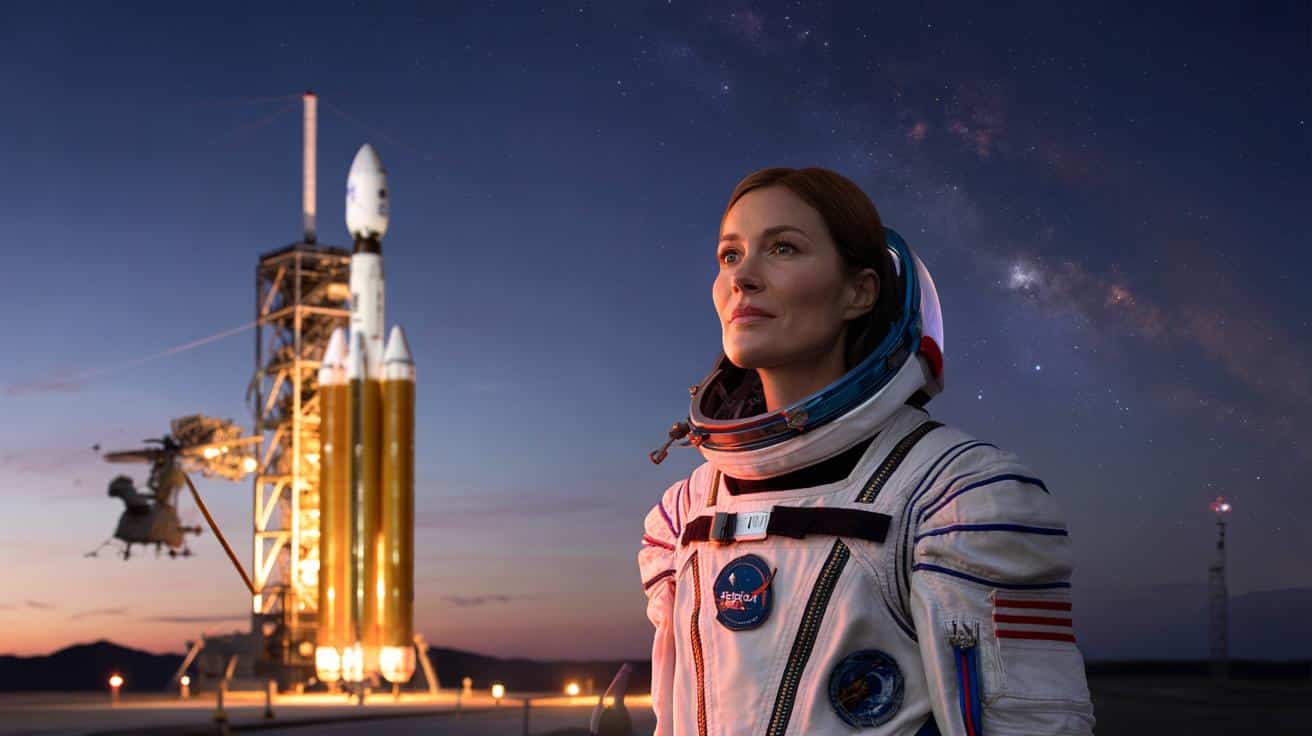
In February 2026, a French Air and Space Force colonel, helicopter test pilot and engineer is due to strap into a SpaceX Crew Dragon capsule bound for the International Space Station. Her name is Sophie Adenot, and her journey says as much about the future of European spaceflight as it does about relentless personal ambition.
A childhood grounded in Burgundy, eyes fixed on the sky
Sophie Adenot was born on 5 July 1982 in Cosne-Cours-sur-Loire, a modest town of around 10,000 people in central France. Her upbringing was solidly middle‑class and anchored in public service. Her mother, a pharmacist who later became head of France’s national digital health agency, and her father, a notary, encouraged academic ambition but did not come from aerospace circles.
Like many astronauts of her generation, her passion began early. Space fascinated her before she could fully grasp the physics behind it. Models of aircraft and rockets, documentaries, and night skies over rural Burgundy quietly shaped her childhood.
The turning point came in 1996, when 14‑year‑old Sophie watched Claudie Haigneré lift off to the Mir space station — proof that a French woman really could go to space.
At the time, Adenot was a pupil at the prestigious Maison d’éducation de la Légion d’honneur in Saint‑Germain‑en‑Laye. Seeing Haigneré become the first French woman in orbit transformed an abstract dream into a concrete project. From that moment, she told herself she would one day follow.
An elite academic route into aerospace
After completing her baccalauréat at the Légion d’honneur high school in Saint‑Denis, she sat the fiercely competitive entrance exams for France’s top engineering schools. In 2001, she was admitted to ISAE‑Supaero in Toulouse, the cradle of many European aerospace leaders.
There, she specialised in flight mechanics and aerospace engineering. By 2003, she held an engineering degree focused on aerospace flight and a private pilot licence. The mix of theory and cockpit time would prove decisive later in her career.
MIT, gravity and the human body
In 2004, Adenot crossed the Atlantic to join the Massachusetts Institute of Technology. At MIT, she dived into a niche yet crucial subject: how the human vestibular system adapts to artificial gravity.
This part of the inner ear, responsible for balance and orientation, is deeply disrupted in weightlessness. Understanding its response to rotating habitats or centrifuges is key for long‑duration spaceflight, including potential missions to Mars.
➡️ The Dutch technique that eliminates moss from your lawn before it even appears
➡️ Why You Really Shouldn’t Air Out Your Home Between 8am and 10am in Winter
➡️ Alte hausmittel feiern ihr comeback und spalten die nation der putzfanatiker
Her research at MIT on artificial gravity and human balance foreshadowed today’s concerns about keeping astronauts healthy on months‑long missions.
She graduated with a Master of Science in aeronautics and astronautics, specialising in human factors, and added a sport parachuting licence to her growing list of qualifications. The combination of laboratory research and high‑adrenaline training is characteristic of her profile: rigorous science, applied in the field.
From Airbus engineer to military officer
Between August 2004 and August 2005, Adenot worked for Airbus Helicopters in Marignane as a cockpit design research engineer. Her role focused on how pilots interact with controls and instruments — a human‑centred approach that would serve her well as both test pilot and astronaut candidate.
She then chose a demanding new path: military aviation. Admitted to the French Air Force Academy in Salon‑de‑Provence as an officer cadet, she began the long process of becoming a military helicopter pilot. This meant mastering complex aircraft, harsh operational conditions and strict chain‑of‑command culture.
A helicopter pilot forged in hostile environments
From 2008 to 2012, Adenot served in the 1/67 “Pyrénées” helicopter squadron, based at Cazaux. The unit specialises in search‑and‑rescue operations and combat recovery, including missions in mountains and other high‑risk terrain.
Missions could involve night flights, rough weather and tight deadlines. Crews had to locate missing pilots or civilians, often in rugged areas where a mistake could be fatal. Such conditions test decision‑making, spatial awareness and composure under pressure.
Search‑and‑rescue missions in mountains demand the same calm, quick thinking and teamwork that ISS crews rely on during in‑orbit emergencies.
From 2012 to 2017, she transferred to the ET 60 squadron at Villacoublay, near Paris. There, she flew government transport missions, carrying the French president and senior officials. These flights brought their own constraints: tight schedules, enhanced security, and an absolute requirement for reliability.
Breaking a barrier as a helicopter test pilot
By 2018, with more than 3,000 flight hours, Adenot reached another landmark. She became the first French woman certified as a helicopter test pilot within the Direction générale de l’armement (DGA), France’s armaments procurement agency.
Test pilots push aircraft to their limits to validate new designs and systems. The job requires deep technical knowledge, precise flying and a strong capacity for risk assessment. Adenot trained at the Empire Test Pilots’ School in the UK, one of the most respected institutions in this high‑risk niche.
- 3,000+ flight hours logged before astronaut selection
- Operational missions in demanding mountain environments
- Government VIP transport pilot at ET 60
- First French woman helicopter test pilot at DGA
In parallel, she progressed through the ranks of the French Air and Space Force, reaching lieutenant colonel in 2021 and then colonel in 2025. Rank brings leadership responsibilities, from managing teams to contributing to strategic decisions.
Joining Europe’s new astronaut generation
On 23 November 2022, the European Space Agency (ESA) unveiled its new astronaut class. Out of more than 22,000 applicants across Europe, just five were selected as career astronauts. Among them: France’s Sophie Adenot.
Her cohort includes Spain’s Pablo Álvarez Fernández, the UK’s Rosemary Coogan, Belgium’s Raphaël Liégeois and Switzerland’s Marco Alain Sieber. Together they form ESA Astronaut Group 4, a generation expected to fly to the ISS, and possibly later to the lunar Gateway as part of the Artemis programme.
Being picked from tens of thousands of candidates positioned Adenot as just the second French woman ever to join ESA’s astronaut corps, three decades after Claudie Haigneré.
Inside ESA’s astronaut training
In April 2023, training began at the European Astronaut Centre in Cologne. The first two years focus on basic skills: systems, survival, science and operations.
Adenot’s programme covers:
| Training area | Objectives |
|---|---|
| Spacecraft and ISS systems | Understand life support, power, communications and fault procedures |
| Robotics | Operate robotic arms for cargo capture and maintenance tasks |
| Science operations | Conduct microgravity experiments in biology, physics and medicine |
| Medical and dental training | Handle basic care and urgent treatment when no doctor is on board |
| Neutral buoyancy and EVA preparation | Practice movements similar to spacewalks in large swimming pools |
Physical conditioning is intense. Hours in a neutral buoyancy pool simulate the sensation of weightlessness. Survival courses prepare crews for emergency landings on land or sea. Language lessons, particularly in Russian and English, ensure fluent communication with international partners.
A 2026 ticket to orbit with SpaceX
ESA has assigned Adenot to a mission to the International Space Station, scheduled around February 2026. She is expected to travel on a SpaceX Crew Dragon spacecraft launched atop a Falcon 9 rocket from Florida.
Dragon missions typically last around six months in orbit. During that time, astronauts live in microgravity, conduct scientific experiments, maintain ISS systems and carry out outreach activities with schools and media on Earth.
If timelines hold, Sophie Adenot will become the next French person in orbit and only the second French woman ever to fly in space.
Her background in flight mechanics, human factors and helicopter operations suggests she may play a key role in on‑board systems monitoring, robotics and possibly European science experiments focused on human physiology.
Terms and concepts behind her mission
Adenot’s studies at MIT centred on the vestibular system, which helps humans sense motion and balance. In weightlessness, this system becomes confused. Astronauts often suffer from “space adaptation syndrome” during their first days in orbit, with nausea and disorientation.
Artificial gravity is one proposed solution. By spinning a spacecraft or a part of it, engineers can create a centrifugal force that mimics gravity. The challenge is to find rotation rates that the inner ear can tolerate without causing motion sickness. Research like Adenot’s helps define feasible designs for future deep‑space missions.
Another term linked to her work is “human factors”. This field studies how people interact with machines and environments. For spaceflight, it covers cockpit layout, alarm design, workload, fatigue, and the way information is displayed. A background in human factors helps astronauts evaluate new procedures, spot potential hazards and give feedback to engineers on the ground.
What her path says about future astronauts
Adenot’s CV illustrates the new baseline for astronaut candidates. No single skill is enough. Modern crews are expected to combine:
- solid scientific or engineering education
- operational experience in high‑risk settings
- leadership in multicultural teams
- physical resilience and strong mental health
Her years in mountains on rescue missions prepared her for life in confined, dangerous environments. Her time as a test pilot trained her to handle anomalies calmly while giving precise technical feedback. Her research experience gives depth to the experiments she will run in orbit.
For young readers dreaming of similar careers, Adenot’s trajectory shows a realistic pattern: choose strong STEM studies, gain hands‑on operational experience — whether in aviation, engineering projects or extreme sports — and build languages and teamwork skills early. ESA’s future astronaut calls are likely to expect nothing less.