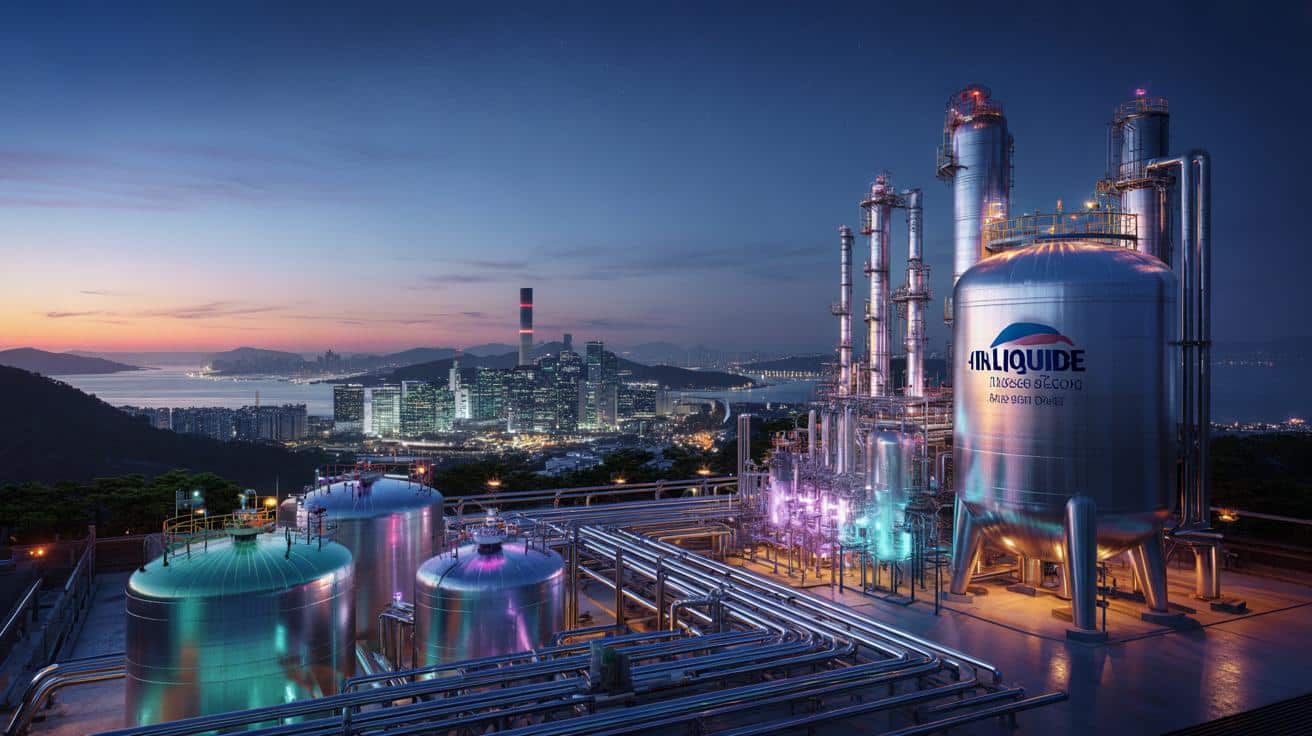
While politicians talk about fabs and sovereignty, the real battle often happens upstream, in chemical plants and pipeline networks that keep production lines breathing. France’s Air Liquide has just made a major move in that hidden game, paying billions to cement a long-term position in one of Asia’s most competitive tech powerhouses: South Korea.
Air Liquide’s €2.85 billion bet on South Korea
On 13 January 2026, Air Liquide confirmed it had completed the acquisition of South Korean industrial gas specialist DIG Airgas for around €2.85 billion. The transaction instantly reshapes the French group’s presence in the country and turns it into a central player in a market that quietly underpins global electronics, batteries and clean-tech projects.
Air Liquide is not a new arrival in South Korea. It has supplied medical oxygen and electronic gases there for more than thirty years. The DIG Airgas takeover, though, takes it from an established foreign supplier to a dominant, deeply embedded industrial partner.
DIG Airgas brings with it a dense network and a solid financial profile:
- around 60 production sites spread across South Korea
- roughly 220 kilometres of gas pipelines
- about 550 employees
- 2024 revenue close to €510 million
By absorbing DIG Airgas, Air Liquide jumps to the front of South Korea’s industrial gas market and locks in a long-term role with the country’s biggest tech manufacturers.
The Korean company already serves core segments of the country’s industrial base and has around twenty industrial projects underway. That pipeline of contracts offers visibility on future cash flows, which helps justify the high price tag in a sector where infrastructure is capital-intensive but highly sticky once in place.
Why ultra‑pure gases are suddenly strategic
Invisible inputs that make or break a chip
Modern semiconductors are built on dozens of extremely precise steps. Each one depends on ultra‑pure gases, where a single unwanted molecule can ruin an entire batch of chips. That means stringent purity thresholds: in some cases 99.9999% or better, often referred to as “six nines” purity.
Typical gases used in advanced chipmaking include:
- ultra‑pure nitrogen to prevent oxidation inside production chambers
- hydrogen for deposition processes and heat treatments
- rare gases like argon, neon or krypton for plasma etching and lithography
A wafer of silicon only a few millimetres thick and a few dozen centimetres wide can be worth several thousand euros by the time it leaves the production line. Any microscopic contamination can turn that shiny disc into scrap. That is why chipmakers want long-term, ultra‑reliable partners for gases, not spot suppliers.
➡️ Tierärzte schlagen Alarm: Ein sehr wichtiges Thema für Hundebesitzer
➡️ Diese einfachen Schritte helfen, günstige Flüge nach New York zu finden und die Stadt zu erkunden
➡️ Wenn du ständig an alles denken musst die eine notizgewohnheit die den kopf spürbar leichter macht
➡️ Diese Münze, nach der alle suchen, ist Gold wert: Sie kann das 700‑Fache ihres Nennwerts bringen
The more advanced the chip node, the more sensitive it becomes to impurities, which pushes demand towards ultra‑pure gas specialists with robust infrastructure and quality control.
DIG Airgas has built its reputation in exactly this niche, supplying high-purity gases to South Korea’s electronics and semiconductor clusters. Air Liquide is now taking control of those assets and relationships, gaining a stronger foothold in one of the most demanding markets on the planet.
A global market leaving niche status behind
Ultra‑pure gases once looked like a technical side business within industrial gases. That era is over. Sector estimates cited in French reporting put the global high-purity gas market at about €18 billion in 2024, rising to around €18.8 billion in 2025. Long-term projections point towards roughly €28.8 billion by 2035.
Two powerful forces push that growth:
- chip miniaturisation, which tightens purity requirements as features shrink
- the energy transition, which increases demand for ultra‑pure hydrogen for electrolysers and select battery technologies
By 2030, some scenarios see the ultra‑pure segment alone worth €7.5–11 billion, depending on how fast factories for semiconductors, solar cells and next-generation batteries scale up.
In this landscape, Air Liquide and German rival Linde act as global gatekeepers. Both control sophisticated purification technologies, cryogenic logistics and pipeline networks that are extremely hard and costly to replicate.
South Korea’s role in Air Liquide’s Asian triangle
A dense tech ecosystem with rising gas demand
With DIG Airgas under its umbrella, Air Liquide tightens what looks like a strategic Asian triangle: Japan, Taiwan and mainland China already figure prominently in its portfolio. South Korea completes the picture, slotting into a region that hosts some of the world’s most advanced fabs and electronics plants.
South Korea holds a unique position in this set. It is:
- the fourth-largest industrial gas market worldwide
- the sixth-largest industrial economy
- among the global leaders for R&D spending as a share of GDP
Corporations like Samsung, SK Hynix, LG and Hyundai are not mere “clients”; they function as sprawling ecosystems. They bring with them layers of suppliers in displays, batteries, automotive components and advanced memory. Their factories run around the clock, and any interruption in gas supply can shut down entire production lines.
Gases need to arrive at constant flow, with stable pressure and guaranteed purity. That favours pipeline delivery and on-site production units, rather than trucked cylinders. Air Liquide’s acquisition gives it control of an already installed network, cutting the time needed to deepen ties with these industrial giants.
For Samsung or SK Hynix, an ultra‑pure gas provider is closer to an infrastructure partner than a commodity vendor, making long-term contracts and co‑investment the norm.
Reducing geographic concentration risk
Asia currently accounts for more than 60% of global ultra‑pure gas production. Taiwan and South Korea alone host a large share of leading-edge semiconductor capacity. That geographic concentration heightens supply chain anxiety in Europe and North America.
By controlling local assets in Asia while expanding or maintaining capacity elsewhere, a company like Air Liquide can offer customers some hedging against regional disruptions. The DIG Airgas deal fits into that pattern: it secures capabilities close to customers in South Korea, while also reinforcing Air Liquide’s bargaining power and technology base globally.
How the business model works on the ground
From capital spending to long-term contracts
Industrial gas projects require heavy upfront investment. Building purification units, liquefaction plants, storage facilities and pipelines can take years and cost hundreds of millions. The payoff comes in the form of multi-year, sometimes multi-decade contracts with large industrial sites.
Typical contract structures involve:
- on-site production units built and operated by the gas company
- take-or-pay clauses that secure minimum revenue levels
- indexation to energy prices or inflation for part of the tariff
These features make the sector attractive for investors seeking predictable cash flows. At the same time, they raise the stakes on execution: delays, cost overruns or quality issues can erode margins fast.
With around twenty industrial projects in the pipeline at DIG Airgas, Air Liquide inherits both opportunity and risk. Integration will need to balance local engineering expertise with the group’s global standards for safety and analytics.
Key concepts behind “ultra‑pure”
What purity levels actually mean
When industry players talk about “six nines” purity — 99.9999% — they are describing a level where impurities fall below one part per million. For some applications, the bar goes even higher, especially for gases like hydrogen or nitrogen used in chipmaking cleanrooms.
| Purity label | Typical notation | Impurities (approx.) |
|---|---|---|
| High purity | 99.99% | up to 100 parts per million |
| Ultra‑high purity | 99.999% | around 10 parts per million |
| “Six nines” ultra‑pure | 99.9999% | about 1 part per million or less |
Reaching those thresholds requires advanced filtration, chemical scrubbing, cryogenic distillation and strict control of contamination in pipes, valves and storage tanks. Analytical equipment constantly checks composition, and any drift can trigger alarms and process adjustments.
For chipmakers, this level of scrutiny reduces the risk of particle defects or unwanted reactions on the wafer surface. For electrolyser developers, ultra‑pure hydrogen cuts degradation and improves efficiency over time.
Risks and scenarios for the next decade
Geopolitics, energy prices and green pressure
The ultra‑pure gas business sits at the intersection of several uncertainties. Geopolitical tensions in East Asia could disrupt shipping lanes or investment flows. Higher energy prices increase operating costs since gas separation and liquefaction are energy-intensive. Climate policies are pushing suppliers to decarbonise their own processes, adding another layer of capital spending.
In one scenario, continued expansion of AI data centres and automotive electronics pushes chip demand higher than current forecasts. That would support further growth in ultra‑pure gases and encourage Air Liquide to expand Korean capacity even more aggressively.
In a less favourable scenario, a deep global downturn or trade conflict slows fab investment. The existing network of pipelines and plants would still generate income thanks to long-term contracts, but pricing power could weaken, and new projects might be delayed.
For Air Liquide, the DIG Airgas acquisition is a calculated risk: big money up front in exchange for a central position in a market that is no longer a niche and could become one of the hidden levers of industrial policy for years to come.