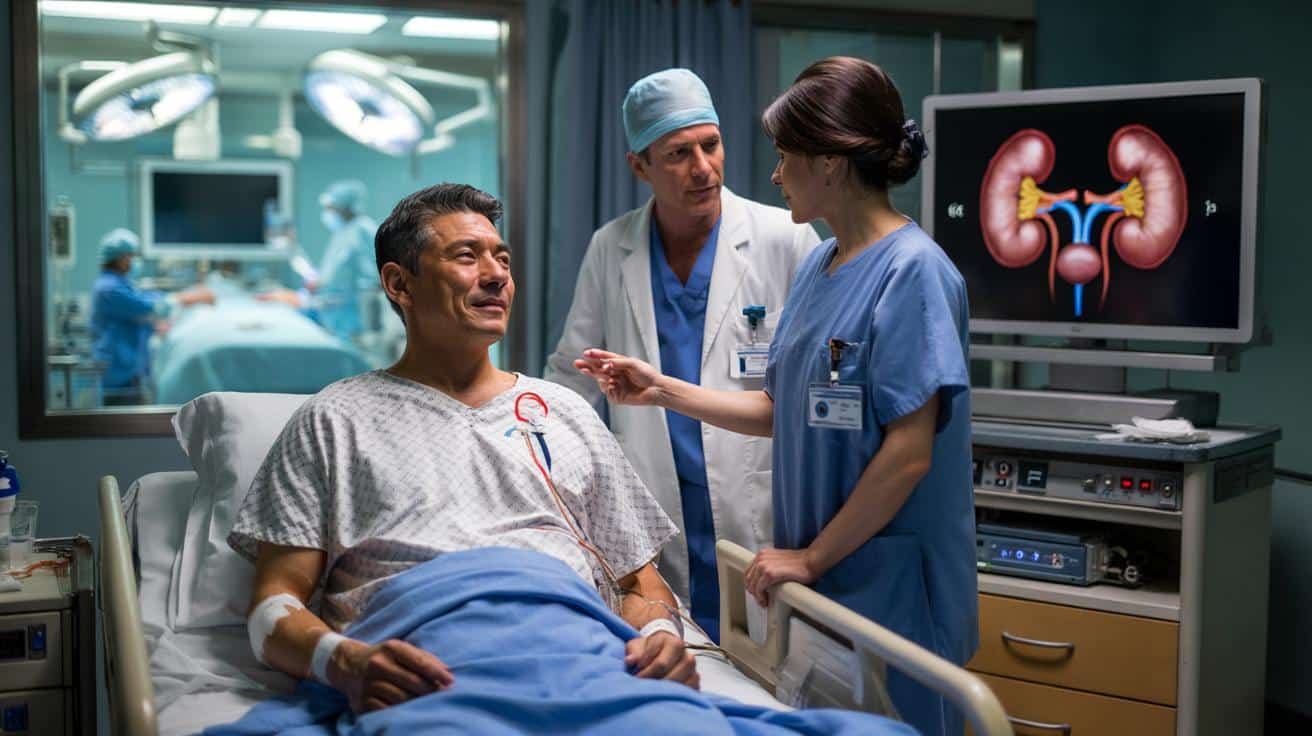
The case, involving a 41‑year‑old cancer survivor who had not passed urine normally in seven years, is now being watched closely by transplant teams around the world. What happened to him could signal a new chapter for people living with severe urinary tract damage and no remaining standard options.
A life on hold before the operation
The patient, identified as Oscar Larrainzar, had already been through years of aggressive treatment before this latest surgery. Cancer had forced doctors to remove both of his kidneys and most of his bladder. Without functioning kidneys, he relied on dialysis several times a week just to stay alive.
Living without a bladder is possible, but rarely simple. Patients are usually offered one of two paths: a bladder “substitute” built from a piece of intestine, or a diversion that drains urine into a bag outside the body. Both approaches save lives, yet they often come with infections, leaks, stones, and repeated hospital stays.
For Larrainzar, conventional fixes were no longer on the table. His previous surgeries and cancer history limited reconstruction options. That is why a team at Ronald Reagan UCLA Medical Center proposed something no one had attempted in a human before: transplanting a donor kidney and a donor bladder together, and then connecting them so they function as a unit.
This was the first reported case of a human receiving a transplanted bladder alongside a kidney, with the clear goal of restoring a more natural way to urinate.
A carefully staged eight‑hour surgery
The operation took place on 4 May 2025 under the leadership of urologist and researcher Dr Nima Nassiri. The team planned the case for years, rehearsing the sequence and refining the way blood vessels and urinary tubes would be connected.
Step by step inside the operating room
- First, surgeons transplanted a donor kidney into Larrainzar’s pelvis.
- They connected the kidney’s blood vessels to his own, allowing blood flow to resume.
- Once the kidney “pinked up,” it began producing urine almost immediately.
- Next, they placed the donor bladder and linked it to his urethra, the natural exit route for urine.
- Finally, they joined the new kidney’s ureter (the tube carrying urine) to the transplanted bladder.
This sequence sounds straightforward on paper, but the anatomy makes it extremely demanding. The pelvis is crowded with delicate arteries and veins. Any misstep can cause serious bleeding or cut off blood supply to the new organs.
According to UCLA’s own report, the kidney started producing a large amount of urine during the operation. That urine flowed into the donor bladder and then out through the urethra, without blockage. This was the moment the team realised the pair of organs were working together as hoped.
Dialysis was stopped as soon as the operation ended, a clear sign that the transplanted kidney was doing the job on its own.
➡️ Warum Sie vor dem Sommerurlaub unbedingt ein Glas und etwas Papier in die Spüle legen sollten
➡️ The product to use to clean the inside of your toilet like new, with no effort and in seconds
➡️ Diese eine Frage stellen sich zufriedene Menschen jeden Abend
➡️ Der überraschende Nachhall von Prop-50 in Bayern, der Kongresssitze für diverse Stimmen umformt
➡️ Zehn übersehene Rassismus-Impacts in Politik und Allyship-Workshops für inklusive Nachbarschaften
➡️ Nur wenige wissen, warum man nachts niemals salz in die toilette geben sollte
Why a bladder transplant has been so elusive
Transplant surgeons have been swapping hearts, kidneys and livers for decades, so why had nobody transplanted a bladder into a living person before this?
Three main obstacles
| Challenge | Why it matters |
|---|---|
| Complex blood supply | The bladder’s small arteries in the pelvis are hard to reach and reconnect safely. |
| Nerve connections | Bladder function depends on nerves that control storage and release of urine. |
| Risk–benefit balance | Until now, doctors relied on intestinal reconstructions, considered safer and more predictable. |
Most surgeons judged the risk of major bleeding, clots or organ failure too high compared with the benefit. People can live with external urine bags. From a strictly survival‑based standpoint, transplanting a bladder never reached the top of the priority list.
The UCLA team could attempt it partly because of how their services are organised. At that hospital, kidney transplantation sits under the urology department. That structure brings transplant physicians, cancer surgeons and urinary reconstruction specialists into the same corridor and, crucially, into the same planning meetings.
An advance filled with promise, but not a quick fix
For Larrainzar, being able to urinate again through the normal route is more than a medical milestone. It changes daily routines, travel plans, intimacy, and how he moves through public spaces.
Yet the team is clear: one successful case does not mean bladder transplants will appear on hospital menus next year. There are major questions they still need to answer.
The transplanted bladder has no full nerve supply, so its long‑term continence and control remain uncertain.
Because the donor organ is not wired back into the spinal cord, the classic “urge to go” may not return in the usual way. Larrainzar might need to follow a timed schedule to empty his bladder, or rely on catheters at times to prevent overfilling.
On top of that, he now needs lifelong immunosuppressant drugs to stop his body rejecting both the kidney and the bladder. Those medications carry their own health costs, from higher infection risk to raised blood pressure and, in some cases, a greater chance of certain cancers returning.
Who could one day benefit from this technique?
The number of people who might qualify for a bladder transplant is relatively small, but for them the impact could be dramatic. Doctors mention several potential groups:
- Patients whose bladders were removed due to invasive bladder cancer.
- People with severe birth defects of the urinary tract that cannot be rebuilt with standard surgery.
- Individuals with catastrophic pelvic trauma from accidents or war injuries.
- Patients like Larrainzar, who need both kidney and bladder solutions at the same time.
Transplant teams will likely reserve this approach for those with no other realistic options, at least in the near future. Each candidate would go through lengthy assessment, including cancer checks, psychological evaluation and discussion of drug side effects.
What this means for future research
This single operation will probably spark several lines of research within urology and transplant medicine.
Nerve repair and bioengineering
One major priority is nerve control. Researchers are already working on ways to reconnect tiny nerves or to engineer nerve guidance channels that help regrow connections over time. If surgeons can restore some signalling between the spinal cord and a transplanted bladder, patients might regain more natural control.
Another route involves lab‑grown tissue. Scientists have experimented with scaffolds seeded with a patient’s own cells to form bladder‑like pouches. Combining such tissue‑engineered bladders with transplanted kidneys, or using them as backups when donor organs are scarce, is an active conversation in academic circles.
Key medical terms, unpacked
For non‑specialists, some jargon around this case can feel opaque. A few phrases are worth clarifying:
- Dialysis: A machine‑based treatment that filters waste and extra fluid from the blood when the kidneys no longer work.
- Immunosuppressants: Drugs that deliberately weaken the immune system so it does not attack transplanted organs.
- Continence: The ability to store urine and release it at the right time, without leaks.
- Ureter: The tube that carries urine from each kidney down into the bladder.
Understanding these concepts helps frame what has actually changed for this patient: he has moved from machine‑based blood cleaning and external urine collection to a system that, while medically managed, functions inside his own body again.
Everyday life after a transplant like this
Doctors who follow kidney transplant recipients often talk about the “second job” patients take on: managing pills, lab tests and lifestyle tweaks. A dual kidney‑bladder transplant adds a further layer but follows the same logic.
In practice, that means regular blood tests to check kidney function, imaging to look for leaks or blockages in the bladder, and close monitoring for signs of rejection such as fever, pain or changes in urine output. Patients are encouraged to avoid smoking, stay hydrated, and keep vaccines up to date because of their weaker immune defence.
Scenarios can vary. Someone who regains good bladder capacity and reasonable control might go back to office work, travel by plane and even exercise with few visible limitations. Another person might still rely partly on catheters or pads, yet feel far less tethered to hospitals than during dialysis years.
The case of Oscar Larrainzar sits somewhere between bold experiment and practical hope. For thousands living with devastated urinary systems, the idea that a complete transplant could restore something as basic as the ability to pee may soon move from headline to option on the consent form.