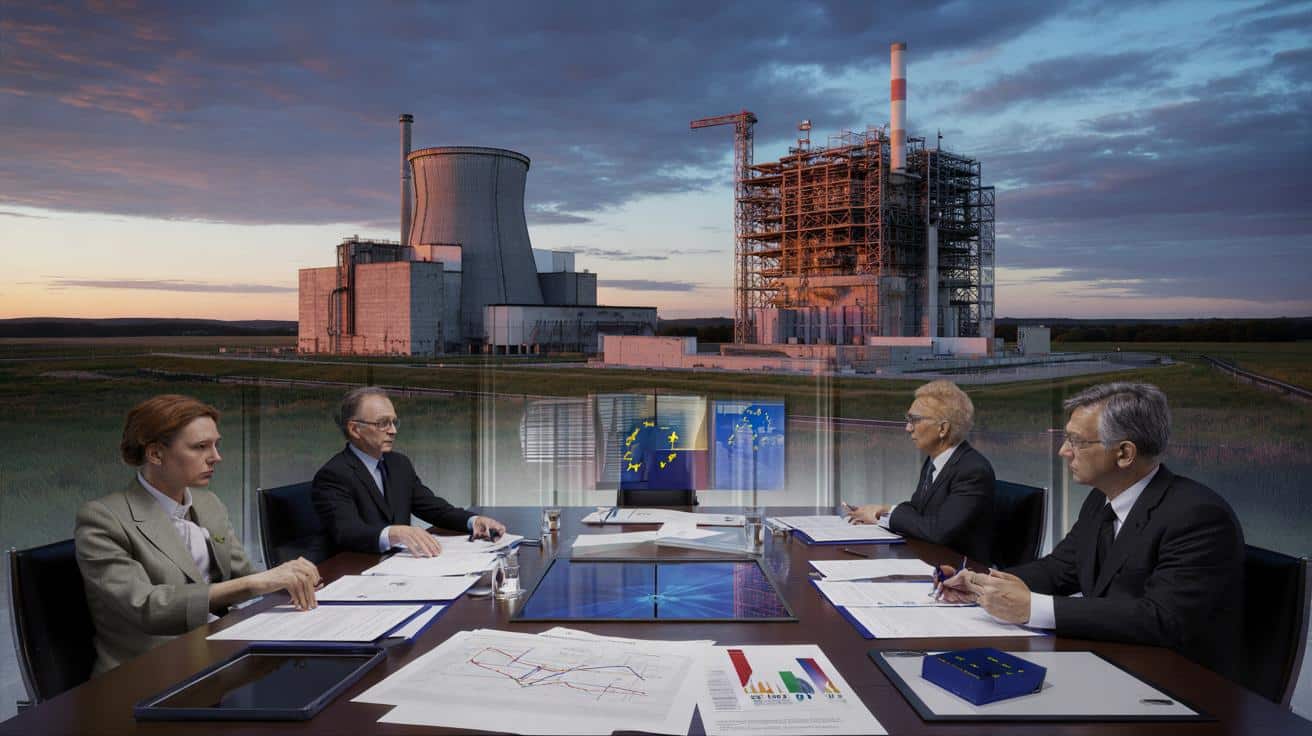
Prague wants new reactors, Brussels wants answers, and French giant EDF sees a once-lost deal that may not be lost forever.
The stakes: a nuclear comeback and a €16.4bn prize
The Dukovany nuclear site in the south-east of the Czech Republic has long been the workhorse of the country’s power system. Its four Soviet-era reactors are nearing the end of their lives, and the government has decided to bet big on new nuclear capacity to secure low-carbon electricity for decades.
That bet comes with a huge price tag. Two new reactors are planned, backed by a public financing scheme whose total value is estimated at between €23bn and €30bn over more than a decade. Inside that package sits what French media have already nicknamed the “contract of the century” for industrial suppliers: roughly €16.4bn of work and associated revenues for the chosen builder.
Officially, that builder is Korea Hydro & Nuclear Power (KHNP), the South Korean group that beat France’s EDF and other rivals in 2024. Yet the case is far from closed. The European Commission has opened an in-depth investigation into the Czech support scheme, while a separate probe looks at potential foreign subsidies benefiting KHNP.
EDF may still claw its way back into a €16.4bn Czech nuclear deal that looked lost when Seoul’s KHNP was named winner.
How Prague plans to fund two new reactors
A state-funded model from start to finish
The Czech government has designed a heavily state-backed model to get the project off the ground and keep costs down for consumers. The core of the structure looks like this:
- A long-term public loan on preferential terms, covering 100% of construction costs, estimated between €23bn and €30bn including interest, fees and reserves.
- A 40-year “Contract for Difference” (CfD), guaranteeing a fixed strike price for the electricity generated.
- Legal protections shielding the investor from abrupt policy changes, such as new taxes or sudden shifts in energy strategy.
The project company, EDU II, is controlled by the Czech state, which owns 80%. The remaining 20% belongs to ČEZ, the country’s dominant power utility. In practice, taxpayers carry most of the financial risk while industry benefits from stable, long-term electricity supply.
Under the CfD mechanism, if market prices fall below the agreed level, the state compensates the operator. If prices rise above that level, the operator pays the surplus back.
The scheme is designed so that the state acts almost like an all-risks insurer, smoothing out market volatility over four decades.
➡️ Die Pomodoro-Technik ist zu kurz: Die Flowtime-Methode für angepasste Produktivitäts-Sprints
➡️ Rentner soll grundsteuer zahlen und erzählt von einer bienengeschichte die das ganze dorf spaltet
➡️ So erstaunlich zuverlässig ist der Strom in Deutschland heute wirklich
➡️ Warum die 4 tage woche im homeoffice unsere faulheit fördert und fleißige bestraft
Why Brussels hit the pause button
State aid rules under the microscope
The European Commission has already approved a similar, but smaller, Czech nuclear project in the past. This time, it wants to take a closer look. The concern is not nuclear technology itself — EU rules allow members to choose their own energy mix — but the way public money shapes competition.
Officials in Brussels say they need to check whether the loan conditions and the CfD are proportionate or whether they distort the electricity market. If the state takes too much risk, the project could become a near risk-free bet for the operator, crowding out rivals and depressing prices for competitors who do not benefit from such backing.
Another question mark concerns the details of the CfD. Key elements of the mechanism remain fuzzy from the Commission’s perspective, including incentives for cost control and operational efficiency. Without clear penalties for overruns or underperformance, the deal could turn into a comfortable rent rather than a disciplined industrial project.
Foreign subsidies and KHNP’s role
The state aid probe is not the only headache. Brussels is also investigating KHNP under the EU’s new regulation on foreign subsidies. The goal is to find out whether Korean public support, in any form, allowed the company to undercut competitors in the Czech tender.
EDF has complained that KHNP’s winning bid — around €8.2bn per reactor in industrial construction costs — relies on support measures that were not transparent in the tender process. Czech courts dismissed EDF’s legal challenge domestically, and Prague signed with KHNP in June 2025. Yet the EU-level foreign subsidy investigation remains open.
KHNP insists it complies fully with European rules and denies receiving any unfair advantages from Seoul.
If the Commission concludes KHNP benefited from distortive foreign subsidies, it could impose remedies or force changes to the contract.
Czech politics, aging reactors and tight deadlines
Why Prague is pushing so hard
Nuclear power currently produces roughly one-third of Czech electricity, with four older Soviet-designed VVER-440 units at Dukovany and two newer reactors at Temelín. As coal plants close and gas prices fluctuate, Prague sees nuclear as the backbone of its long-term energy strategy.
The government has set ambitious commissioning dates: 2036 and 2037 for the two new units. In nuclear terms, that is a tight schedule, especially in Europe, where projects often suffer delays and cost overruns.
Officials argue that generous state support is needed to keep financing costs under control. Low interest loans from the state can save billions over the lifetime of the project, making nuclear more competitive compared with gas and renewables backed by storage.
EDF waits in the wings
A lost tender that might not be final
From Paris, Dukovany looks like a major piece on the European nuclear chessboard. Landing the contract would showcase EDF’s new EPR2 reactor design, consolidate its presence in Central Europe and create industrial synergies with projects in France and possibly Poland.
When EDF lost the tender to KHNP in 2024, the verdict seemed clear. The Czech courts later backed the government’s choice, closing the national chapter. The signature in June 2025 appeared to cement KHNP’s victory.
Brussels has now reopened the game. If the state aid scheme is deemed incompatible, or if KHNP is sanctioned under the foreign subsidies rules, the current contract might need heavy modification or, in an extreme case, could be scrapped. That would give EDF a second shot at the so-called contract of the century.
For EDF, Brussels is no longer just a regulator; it has become the last referee in a match seemingly already played in Prague.
What could happen next
Possible scenarios for the Dukovany project
The Commission stresses that its investigation does not prejudge the outcome. Still, several plausible paths are already visible:
- Approval with tweaks: Brussels greenlights the project but forces Prague to adjust loan conditions, share more risk with the operator or tighten the CfD formula.
- Partial restrictions: The state can support only part of the investment, increasing the share of private capital and changing project economics.
- Severe remedies on KHNP: The foreign subsidy probe leads to financial penalties or constraints on KHNP, which could make its bid less attractive.
- Reopening the competition: In a high-impact scenario, legal constraints require a new tender, giving EDF and other players a fresh opportunity.
For now, the Czech government claims that work can continue under private and interim funding while talks with Brussels unfold. The previous nuclear state aid case in the country took roughly two years to clear; this one might follow a similar timetable, with a decision around 2027.
Key concepts behind the legal fight
What a Contract for Difference really does
A Contract for Difference is a long-term financial contract between a power producer and a public counterparty. Both sides agree on a “strike price” per megawatt-hour. If the market price is below that level, the state tops up the difference. If the market price is above it, the producer pays the extra back.
This structure reduces price risk and can significantly lower financing costs, because investors gain predictable cash flows. The flipside is a potential burden on taxpayers or consumers if market prices stay low for many years.
How EU state aid rules apply to energy megaprojects
EU state aid law does not ban public support outright. But it only allows it under strict conditions: aid must target a clear objective of common interest, be limited to the minimum necessary and avoid granting an unfair edge over competitors.
In energy, the Commission typically looks at:
| Factor | Why it matters |
|---|---|
| Risk sharing | Checks whether the company bears enough construction and operating risk. |
| Market impact | Assesses if subsidised output will push rivals out or depress prices artificially. |
| Cost transparency | Verifies that the support reflects realistic costs, not inflated estimates. |
| Duration of aid | Looks at whether long contracts lock in advantages for too many years. |
In the Dukovany case, the combination of a massive concessional loan, a 40-year CfD and political risk guarantees raises questions on all four fronts.
Why this case matters beyond Czech borders
Several EU countries are toying with new nuclear plans or life extensions for existing fleets: France, Poland, the Netherlands and potentially others. They are watching Dukovany closely to understand how far they can go with state-backed financing without running into legal trouble in Brussels.
The case also tests the EU’s new approach to foreign subsidies. If KHNP faces strict remedies, non-EU suppliers from countries like China or the United States will need to rethink how they structure bids for European infrastructure.
For energy consumers, the outcome will shape future bills. Generous state support can lower the cost of capital, but the burden eventually lands either on taxpayers or on electricity tariffs if market prices stay below the strike price for long periods.
For EDF, the story is simple: a mega-contract that once looked out of reach is still on the table, for now. The real decision may no longer rest in Prague, but in the meeting rooms of the European Commission, where legal nuance and economic modelling could shift billions of euros in industrial opportunity.