Most households still feel stuck.
Between glossy brochures and confident installers, choosing a heating system has become a stressful gamble. A new 2024 scientific study from Germany, though, cuts through the noise and compares 13 different systems on both cost and environmental impact. The results challenge a few clichés and put one clear winner in the spotlight.
A rare study that looks at the whole picture
Instead of focusing only on upfront price or on carbon emissions, the research team combined two heavyweight tools usually used by engineers and economists.
- Life cycle assessment (LCA) to measure environmental impact from manufacture to end of life
- Net present value (NPV) to judge long-term financial performance, including future energy prices
The model used a typical two-storey family home as a reference. Each of the 13 systems was “installed” virtually in the same building so results could be compared fairly.
The researchers fed the model with a wide range of data: installation costs, energy consumption, yearly maintenance, expected lifespan, CO₂ emissions, and use of natural resources. They also factored in how electricity production in Germany is likely to change, with a growing share of renewables, as well as different future price scenarios for gas, electricity, and biomass.
The study does what marketing never does: it puts cost, climate impact and technical complexity on the same scale.
The clear winner: air-to-water heat pump plus solar panels
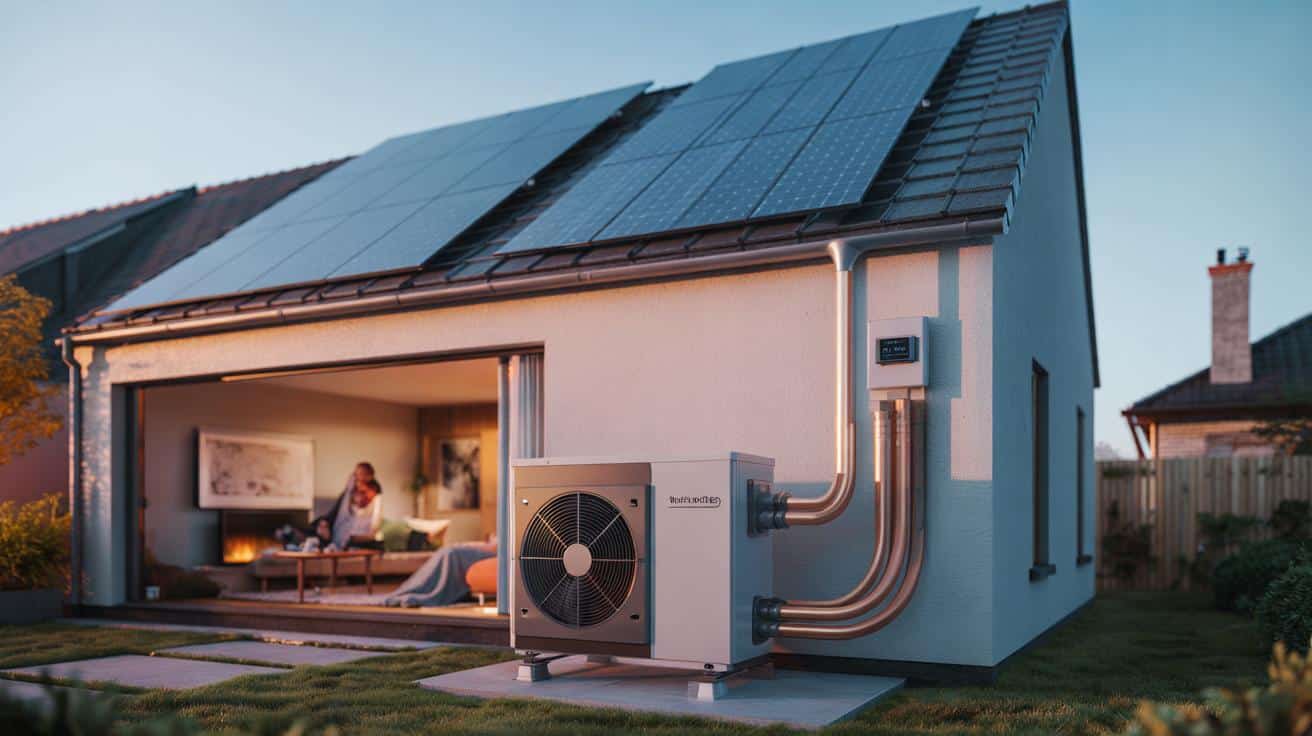
Among all the options, one combo stands out: an air-to-water heat pump powered partly by rooftop solar panels (photovoltaics, or PV).
Compared with a modern gas boiler used as the reference, this pairing delivers:
- around 17% lower environmental impact
- around 6% lower total cost over its lifetime
Even under pessimistic assumptions – higher electricity prices, lower solar output, or poorer insulation – the system still beats many of the alternatives studied.
Why this duo works so well
An air-to-water heat pump extracts heat from outside air and transfers it into the home, usually via radiators or underfloor heating. It doesn’t generate heat by burning fuel; it moves it. That’s why its efficiency, often expressed as a “coefficient of performance” (COP), can be three or more. Put simply, for 1 kWh of electricity consumed, you can get 3 kWh or so of heat.
➡️ Pflegegeld bei Pflegegrad 2, so viel monatliches Geld gibt es 2025 laut offizieller Übersicht
➡️ Der Trick mit Alufolie, um Besteck glänzend zu halten
➡️ Sie sollten ein Glas und Papier in die Spüle legen wenn Sie in den Sommerurlaub fahren deshalb
Adding solar PV changes the equation again. Instead of buying all the electricity from the grid, part of the heat pump’s demand is covered by locally produced solar power. This reduces both the electricity bill and the carbon footprint.
The study suggests that improving self-consumption of solar power – for example with smart controls or small batteries – would push this system even further ahead.
The surprise runner-up: wood gasification boiler
One result will raise eyebrows. A wood gasification boiler, often seen as a bit of an “old school” option, lands in second place for eco-efficiency.
In the study, this system shows a 42% lower environmental impact than the gas boiler benchmark. On the downside, its overall cost is about 20% higher. The key factor here is how the wood is sourced: the model assumes sustainable forestry practices and a renewable resource that regrows over time.
This type of boiler burns logs at very high temperatures, with improved combustion and fewer pollutants than traditional wood stoves. For rural households with access to sustainably managed wood, it remains a credible candidate, especially where heat pumps are tricky to install or insulation is poor.
When “green” systems disappoint
Some technologies often presented as highly ecological perform poorly once their full life cycle and real costs are examined.
The study highlights two main underperformers in eco-efficiency terms:
- Pellet boiler combined with solar thermal panels
- Heat pump with an ice storage system
Both are technically advanced and can work well in practice. Yet their complexity, high upfront cost, and additional components mean that the environmental and economic payback is weaker than expected in the model.
Pellet systems require fuel logistics, storage, and regular maintenance. Solar thermal, while efficient at producing hot water, adds costs and hardware that do not always compensate for the benefits, especially in cloudy climates or where hot water demand is modest.
The gas boiler problem
Conventional gas boilers, the workhorse of many European homes, still look appealing when judged only by installation cost and ease of use. Fuel is widely available, and modern condensing models can be very efficient at turning gas into heat.
Once environmental impact is included, the picture darkens. Gas boilers show the highest greenhouse gas emissions among all systems examined, even when combined with solar thermal panels for hot water.
Cheap to install does not mean cheap over 20 years, especially when climate and future energy prices enter the equation.
What this means for a typical household
For a family in a reasonably insulated home with a suitable roof, an air-to-water heat pump plus PV now stands out as one of the best long-term bets. The initial bill can be higher than a simple boiler swap, but operating costs and carbon impact are both lower across the system’s life.
In rural or forested areas where sustainable firewood is available, a modern wood gasification boiler still has a role. It is not the cheapest route, yet its climate performance is strong when wood is genuinely renewable and transport distances remain limited.
| System | Climate impact vs gas boiler | Lifetime cost vs gas boiler |
|---|---|---|
| Air-to-water heat pump + PV | ~17% lower | ~6% lower |
| Wood gasification boiler | ~42% lower | ~20% higher |
| Pellet boiler + solar thermal | Weaker than expected | High |
| Standard gas boiler | Highest emissions | Low initial cost only |
Key concepts worth unpacking
Eco-efficiency
Eco-efficiency tries to answer a simple question: how much environmental damage do you cause for each unit of service you get? In heating, the “service” is keeping a home warm and providing hot water at a comfortable, healthy level.
A highly eco-efficient system uses fewer resources and produces fewer emissions for the same comfort. The German study ranks systems by this combined score rather than looking only at CO₂ or only at cash.
Why future energy prices matter
The net present value approach used in the study discounts future cash flows. In plain language, it asks: if you add all the bills and savings up over 15–25 years and adjust them to today’s money, which system comes out ahead?
This method can flip the decision. A cheap gas boiler looks good on day one. Yet if gas prices spike or carbon taxes rise, that “bargain” quickly turns into the most expensive path. Electricity, especially when partly self-produced with solar panels, becomes more predictable and less exposed to fossil fuel volatility.
Practical scenarios and mixed strategies
Not every home can host a large heat pump and a full solar array. Flats, shaded roofs, or historic buildings face constraints. In those cases, partial solutions still help.
- A smaller heat pump as a main source with a small gas boiler as backup for the coldest days
- PV panels feeding household electricity while an efficient boiler handles heating
- Improved insulation combined with a modestly sized renewable system
The study focuses on heating systems themselves, yet insulation and airtightness often cut bills faster than any technology swap. A smaller heat demand allows for a smaller, cheaper heat pump and improves its efficiency, because it can run at lower flow temperatures.
Households weighing a change can use the study’s logic even without complex modelling: compare full life-cycle costs, question marketing claims about “green” systems, and look at how much of your future energy can realistically come from your own roof. That mindset, rather than any single gadget, is what makes the air-to-water heat pump with PV such a compelling benchmark today.