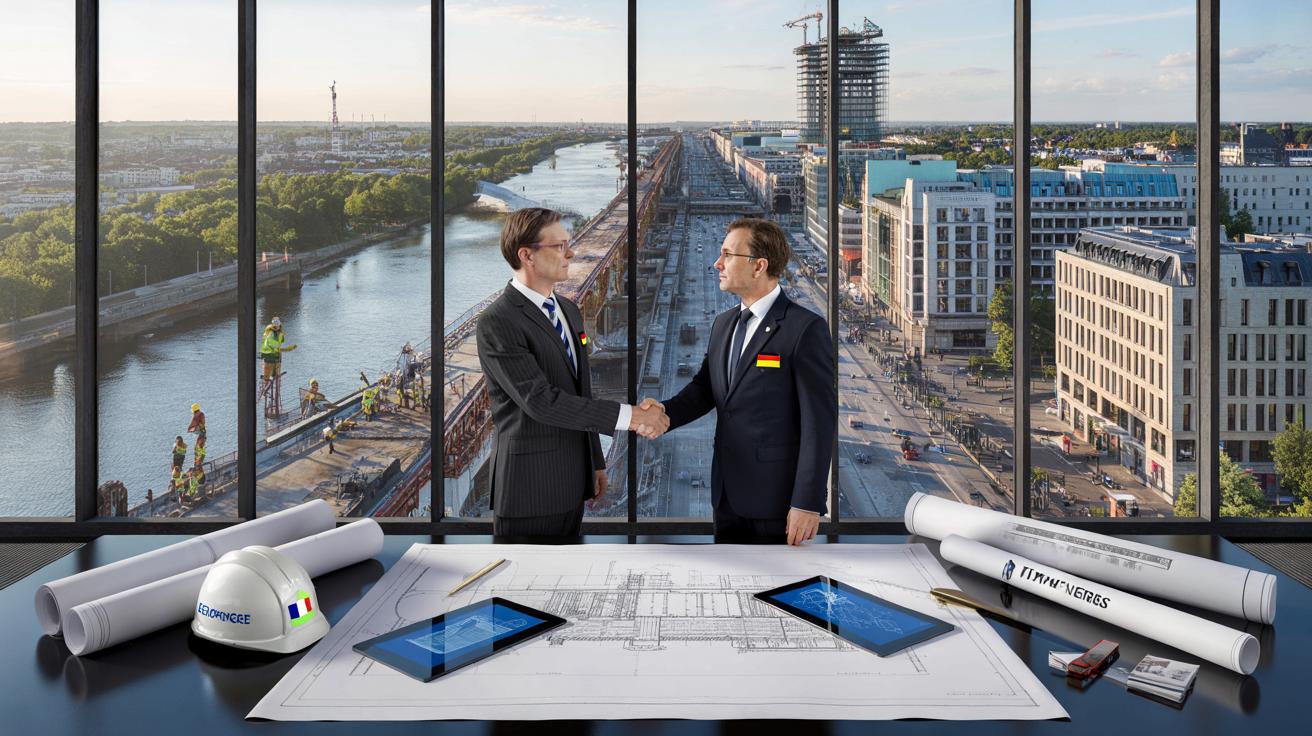
A major French construction group is tightening its grip on Europe by quietly buying brains, not just concrete, in Germany’s vast infrastructure market. The latest deal targets a respected local engineering house that designs the technical guts of modern buildings.
A French heavyweight sharpens its German game
Eiffage, currently ranked number four among European construction giants by revenue, is pushing deeper into Germany, the continent’s largest building market.
After winning major bridge contracts across the Rhine and the Kiel Canal, the group has now moved up the value chain by acquiring HTW Engineers through its German subsidiary Salvia.
Eiffage is no longer just shipping in steel and crews to Germany; it is buying the technical expertise that shapes projects from day one.
The deal gives the French group a solid foothold in the high-value segment of building engineering: the systems that make structures actually work once the shell is built.
While financial details of the acquisition have not been disclosed, the target is no boutique outfit. HTW Engineers posted close to €10 million in revenue in 2024 and employs around 80 specialists. For a niche engineering house, that is a substantial scale, especially on a market where reputation and references often matter more than sheer size.
Who are HTW Engineers?
Founded in 1969, HTW Engineers has built a name in Germany for handling complex projects for both public authorities and private developers.
The company operates from three strategic hubs:
- Düsseldorf, close to the industrial heartland of western Germany
- Berlin, the political capital and home to major public building schemes
- Leipzig, a fast-changing city in the north-east with heavy urban renewal needs
Its core business is what engineers call “technical building services” or “building services engineering”. In plain language, everything that makes a building livable and usable:
➡️ Wie eine Abendentspannungsroutine den Schlaf einleitet
➡️ Hausmittel zur Entfernung von Brandflecken und Glasringen auf Holzmöbeln
- Water treatment and plumbing networks
- Heating systems and energy distribution
- Ventilation and air-conditioning (HVAC)
- Electrical engineering and power supply
- Security and fire safety systems
- BIM modelling and digital coordination of all these systems
If the concrete frame is the skeleton, HTW Engineers designs the nervous system and blood vessels. That includes pipes, cables, air ducts, smart controls and the digital models that keep everything in sync.
Monheimer Tor: a showcase project
One flagship reference is Monheimer Tor in Monheim am Rhein, a redevelopment of two ageing shopping centres into a mixed-use urban hub.
The project includes:
- A 142-room hotel
- A multi-storey car park
- Expanded retail areas
- A six-screen cinema
HTW Engineers has been involved in the technical design of this transformation, which aims to revive a tired town centre and pull more residents and visitors back into the urban core.
Mixed-use projects like Monheimer Tor are exactly where advanced building engineering makes the difference between a generic mall and a vibrant city hub.
Why Salvia and Eiffage want local brains
Salvia, Eiffage’s German energy and building-systems arm, is not new to the market. But until now, its role often started once the main design was already in place.
With HTW Engineers on board, that changes significantly.
Salvia can now weigh in from the first sketches of a project. Early design decisions lock in the cost, carbon footprint and energy performance of a building for decades. That is where German clients, especially public ones, want robust local expertise.
Acquiring HTW Engineers shifts Salvia from being mainly an installer to a full project partner shaping technical concepts and long-term performance.
Germany also relies heavily on “design–build” models, where the same group both designs and delivers the project. In this format, integrated teams have a clear advantage. They can manage risks, coordinate trades and optimise costs far better than fragmented consortia.
For Eiffage, this is not about chasing a single deal, but about building a self-sufficient German platform that looks and feels local to clients, regulators and partners.
Big bridges, long money: Eiffage’s German pipeline
The push into German engineering fits a broader pattern: Eiffage is already landing some of the country’s most strategic infrastructure projects.
Levensau Bridge on the Kiel Canal
On the Kiel Canal, one of Europe’s busiest shipping lanes, Eiffage is co-building the new Levensau Bridge. The overall contract stands at around €183 million, with about €82 million for Eiffage.
The numbers give a sense of scale:
- Approximate length: 241 metres
- Height: 42 metres
- Steel structure: roughly 10,000 tonnes
- Expected service life: several decades
These types of projects require precise coordination between civil works, steel, traffic management and technical systems, from lighting all the way to structural monitoring.
Leverkusen A1 bridge over the Rhine
In Leverkusen, on the A1 motorway over the Rhine, Eiffage took a substantial slice of a €358 million contract in 2023.
The scope includes demolishing the ageing bridge and erecting a new 2×4 lane crossing, requiring around 16,000 tonnes of steel, with completion targeted for late 2027.
Here again, having in-house engineering capabilities for complex metal structures and technical installations makes bidding more competitive and project delivery smoother.
Germany, Europe’s biggest construction prize
Germany is the largest construction market in Europe, with sector revenues of around €143.5 billion in 2021 and roughly 75,000 companies active in the field.
The growth engine has shifted. New builds still matter, but the real momentum comes from upgrading an ageing building stock and boosting energy efficiency in homes, offices and public infrastructure.
The state-owned development bank KfW plays a central role. It channels billions in low-cost loans and grants into energy renovation and climate-friendly buildings. In one recent year alone, its support for this area reached about €8.6 billion.
Germany is turning itself into a full-scale test bed for companies that can mix engineering, energy efficiency and long-term asset management.
For a group like Eiffage, this means that acquiring a solid German engineering boutique is not just a geographic expansion. It is a way to position itself on the higher-margin, longer-term segment of the market, where performance contracts and complex refurbishments sit.
How Eiffage ranks among Europe’s giants
In the European construction league table, Eiffage sits in strong but pressured company:
| Rank | Company | Country | Turnover (approx.) |
| 1 | Vinci | France | €58.5bn (2023) |
| 2 | Bouygues | France | €46.2bn (2022/23) |
| 3 | ACS | Spain | ~€40bn (2024 est.) |
| 4 | Eiffage | France | €21.8bn (2023) |
| 5 | Strabag | Austria | ~€17–18bn |
| 6 | Skanska | Sweden | ~€18bn |
| 7 | Ferrovial | Spain | ~€10bn |
| 8 | Acciona | Spain | ~€8–10bn |
| 9 | Webuild | Italy | €10bn (2023) |
| 10 | Balfour Beatty | UK | ~€9bn |
Against such rivals, presence in Germany is no optional extra. It can shift the balance in terms of backlog, recurring business and technical references.
Key concepts behind the deal
What “technical building services” really means
The term might sound abstract, but it touches daily life. Technical building services cover all engineered systems that influence comfort, safety and energy use inside a structure. For policymakers and investors, they are now a major climate lever.
Replacing a boiler system, redesigning air flows, adding heat recovery or smart controls can cut a building’s energy use by 30–50% in some cases. That is why German public funding strongly targets this layer of engineering.
Scenario: how Eiffage could leverage HTW
Imagine a large federal office building in Berlin scheduled for deep renovation. With HTW Engineers integrated into Salvia, Eiffage could offer:
- Structural assessments and planning for phased works
- Complete redesign of heating, cooling and ventilation around strict energy targets
- BIM coordination between architects, engineers and contractors
- Installation and commissioning through Salvia’s teams
- Long-term maintenance and performance optimisation contracts
Such an integrated package gives clients a single point of contact and shifts risk and responsibility onto one group, which can be attractive when budgets are tight and technical constraints high.
Benefits and risks for Eiffage
The acquisition brings obvious benefits: better access to German clients, a stronger local brand, and higher-value services linked to energy transition policies.
There are also risks. Germany’s construction sector faces cost inflation, labour shortages and political debates over climate spending. Integrating a specialised engineering firm into a large international group can also strain culture and staff retention if not handled carefully.
For now, though, the move signals that Eiffage sees Germany not just as a big worksite, but as a strategic arena where design, energy efficiency and long-term infrastructure management will decide who stays in Europe’s top tier of builders.