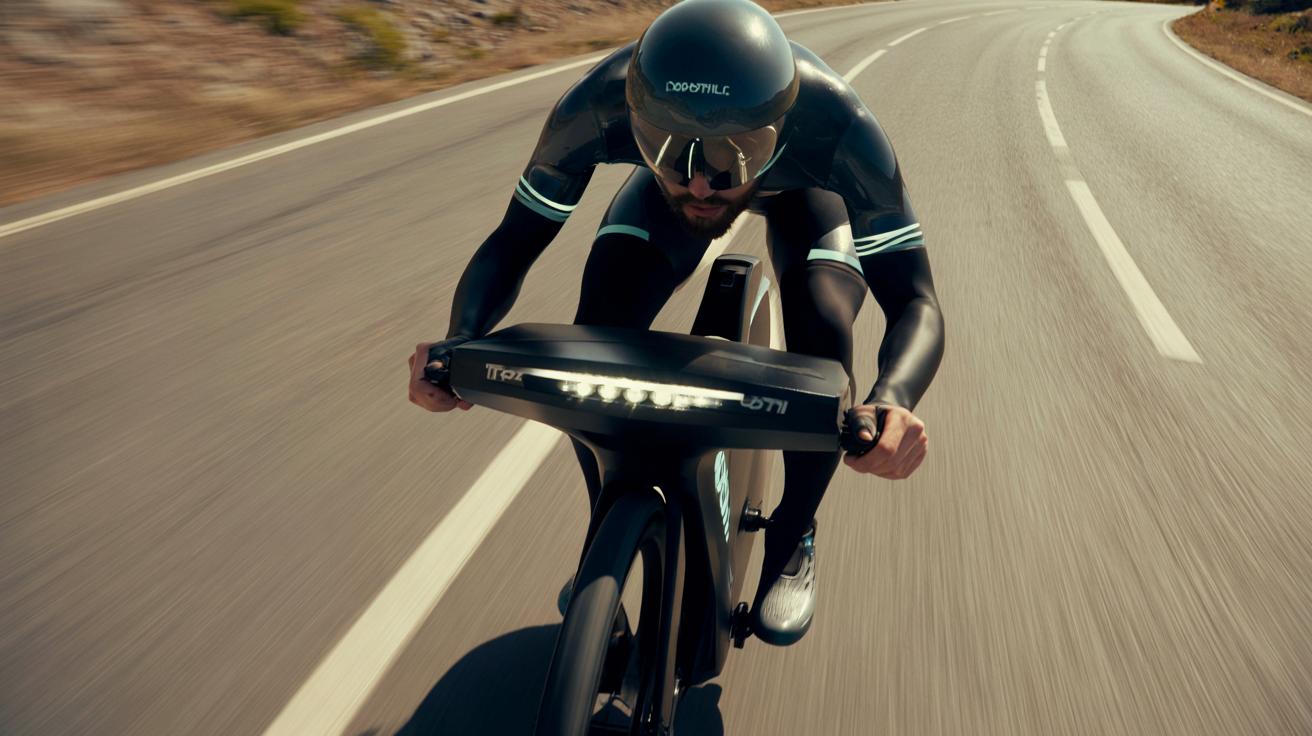
Instead of another polite pedelec capped at 25 km/h, Decathlon’s performance brand Van Rysel rolled out a prototype so wild it barely counts as a bicycle. Designed to double a rider’s power and flirt with motorway speeds, the FTP² concept bike has pushed the idea of an electric road bike into almost sci‑fi territory.
A concept bike that refuses to play by the rules
The machine is called FTP², and that name is not just marketing fluff. In cycling jargon, FTP stands for Functional Threshold Power, essentially the maximum power a rider can sustain for an hour. Van Rysel’s target was simple on paper and brutal in practice: double that number.
FTP² is not meant for the bike lane outside your flat; it is a rolling lab, built purely to test the limits of assisted cycling.
Unveiled at the VeloFollies show in January 2026, FTP² is a pure concept bike. There is no price, no release date, and no plan to sneak it into the Decathlon catalogue next season. Engineers describe it as a technology demonstrator, the kind car brands bring to motor shows to hint at tomorrow’s ideas.
Rather than taking a normal frame and bolting on a bigger motor, Van Rysel built the system as a single ecosystem. Frame, motor, software, clothing, even the shoes were designed together, with one brief: create a controllable way to hit extreme speeds on two wheels.
The motor that ignores the speed limit
At the heart of FTP² sits a custom Mahle M40 motor, tuned far beyond the polite assistance found on typical city bikes. Most legal e‑bikes in Europe and the UK are limited to 250 watts nominal power and cut off at 25 km/h. This one does not play that game.
Mahle’s unit on the FTP² delivers up to 850 watts peak and 105 Nm of torque, figures closer to light motorcycles than urban e‑bikes.
Once that usual 25 km/h regulatory threshold is passed, the prototype simply keeps pushing. On flat ground, Van Rysel’s engineers talk about cruising speeds between 70 and 80 km/h. Those numbers alone would make it one of the fastest pedal‑assist bikes ever built.
On long descents, with enough courage and road, the team believes the bike could theoretically touch 150 km/h. At that point, the real limitation stops being the motor and starts being human survival: concentration, reaction time, and the sheer mental strain of travelling that fast on two slender contact patches.
➡️ Geflüchtete in der nachbarschaft wenn hilfsbereitschaft auf angst trifft
➡️ Warum semantische Such-Tools wie Grok Nischen-X-Posts für Marktforschungs-Goldgräber enthüllen
➡️ Wie Polygon-API für Echtzeit-Finanz-Tracking in Ihrem persönlichen Dashboard-App zu integrieren
➡️ Adieu nivea creme dieses kollagenreiche ätherische öl glättet falten nach 50 wie durch zauberhand
➡️ Zehn Wege, Loyalty-Programme für Gratis-Upgrades bei Flügen und Hotels zu leverage
➡️ Wem gehört die stadt steigende nebenkosten als auslöser eines neuen klassenkampfs
To prevent the system from cooking itself, Mahle and Van Rysel wrote bespoke control software. It meters out power to avoid thermal runaway and manages energy draw from a 580 Wh battery hidden in the down tube. That battery includes cooling fins to shed heat during long, hard pushes where both rider and motor sit near their limit.
A cockpit inspired by Formula 1
At the speeds FTP² targets, taking a hand off the bars to press a button can become a life‑or‑death mistake. So Van Rysel built a cockpit that borrows ideas from motorsport rather than traditional cycling.
A Hammerhead computer is integrated neatly into the stem, not clamped on as an afterthought. It shows speed, power, battery status, and navigation data without forcing the rider to look away from the road for long. All the control points sit within thumb reach.
From that cockpit, the rider can:
- Shift the SRAM Red AXS electronic groupset
- Change the motor assistance mode and power delivery
- Tighten or loosen the shoes via a remote control signal
Remote‑controlled shoe tightening sounds like a gimmick, but at 80 km/h it means one less reason to let go of the bars.
This level of integration hints at where premium e‑road bikes could go: fewer add‑ons and more fully designed systems where software, cockpit and drivetrain speak the same language.
Shoes that screw into the crank instead of clipping to pedals
The most radical part of FTP² isn’t the motor or the frame. It is the footwear. Van Rysel’s engineers essentially deleted the pedal as a separate component.
Instead of cleats that latch into a pedal body, the shoe itself connects directly to the crank arm. The sole includes a rigid interface that literally screws onto the crank, turning the entire shoe into a pedal surface. In theory, this removes small flex losses and makes the transfer of power more direct.
Each shoe system weighs around 500 grams and has a 3D‑designed, wing‑like profile inspired by NACA airfoil shapes to smooth airflow.
The tightening system is fully motorised and controlled from the handlebar, giving micrometric adjustment on the fly. The idea is to avoid hot spots or loosening during intense efforts, especially when a small loss of control could have serious consequences.
There is a catch: the current prototypes make mounting and dismounting awkward. Riders often need help to clip in or step away, a bit like a track sprinter being held at the start gate. Van Rysel says that ergonomics and practicality are still being worked on before the idea can move anywhere near real‑world products.
Aerodynamic armour for 150 km/h wind
FTP² was never just about the bike. Van Rysel assembled a full high‑speed kit: frame, wheels, clothing, and helmet all treated as one airflow puzzle.
On the rider’s head sits a concept helmet called X‑Clip. It combines a conventional safety shell with an additional aero fairing designed with Swiss Side, a specialist in aerodynamic engineering. The add‑on shell guides air cleanly around the head, where turbulence can steal significant wattage at high speeds.
The clothing follows the same logic. Van Rysel worked with the French studio Jonathan & Fletcher, known for ski and speed‑sport textiles, to create what they call an “aerodynamic armour” suit. The garment is both protective and slippery, with panels mapped to manage airflow between roughly 80 and 150 km/h.
| Component | Partner / tech | Key role |
|---|---|---|
| Frame & fork | In‑house carbon design | Stiff, aero structure with integrated lighting, ~15 kg total bike weight |
| Wheels | Swiss Side Hadron 850 | Deep‑section aero wheels for high‑speed stability |
| Saddle | Fizik Argo Vento Adaptive | Comfort and control in extreme, sustained efforts |
| Helmet | Concept X‑Clip with Swiss Side | Hybrid safety and aero shell for smoother airflow |
With all of this combined, the complete bike still weighs only about 15 kg. For a machine carrying a large battery, powerful motor and integrated lighting, that figure sits surprisingly close to the upper range of conventional high‑end road bikes with aero wheels.
Why you will not buy this bike – and why it still matters
Van Rysel is clear: you will not walk into a Decathlon store and roll out with an FTP² this year or next. The prototype sits in the same category as wild concept cars with butterfly doors and no boot space: they shape the future more than they become it.
FTP² acts as a testing ground for software, integration and aero ideas that could trickle down to normal e‑bikes over the next decade.
Elements that have a realistic path to the market include the clean battery integration, the sculpted carbon fork, and the built‑in lighting signature. Those can add safety and efficiency without requiring motorway speeds. Higher‑end commuters and gravel e‑bikes from Decathlon could be the first to benefit.
The project also raises a philosophical and regulatory question: at what point does an e‑bike stop being a bicycle and start behaving like a motorbike? With 850 watts on tap, 80 km/h on the flat and 150 km/h on descents, FTP² would not fit any existing e‑bike category on public roads.
Understanding the numbers: FTP, watts and speed
For non‑cyclists, the terms being thrown around can sound abstract. FTP, for instance, is a performance benchmark used by coaches to gauge training zones. Many amateur riders have an FTP between 200 and 300 watts. Elite professionals might reach 400 watts or a bit more.
By aiming to double a rider’s FTP through assistance, Van Rysel is effectively targeting the equivalent output of a top‑tier professional added on top of a committed amateur. Combine that with aero optimisation and you move from 40–45 km/h race speeds into 70–80 km/h territory.
At those speeds, the physics of drag dominate. Air resistance scales roughly with the cube of speed, meaning that going a little faster demands a lot more power. This is why the aero helmet, suit and shoe shapes are not just cosmetic flourishes. They are attempts to stop the power requirement from exploding as velocity climbs.
Safety, regulation and what this could mean for everyday riders
Imagining 150 km/h on a bicycle immediately raises safety concerns. Braking distances lengthen dramatically. Crosswinds hit harder. Road imperfections that would be a minor jolt at 25 km/h could become severe hazards.
Real‑world use of such a machine would demand closed circuits, motorcycle‑grade protective gear, and strict test protocols. From a legal perspective, most regions would classify it as a speed‑pedelec or even a light motorcycle, triggering licence, insurance and equipment requirements.
Yet parts of the tech stack clearly have gentler, practical applications. Smarter software that manages motor heat could extend battery life for commuters. Integrated, car‑like lighting helps visibility on dark winter rides. More efficient aero designs could let riders travel farther at the same power, rather than simply going faster.
For riders considering an e‑bike today, projects like FTP² act as a preview of where assistance systems might head. Expect more seamless integration, less cluttered handlebars, and bikes that feel designed as one object, not as frames with gadgets stuck on.
There is also a cultural angle. As assisted speeds climb, the line between human performance and machine contribution blurs. Future events could arise where riders compete not just on fitness but on how skillfully they manage power modes, aerodynamics and energy budgets across a course, closer to motorsport strategy than classic cycling.