The ISS is supposed to be retired by the end of this decade, yet the United States still has no certified replacement for continuous human presence in orbit. Behind the scenes, senators, engineers and commercial partners are scrambling, worried that the country could lose the space outpost it has treated as a given for more than two decades.
The ISS is on borrowed time
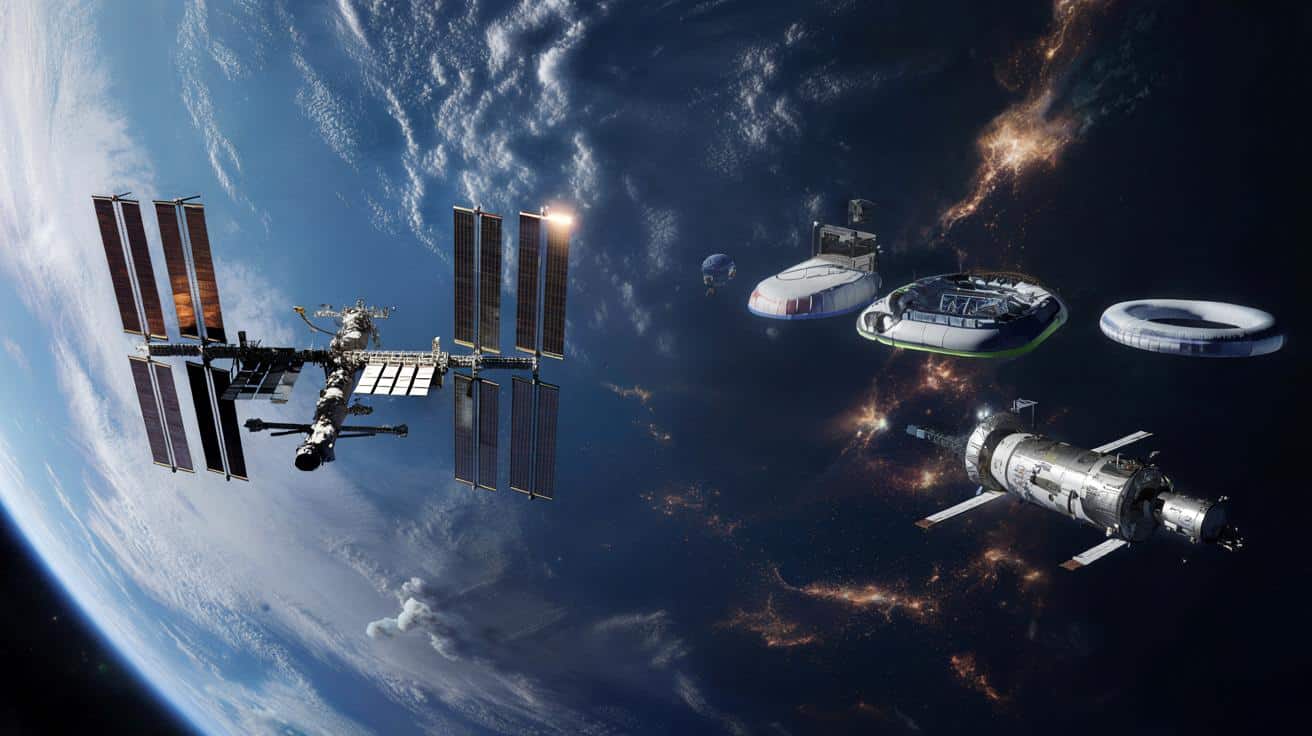
The International Space Station is scheduled to be deorbited around 2030. Before that date, it must be emptied, shut down, and deliberately plunged into the atmosphere to burn up over the Pacific. The structure is ageing, with leaks, cracks and outdated systems piling up year after year.
The station was never designed to last forever. Critical modules are now past their original life expectancy. Keeping them safe demands growing maintenance, complex workarounds and extra inspections. Engineers can extend the timeline only so far before structural risk outweighs scientific benefit.
The US has fewer than six years to switch from a 400‑tonne orbital laboratory to something new, without pausing crewed operations.
That tight schedule is driving fresh concern in Congress. The fear is simple: when the ISS is finally steered into the ocean, American astronauts might have nowhere of their own to go.
Senators press Nasa: no gap allowed
Pressure is coming from the US Senate, particularly from staff working with Republican senator Ted Cruz of Texas. Texas hosts Nasa’s Johnson Space Center in Houston, the historic nerve centre for human spaceflight. Jobs, contracts and political clout all depend on what comes after the ISS.
Madeline Davis, a key staffer on the Senate committee overseeing science and transportation, has publicly warned Nasa that patience is wearing thin. She has been quoted as saying that every time she meets with agency officials, one message is repeated: the US must keep a continuous human presence in orbit, with no gap.
Translated into policy, that means one thing: as soon as astronauts close the hatch and leave the ISS for the last time, other US‑backed stations should already be operating. That vision demands a fast and clean transition that today still looks uncertain.
Cruz’s line: speed up commercial stations
Ted Cruz has pushed Nasa to accelerate its shift toward private, US‑built stations in low Earth orbit. Under existing plans, the agency will stop owning a flagship ISS‑style outpost. Instead, it wants to buy “services” from companies that design, build and operate their own orbital platforms.
➡️ Menschen, die selten Hilfe annehmen, haben oft gelernt, sich selbst zurückzustellen
➡️ Sie werden nie erraten, welche Position den Husten verschlimmert – ob trocken oder verschleimt
➡️ Warum Menschen mit mehr Energie ihren Tag nicht mit E-Mails beginnen
➡️ Diese drei bretonischen Gewürze waren im 17. Jahrhundert mehr wert als Gold
For Cruz and other lawmakers, the danger lies in delay. If these commercial stations are not ready when the ISS retires, the US could find itself renting Russian capacity, queuing for Chinese slots, or staying home while others conduct the science and reap the prestige.
Senate staff are effectively begging Nasa to move faster on commercial space stations before the calendar, and gravity, win the argument.
What comes after the ISS?
Nasa calls its strategy the “commercial LEO” transition, LEO standing for low Earth orbit. Several industry teams have contracts to study and prototype future stations. While the article that sparked this alarm focused on the political tension, the hardware story is just as complex.
Under various Nasa programmes, companies are proposing different visions for life after the ISS:
- Compact research stations focused on microgravity science and manufacturing
- Expandable habitats using inflatable modules to save launch mass
- Multi‑purpose platforms mixing tourism, government research and industry
- Modular designs that grow as demand and funding increase
Some European players, including Airbus with its “Loop” concept, are also sketching ambitious next‑generation orbital habitats built for more comfort and long‑duration missions. These concepts hint at ring‑like structures, larger windows, and dedicated exercise and medical areas. Yet paper designs and CGI tours are the easy part. Certifying a real orbital station, ready for people, is far harder.
The stakes: science, industry and geopolitics
The ISS is far more than a symbol. Its retirement touches several critical areas for the US and its partners.
| Domain | What is at risk after the ISS |
|---|---|
| Science | Continuous microgravity research on health, materials and fundamental physics |
| Industry | Experiments in fibre optics, protein crystallisation and pharmaceutical production |
| Training | Routine experience for astronauts before deep‑space missions to the Moon and Mars |
| Diplomacy | Long‑standing cooperation with Europe, Japan, Canada and, until recently, Russia |
| Prestige | Soft power of operating a permanent crewed platform in orbit |
Without some form of follow‑on station, Nasa would also lose an everyday testbed for technologies needed for Artemis lunar missions and future Mars expeditions. Life‑support systems, radiation protection, closed‑loop recycling and telemedicine all benefit from long stays in orbit close to Earth.
Competition from China and Russia
While the US wrestles with its transition plan, other nations are building or extending their own projects. China’s Tiangong station is already permanently crewed, with a steady rhythm of missions and experiments. Beijing has signalled that foreign astronauts may eventually fly there, under Chinese terms.
Russia has floated plans for a new independent station once it ends participation in the ISS partnership. Whether Moscow can afford a complex new outpost is open to debate, but the intent is clear: stay an autonomous human spaceflight power.
Lawmakers in the US do not want a scenario in which American crews rely on seats aboard rival stations while domestic facilities lag behind. That prospect colours every budget hearing and policy argument about Nasa’s post‑ISS roadmap.
Technical and financial bottlenecks
Even with strong political pressure, building new stations is slow. Several bottlenecks stand in the way of a seamless handover.
- Certification for human spaceflight – Structures, life‑support, docking ports and power systems must go through rigorous testing.
- Funding uncertainty – Costs are shared between Nasa and industry, and both sides face shifting budgets.
- Launch capacity – Rockets and cargo vehicles must be available to assemble and resupply the new platforms.
- International agreements – Partners need clarity on access, cost, and data sharing before committing experiments.
One political worry is that companies might overpromise and underdeliver. If a headline commercial station slips by several years, Nasa may have to choose between extending the ISS yet again at high cost or stepping away from LEO crewed missions for a period.
The nightmare scenario in Washington is a forced “pause” in US orbital operations, just as China’s Tiangong is hitting its stride.
Why continuous human presence matters
On paper, a short break between stations might sound manageable. In practice, even a few years without a US‑backed outpost could have lasting effects. Engineering teams disperse if projects stall. Highly trained astronauts may shift to other careers. Students might drift to different fields if human spaceflight looks uncertain.
There is also a psychological angle. For more than two decades, people have lived in orbit every single day. That quiet fact shapes how the public thinks about space: not as a series of rare expeditions, but as an ongoing activity. Losing that continuity would feel like stepping back after a generation of progress.
Key terms: low Earth orbit and microgravity
Low Earth orbit, or LEO, refers to the band of space roughly 200 to 2,000 kilometres above the planet’s surface. The ISS circles Earth in this region, completing an orbit in about 90 minutes. At these altitudes, Earth’s gravity still acts strongly, but spacecraft fall around the planet fast enough to stay aloft.
This constant free‑fall creates microgravity. Objects seem to float, and tiny forces that are masked on the ground become measurable. That environment lets scientists study how crystals grow, how flames behave, how bone and muscle respond to weightlessness and how fluids move without a dominant “down” direction.
What happens if the gap becomes real?
Several scenarios are being discussed informally among policy analysts. One assumes a partial gap, in which the ISS is extended beyond 2030 while at least one commercial module begins operations in parallel. This would keep a safety net while new systems prove themselves.
A harsher possibility is a forced early retirement of the ISS due to a major technical failure: a serious leak, structural crack, or power system breakdown. In that case, crews could be evacuated, and engineers might recommend deorbiting the station earlier than planned. If commercial stations are late, the US would go from a permanent presence to none almost overnight.
There are also blended options. Nasa could choose to buy short‑term access to foreign stations strictly for research, while pressing US companies to finish their platforms. Astronauts might rotate between lunar missions and temporary LEO visits on international craft, keeping some skills alive but thinning out the routine stays.
Each scenario carries risk. A stretched ISS raises safety and maintenance costs. A gap threatens industrial and scientific momentum. Aggressively accelerating commercial projects increases the chance of technical mistakes or financial strain. Balancing those risks is at the heart of today’s arguments between Nasa managers, lawmakers and contractors.